Hackney is one of the most varied parts of East London. Within a relatively compact area, you can move from Tudor history and Victorian cemeteries to canals, large parks, independent markets, theatres, galleries and one of London’s best-known city farms.
The borough also changes noticeably from one neighbourhood to the next, with Hackney Central, London Fields, Dalston, Stoke Newington, Homerton, Clapton and Hackney Wick each offering a different experience.
If you are looking for Things to Do in Hackney, it helps to think beyond a single attraction. A good day here is often about combining several places: a walk through London Fields followed by Broadway Market, an afternoon around Hackney Central and Sutton House, or a slower stroll through Stoke Newington and Abney Park.
This guide brings together the best things to see and do across Hackney, including free activities, family-friendly attractions, green spaces, markets, cultural venues and ideas for rainy days. Opening information can change, so check the attraction’s official website before setting out.
The best Things to Do in Hackney at a glance
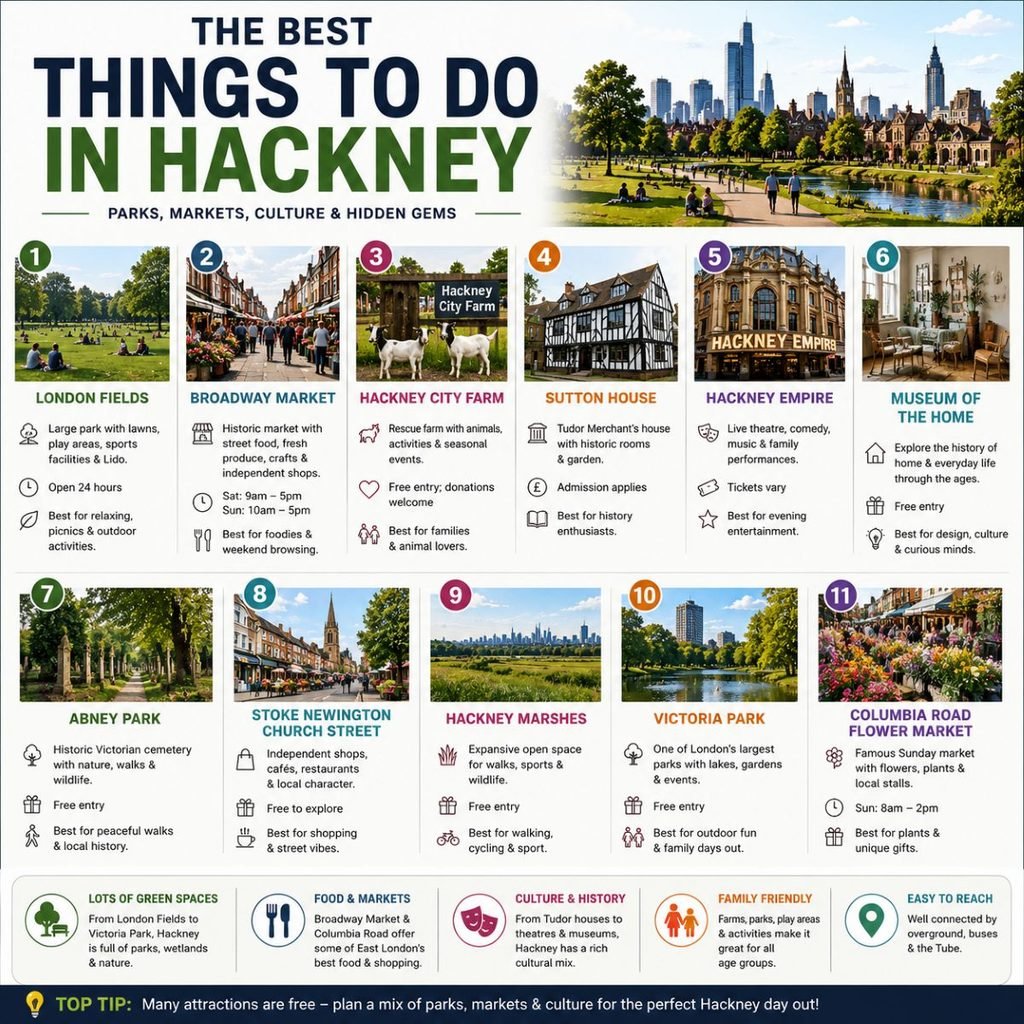
| Place or activity | Best for | Cost | Area |
| London Fields | Parks, walking and sport | Free | London Fields |
| Broadway Market | Food, shopping and weekend browsing | Free to enter | London Fields |
| Hackney City Farm | Families and animals | Free; donations welcome | Haggerston |
| Sutton House | Tudor history | Admission applies | Homerton |
| Hackney Empire | Theatre, comedy and live entertainment | Varies | Hackney Central |
| Museum of the Home | History, design and interiors | Free | Hoxton |
| Abney Park | Nature, history and quiet walks | Free | Stoke Newington |
| Stoke Newington Church Street | Independent shops and cafés | Free to explore | Stoke Newington |
| Hackney Marshes | Open space, walking and sport | Free | Homerton/Hackney Wick |
| Victoria Park | Large-scale park walks and recreation | Free | Near Hackney Wick |
| Columbia Road Flower Market | Plants and Sunday shopping | Free to browse | Nearby Bethnal Green |
1. Spend time in London Fields
London Fields is one of the easiest places to start exploring Hackney. The large park has open lawns, mature trees, a wildflower meadow and several facilities for sport and recreation.
Hackney Council lists two children’s play areas, cricket, an outdoor gym, pétanque, table tennis and two tennis courts among its amenities. The park is open 24 hours.
The park works well when you do not want a tightly planned itinerary. Take a walk along its tree-lined paths, find a patch of grass for a picnic or use it as the starting point for exploring the surrounding streets.
London Fields is also home to London Fields Lido, an Olympic-size heated outdoor swimming pool.
Is London Fields good for families?
Yes. The play areas and open spaces make it particularly useful for families, while the sports facilities give older children and adults more options. The park is also a practical place to pause between visits to Broadway Market and other nearby attractions.
One thing to remember: Hackney Council does not permit barbecues in London Fields.
2. Browse Broadway Market
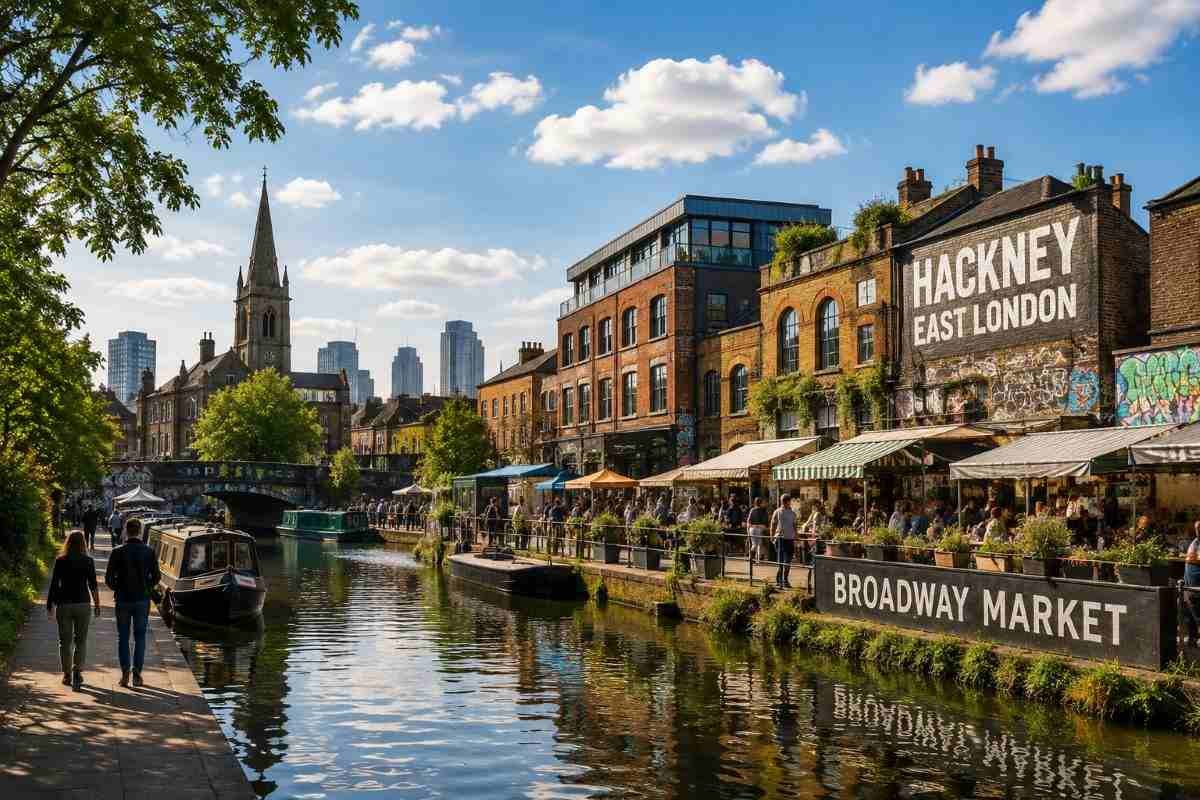
Broadway Market runs along a street between Regent’s Canal and London Fields. Hackney Council says the market has roots going back to the 1890s and describes its stalls as offering fresh produce, street food, clothing, arts and crafts.
Saturday is the main market day, with the council currently listing opening hours of 9 am to 5 pm. Sunday hours are listed as 10 am to 5 pm.
The attraction is not simply the stalls. Broadway Market is surrounded by cafés, pubs, restaurants and independent shops, making it easy to turn a market visit into a longer walk.
How to visit Broadway Market
For a relaxed visit, combine it with London Fields. Start in the park, walk towards Broadway Market, browse the stalls and then continue towards Regent’s Canal.
It is also well connected. Hackney Council lists London Fields, Cambridge Heath, Hackney Central and Bethnal Green among the nearest stations, with several bus routes serving the wider area.
3. Visit Hackney City Farm
Hackney City Farm is a particularly good choice if you are looking for things to do in Hackney with children.
The working city farm gives visitors the chance to see farm animals, gardens and food-growing projects in an urban setting. Its animals include donkeys, goats, sheep, pigs, geese, chickens and ducks.
Entry to the farmyard is free, although donations are welcomed. The current farmyard opening hours are Tuesday to Sunday, 10 am to 4.30 pm, with Mondays generally closed except bank holidays.
The farm also runs workshops and other activities, so it is worth checking its calendar if you want more than a straightforward visit.
Why it stands out
Hackney City Farm offers something that a conventional museum or playground cannot: a chance to see food production, gardening and animal care close to central London. It is educational without feeling like a formal lesson.
4. Step inside Sutton House
Sutton House and Breaker’s Yard provide one of Hackney’s strongest links with Tudor London.
Built in 1535 for Sir Ralph Sadleir, Sutton House is described by the National Trust as one of London’s last remaining Tudor houses and the oldest house in Hackney. Its oak-panelled rooms, fireplaces, courtyard and later additions reveal how the building changed over more than five centuries.
Its history is unusually varied. After its Tudor origins, the building became a Victorian school, a church institute, a trades union office and later a punk squat before becoming a heritage attraction.
The adjoining Breaker’s Yard has an equally unusual story. The site was formerly a car-breaker’s yard and was transformed into a garden and pocket park, incorporating elements that reflect Hackney’s industrial history.
The National Trust currently lists Sutton House as open on Fridays and Sundays from 11 am to 4 pm, with guided tours at selected times.
Who should visit Sutton House?
It is particularly worthwhile for:
- Local history enthusiasts
- Families interested in historic buildings
- Architecture fans
- Visitors who want something different from central London’s major museums
- Anyone interested in the social history of Hackney
Check the National Trust’s current calendar before travelling, as opening arrangements and tours can vary.
5. See a show at Hackney Empire
Hackney Empire is one of the borough’s major cultural landmarks.
The theatre is a Grade II* listed building, and its programme covers live entertainment including theatre, comedy and music. Its heritage is part of the experience: rather than visiting Hackney simply for a performance, you can also appreciate the architecture and history of one of east London’s best-known theatres.
The theatre is on Mare Street, close to Hackney Central, so it is easy to combine with a walk around the Narrow Way, Hackney Central and nearby parks.
For evening plans, check the current programme rather than assuming a particular type of performance will be available. Shows and ticket prices vary.
6. Explore the Museum of the Home
Museum of the Home is just south-west of Hackney’s central neighbourhoods in Hoxton and makes a useful addition to a cultural day out.
The museum explores how people have lived and how ideas about home, interiors and domestic life have changed. Its permanent Rooms Through Time display traces domestic life across four centuries.
Entry is free, and the museum currently opens from 10 am to 5 pm Tuesday to Sunday, as well as Bank Holiday Mondays.
Why visit the Museum of the Home?
It offers a different perspective on London’s history. Instead of concentrating on royalty, politics or major battles, it looks at everyday life: furniture, rooms, domestic routines and changing attitudes towards the home.
That makes it a strong rainy-day option and a good choice for visitors who prefer museums that connect historical objects with ordinary life.
7. Walk through Abney Park
Abney Park is one of the most distinctive places to walk in Hackney.
The site is one of London’s “Magnificent Seven” garden cemeteries, as well as a woodland memorial park and Local Nature Reserve. Abney Park Trust works with Hackney Council on its heritage, ecology and community life.
The combination of mature vegetation, paths, memorials and historic structures makes it very different from a conventional London park.
The park currently opens at 8 am and closes at dusk, with exact closing times varying by season. Entry is free.
What makes Abney Park special?
The cemetery provides an unusual meeting point between natural history and London’s social history. It is somewhere to walk slowly rather than rush through.
The internal paths can be uneven, cobbled or slippery when wet, so sensible footwear is advisable. The main entrance has level access, and the Church Street entrance has a ramp and wider paths.
8. Explore Stoke Newington Church Street
Stoke Newington Church Street is one of the better areas in Hackney for a slower afternoon of independent shopping, cafés and local architecture.
The street works particularly well when paired with Abney Park. Browse the independent shops, stop for coffee or food, then head into the cemetery for a quieter walk.
Visit London’s guide to independent shopping highlights Stoke Newington Church Street for its mix of children’s shops, vintage and modern fashion stores and independent retailers.
It is also useful to think of Church Street as part of a broader visit to Stoke Newington. You can extend the walk towards Stoke Newington High Street and nearby green spaces rather than treating the street as a standalone attraction.
9. Walk the Regent’s Canal
The Regent’s Canal provides one of the simplest ways to explore Hackney on foot.
A canal walk lets you move between different neighbourhoods without having to follow busy main roads. Around Broadway Market and London Fields, it can be combined with the market, food stops and a visit to the park.
The canal is particularly useful for visitors who want a low-cost day out. You do not need an itinerary packed with attractions; choose a section, walk at your own pace and stop whenever something catches your attention.
For cyclists, the canal corridor can also form part of a longer east London route, although conditions and shared-path etiquette should be considered carefully.
10. Spend time around Hackney Marshes
Hackney Marshes offer a completely different side of the borough. Instead of the closely packed streets and independent shops associated with central Hackney, the marshes provide broad open space beside the River Lea.
The area is especially associated with football pitches and outdoor recreation, while paths around the Lea Valley provide opportunities for walking and cycling.
It is a useful choice when the priority is fresh air rather than sightseeing. The marshes also connect naturally with the wider Hackney Wick and Queen Elizabeth Olympic Park area, allowing you to create a much longer East London walk.
11. Visit Hackney Wick and explore the waterways
Hackney Wick sits towards the eastern edge of the borough and has a strong connection with the waterways around the River Lea and the Olympic Park.
The area is best approached as a neighbourhood to wander through rather than a single attraction. Canal-side routes, converted industrial buildings, creative spaces and access towards Queen Elizabeth Olympic Park make it a good option for an afternoon when you want to cover more ground.
A useful route is to combine Hackney Wick with Victoria Park or the Olympic Park, depending on how much walking you want to do.
12. Walk around Victoria Park
Victoria Park is not wholly within the London Borough of Hackney, but its western and northern edges make it a natural addition to an east London itinerary, particularly when visiting Hackney Wick.
The park was created in the 1840s and covers around 88 hectares. It includes large lawns, mature trees, lakes and recreational facilities.
Its scale makes it particularly good for longer walks. You can also use the park as a break between Hackney Wick and the Bethnal Green side of east London.
Victoria Park is also well connected by public transport, with Hackney Wick railway station among the listed nearby options.
13. Make a Sunday trip to Columbia Road Flower Market
Columbia Road Flower Market is technically in the London Borough of Tower Hamlets rather than Hackney, but it is close enough to make sense as part of a wider Hackney weekend itinerary.
The market operates on Sundays, with the official market website currently listing hours from 8am until around 3pm.
Expect cut flowers, plants, herbs, succulents and seasonal displays. The surrounding street is also home to independent shops, galleries, cafés and food businesses.
One practical point: Columbia Road can become very busy during the main market period. Arriving earlier gives you more room to browse before the busiest part of the day.
A useful route is Columbia Road → Regent’s Canal → Broadway Market → London Fields.
14. Find smaller green spaces around Hackney
Hackney has far more green space than visitors sometimes expect.
Beyond London Fields and Hackney Marshes, Hackney Council’s parks list includes places such as Clapton Common, Millfields Park, Haggerston Park, Hackney Downs, Mabley Green and Broadway Market Green.
These smaller parks are useful when you are already exploring a particular neighbourhood and want somewhere to stop without crossing the borough.
For families, Hackney Council also lists play areas at locations including Clapton Common, Hackney Downs, Haggerston Park and London Fields.
Learn about Hackney’s history — with one important update
Hackney Museum would normally be one of the obvious answers to the question of what to do in Hackney for history lovers.
However, Hackney Museum is currently closed for refurbishment and is expected to reopen in 2027. The redevelopment is updating its permanent galleries and community spaces, while retaining important parts of its collection and local history interpretation.
The museum’s collections cover more than 8,500 objects, artworks, images and oral-history recordings, including material reflecting the experiences of communities who have migrated to Hackney.
Until it reopens, visitors interested in local history can look at alternatives such as Sutton House, Abney Park and the Museum of the Home.
The best things to do in Hackney by interest
| If you want… | Start with… | Add on… |
| A free day out | London Fields | Broadway Market and Regent’s Canal |
| Family activities | Hackney City Farm | London Fields |
| Tudor history | Sutton House | Hackney Central |
| Theatre | Hackney Empire | Mare Street |
| Nature | Abney Park | Stoke Newington Church Street |
| Shopping | Broadway Market | London Fields |
| A rainy-day activity | Museum of the Home | Hoxton |
| A long walk | Hackney Marshes | Hackney Wick |
| Plants and flowers | Columbia Road Flower Market | Regent’s Canal |
| A relaxed afternoon | Stoke Newington Church Street | Abney Park |
A simple one-day Hackney itinerary
If you only have one day, avoid trying to cover the entire borough.
Morning: London Fields and Broadway Market
Start around London Fields and walk through the park before heading to Broadway Market. If you are visiting on a Saturday or Sunday, this gives you the chance to see the market at its busiest.
Early afternoon: Regent’s Canal and Hackney City Farm
Walk towards the canal and continue east or west depending on your plans. Families can add Hackney City Farm to the route.
Late afternoon: Hackney Central
Head towards Hackney Central for Mare Street and the area around Hackney Empire. If Sutton House is open on your chosen day, make that the main historical stop.
Evening: Hackney Empire or local food
Finish with a theatre performance if something suitable is scheduled, or simply explore the surrounding streets for dinner.
A quieter Hackney itinerary
For a less crowded day, head north towards Stoke Newington.
Start at Abney Park, then walk towards Stoke Newington Church Street. Spend time browsing the independent shops and cafés before continuing through the neighbourhood.
This route is particularly good for visitors who prefer history, architecture, nature and local streets to large attractions.
Things to do in Hackney for free
Hackney can be explored relatively cheaply because several of its strongest attractions cost nothing to enter.
Free options include:
- Walking through London Fields
- Exploring Broadway Market without buying anything
- Walking beside Regent’s Canal
- Visiting Hackney City Farm
- Exploring Abney Park
- Walking through Hackney Marshes
- Exploring Hackney’s smaller parks
- Visiting the Museum of the Home
- Browsing Columbia Road Flower Market
Free does not necessarily mean cost-free for the whole day, of course. Food, drinks, transport and paid activities can quickly add to the budget, so planning around the parks and free museums is the easiest way to keep spending under control.
Things to do in Hackney with children
Hackney works well for family days because several attractions are practical rather than purely sightseeing-focused.
Hackney City Farm is the obvious starting point for younger children. The animals and gardens provide plenty to look at, while its educational work adds some substance to the visit.
London Fields is useful for outdoor play, sports and space to run around. Its two children’s play areas and sports facilities give families several options.
Sutton House can work well with older children who enjoy history, particularly when combined with the Breaker’s Yard and its unusual industrial story.
For a family day, it is sensible to keep the itinerary flexible. Hackney is better explored in a few manageable stops than by trying to cross the entire borough in one go.
Things to do in Hackney when it rains
Rain does not have to end a Hackney day.
The strongest indoor options include:
- Museum of the Home – free and focused on domestic history and design.
- Hackney Empire – check the current performance programme for theatre, comedy and music.
- Sutton House – an atmospheric historic house when open.
- Cafés and independent shops around Stoke Newington Church Street and Broadway Market.
- Hackney City Farm – useful in mixed weather, although much of the experience is outdoors, so waterproof clothing helps.
The best choice depends on the weather. A light shower can easily be worked around with museums and cafés, while prolonged rain calls for a mainly indoor itinerary.
Getting around Hackney
Hackney is well suited to walking, particularly around London Fields, Broadway Market, Hackney Central and Stoke Newington.
The borough has several Overground stations, including Hackney Central, Hackney Downs, London Fields and Stoke Newington, while nearby Underground stations can also be useful depending on your starting point.
For Broadway Market specifically, Hackney Council lists London Fields and Hackney Central Overground among the nearest stations, along with Cambridge Heath and Bethnal Green.
For Sutton House, Hackney Central is around a quarter of a mile away, while Hackney Downs is around half a mile away, according to the National Trust.
For Abney Park, Stoke Newington railway station is about 200 metres from the Stoke Newington High Street entrance.
Walking or public transport?
| Type of visit | Best option |
| London Fields + Broadway Market | Walking |
| Hackney Central + Sutton House | Walking |
| Stoke Newington + Abney Park | Walking |
| Hackney Marshes + Hackney Wick | Walking/cycling with public transport as needed |
| Several distant neighbourhoods | Overground/bus plus walking |
| Family day with young children | Short walks with public transport between areas |
What makes Hackney different from other parts of London?
Hackney’s appeal comes from the way its attractions are woven into residential neighbourhoods.
You can spend an hour looking at Tudor architecture, then walk past modern cafés and independent shops. A large green space may be only a few streets from a busy market. Canals, railway lines and former industrial sites sit alongside historic houses and community spaces.
That mixture makes Hackney particularly rewarding for visitors who prefer exploring rather than ticking off famous landmarks.
It also means there is no single “Hackney experience”. Stoke Newington feels different from Homerton, while London Fields has a different rhythm again. The best approach is to choose one part of the borough and explore it properly.
Practical tips for visiting Hackney
- Check opening days before travelling. Sutton House, Hackney City Farm and other attractions have specific schedules.
- Plan around markets. Broadway Market is primarily a weekend destination, while Columbia Road Flower Market takes place on Sundays.
- Wear comfortable shoes. Several of the best experiences involve walking, and some park paths can be uneven.
- Check temporary closures. Hackney Museum is currently closed for refurbishment until 2027.
- Use public transport for longer cross-borough trips. Hackney is walkable in sections, but its neighbourhoods cover a sizeable area.
- Keep outdoor plans flexible. Parks, canals and markets are weather-dependent.
- Respect residential areas. Hackney’s attractions sit among established neighbourhoods, so normal London consideration around noise, litter and shared paths matters.
FAQ
What are the best things to do in Hackney?
The best Things To Do in Hackney include visiting London Fields, browsing Broadway Market, exploring Sutton House, seeing a show at Hackney Empire, visiting Hackney City Farm, walking through Abney Park and exploring Stoke Newington.
Is Hackney good for a day out?
Yes. Hackney has enough parks, markets, historic buildings, museums and cultural venues to fill a full day. A focused itinerary works better than trying to cover the entire borough.
What can you do in Hackney for free?
Free options include London Fields, Abney Park, Hackney Marshes, walking along Regent’s Canal, browsing Broadway Market, visiting Hackney City Farm and visiting the Museum of the Home.
Is Hackney City Farm free?
Yes. Hackney City Farm states that entry to the farm is free, although donations are welcome. The farmyard currently opens Tuesday to Sunday from 10 am to 4.30 pm.
Is Broadway Market open every day?
No. Hackney Council currently lists Broadway Market as operating on Saturdays from 9 am to 5 pm and Sundays from 10 am to 5 pm.
What is the oldest house in Hackney?
Sutton House is described by the National Trust as the oldest house in Hackney. It was built in 1535 for Sir Ralph Sadleir and is one of London’s last remaining Tudor houses.
Is Abney Park free to visit?
Yes. Abney Park Trust states that there is no entry fee. The park opens at 8 am and closes at dusk, with seasonal closing times.
Is Hackney Museum open?
No. Hackney Museum is currently closed for refurbishment and is scheduled to reopen in 2027.
What can you do in Hackney when it rains?
The Museum of the Home is one of the best rainy-day options because it is free and mainly indoors. Hackney Empire can also work well when a suitable performance is scheduled, while Sutton House offers an indoor historical experience on its opening days.
Is Columbia Road Flower Market in Hackney?
No. Columbia Road Flower Market is in the London Borough of Tower Hamlets, although it is close to Hackney and works well as part of an east London itinerary. The market operates on Sundays.
Conclusion
The best things to do in Hackney are rarely confined to one landmark. The borough rewards visitors who combine attractions with neighbourhood walks: London Fields with Broadway Market, Sutton House with Hackney Central, or Abney Park with Stoke Newington Church Street.
For a first visit, start with London Fields and Broadway Market, then choose either the historical route around Sutton House or the greener Stoke Newington route. Families should put Hackney City Farm high on the list, while culture lovers can look to Hackney Empire and the Museum of the Home.
Hackney Museum is currently unavailable while its redevelopment takes place, but the borough still has plenty of history, green space, markets and cultural venues to fill a day or a whole weekend.
The simplest next step is to pick the neighbourhood that matches your interests and build a walk around it rather than attempting to see everything at once.