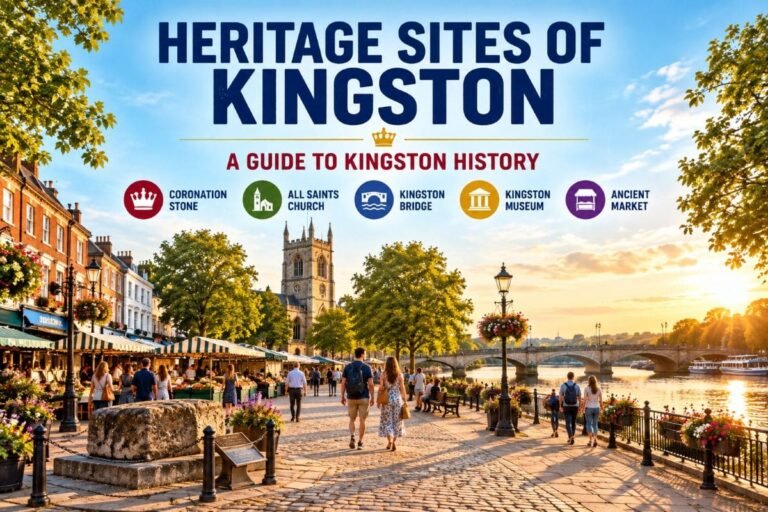

Kingston upon Thames has the sort of history that can be easy to miss if you arrive mainly to shop. The town centre grew around a historic crossing of the River Thames and became an important market settlement, while its royal connections reach back to the Anglo-Saxon period. Today, the same compact centre combines historic streets, riverside walks, independent food spots, major shops, green spaces and a strong cultural scene.
For anyone researching the best Things to Do in Kingston, that mix is the main attraction. You can see the Coronation Stone, walk through the Ancient Market, cross the historic Kingston Bridge, browse the shops around the town centre, watch a production at the Rose Theatre and finish with a riverside meal. A short journey beyond the centre also opens up Hampton Court Palace, making Kingston a useful base for a full day in south-west London.
Kingston Town and North Kingston are part of the Royal Borough of Kingston upon Thames, with Kingston Town at the heart of the borough. The council identifies Kingston as a major shopping and cultural centre, with Kingston and Norbiton railway stations serving the neighbourhood.
Here is how to make the most of a visit, depending on whether you are interested in history, shopping, food, culture, green space or the Thames.
Quick guide to the best things to do in Kingston
| Experience | Best for | Time to allow | Cost |
| Explore the Ancient Market | Food, shopping and atmosphere | 30–60 mins | Free to browse |
| See the Coronation Stone | History | 15–20 mins | Free |
| Visit All Saints Church | Heritage and architecture | 30–45 mins | Free |
| Walk across Kingston Bridge | Riverside views and photography | 15–30 mins | Free |
| Walk along the Thames | Outdoors and relaxed days | 1–2 hours | Free |
| Spend time at Canbury Gardens | Families and green space | 1–2 hours | Free |
| Visit the Rose Theatre | Theatre and live entertainment | 2–3 hours | Ticketed |
| Explore Kingston’s shops | Shopping | 1–3 hours | Depends on spending |
| Visit Hampton Court Palace | History and gardens | Half or full day | Ticketed |
| Explore the historic Old Town | Architecture and walking | 1–2 hours | Free |
Best things to do in Kingston

1. Start at Kingston’s Ancient Market
The Ancient Market is one of the easiest places to begin exploring Kingston because it puts you directly into the historic centre.
The market sits beside the old Market Place and All Saints Church, in the part of Kingston where the medieval town developed. The surrounding streets retain much of the historic layout, making this a useful starting point before heading towards the Thames. Kingston’s Old Town conservation area is recognised for its medieval street pattern and its importance as an early market town, port and river crossing.
The market itself has changed over the centuries, but trading remains central to the area. Kingston currently has one permanent market, the Ancient Market, with more than 20 permanent stalls. The council says it trades seven days a week, generally from 10 am to 5 pm, with stalls including food traders and an artisan bakery alongside street food.
For visitors, it is particularly useful around lunchtime. You can browse before deciding what to eat, then continue through Church Street and the surrounding Old Town.
Good for: food, casual browsing, families and first-time visitors.
2. See the Coronation Stone
One of Kingston’s most unusual historical sights is also one of its smallest.
The Coronation Stone stands close to the Guildhall in the historic centre. It is an ancient sarsen stone traditionally associated with the coronations of seven Anglo-Saxon kings. Historic England lists it at Grade I and explains that at least two kings, Æthelstan in 925 and Æthelred the Unready in 979, are certainly associated with coronations at Kingston.
That distinction matters because the popular story surrounding the stone is stronger than the surviving evidence. The stone is traditionally said to have been used for the coronation ceremonies, but historians have questioned parts of the later legend.
That makes the site more interesting rather than less. It gives visitors a chance to see how historical evidence, local tradition and civic identity can overlap.
The stone is free to view and takes only a few minutes, so there is little reason to skip it when walking around the centre.
Best approach: combine it with All Saints Church, the Market Place and Clattern Bridge.
3. Step inside All Saints Church
All Saints Church stands at the centre of Kingston’s historic Market Place and is closely connected with the town’s royal history.
The church describes its history as stretching back to the Saxon kings and identifies the site with Æthelstan’s coronation in 925. The current building is part of the historic fabric of Kingston Old Town, which includes a number of protected buildings around the Market Place.
It is also a functioning community space rather than simply a historic monument. Visitors can find services, concerts, events and a café, giving the building a more active role in the town centre.
All Saints currently states that it is open every day from 10 am to 4 pm, with longer hours when events are taking place; Sunday opening is listed as 8 am to 7 pm. Visitors should check the church’s current arrangements before travelling, particularly around services and special events.
Allow: around 30–45 minutes if you want to look properly rather than simply step inside.
4. Explore Kingston’s medieval Old Town
Kingston is particularly rewarding on foot because its historic core is relatively compact.
Walk around the Market Place, Church Street and the streets leading towards the river. Look beyond the modern shopfronts, and you will see the narrower plots and irregular street pattern that reveal the medieval origins of the town.
The Royal Borough’s conservation-area assessment describes Kingston Old Town as retaining an essentially medieval street layout. Archaeological work has also uncovered evidence of the town’s long history as a trading settlement, including waterside structures and buildings associated with the medieval market.
This is one of the best free things to do in Kingston and does not require a fixed itinerary.
A simple walking route is:
- Ancient Market
- All Saints Church
- Coronation Stone
- Clattern Bridge
- Kingston Bridge
- River Thames
- Riverside restaurants and cafés
The route can be completed comfortably in a couple of hours, with plenty of opportunities to stop along the way.
5. Look for Clattern Bridge
Clattern Bridge is another small landmark with a disproportionately long history.
The bridge crosses the Hogsmill River near the High Street and is both Grade I listed and a Scheduled Ancient Monument.
It is easy to walk past without realising its significance. That is part of the appeal. Kingston’s historic importance was tied to crossings and movement, and bridges such as Clattern Bridge help explain how the medieval town developed.
It is worth seeing as part of a walking tour rather than treating it as a standalone attraction.
Photography tip: look for views that include the bridge, surrounding historic buildings and the river channel rather than photographing the structure in isolation.
6. Walk across Kingston Bridge
Kingston Bridge is one of the town’s defining landmarks and an obvious place to pause when you reach the Thames.
The present bridge dates from the early 19th century. Historic England lists it at Grade II*, noting that it was designed by Edward Lapidge and opened in 1828.
Crossing the bridge gives you a useful perspective on Kingston’s relationship with the river. From here, you can continue along the waterfront, stop for food or head towards the riverside paths.
The bridge also provides some of the most recognisable views of Kingston, particularly looking back towards the town centre and All Saints Church.
7. Take a riverside walk along the Thames
For many visitors, the Thames is Kingston’s most enjoyable feature.
The riverside is close to the town centre, so you do not need to plan a separate excursion. The Riverside Walk passes the central waterfront, with restaurants, bars and public spaces along the route. Council planning documents identify the riverfront as a key part of Kingston’s character, including the point where the Hogsmill meets the Thames.
You can keep the walk short or turn it into a longer outing.
A leisurely version is simply to walk from Kingston Bridge along the central waterfront and back. If you want more exercise, continue towards Canbury Gardens or explore the riverside towards Surbiton.
The council also highlights riverside walking and running as popular activities, although visitors should take care near the water, particularly in poor weather or around slippery edges.
Best time to go: late afternoon is particularly pleasant if you want to combine the walk with dinner.
8. Spend time at Canbury Gardens
Canbury Gardens provides a change of pace from Kingston’s commercial centre.
The park lies north of the town centre beside the Thames and includes a playground, tennis facilities, a community pavilion and café, a bandstand and a public house. The council also identifies it as a Green Flag Award-winning park.
It works particularly well for families who want some open space after spending time in the centre. The park is also useful if you simply want somewhere to sit and slow down.
Canbury Gardens has an interesting history of its own. The area was once marshland and woodland before being transformed into public parkland in the late 19th century.
If you are planning a longer Thames walk, Canbury Gardens is a natural point to include.
9. Go shopping around Kingston town centre
Shopping remains a major reason people visit Kingston.
The town centre combines large retailers with smaller shops and historic streets, meaning you can move between conventional high-street shopping and the older Market Place area without travelling far.
The Royal Borough describes Kingston Town as a major shopping centre outside the West End and identifies the area as one of the borough’s main cultural and commercial centres.
For a practical shopping day, concentrate on the central retail streets and shopping areas before moving towards the Ancient Market and riverside.
It is also worth remembering that Kingston is more than a retail destination. Pairing shopping with the Old Town, theatre or Thames makes for a much more varied day.
10. See a show at the Rose Theatre
The Rose Theatre has become one of Kingston’s most important cultural venues since opening in 2008.
Its programme covers drama, comedy, music and family productions, alongside community and learning activity. The theatre says its programme includes both Rose-produced work and touring productions.
The auditorium is particularly distinctive, based around a circular arrangement and thrust stage inspired by the original Elizabethan Rose Theatre on London’s Bankside.
For visitors, the practical advantage is location. The theatre is on the High Street, close to the historic centre, shops and riverside.
Check the programme before your visit rather than assuming there will be a particular type of show. The calendar changes throughout the year and includes theatre, comedy, music and family entertainment.
Good option for: an evening in Kingston, rainy-day plans and visitors looking for something beyond sightseeing.
11. Visit Hampton Court Palace from Kingston
Hampton Court Palace is not in Kingston itself, but its proximity makes it one of the best additions to a Kingston itinerary.
The former royal palace is in East Molesey and is strongly connected to Kingston’s wider historic landscape. Historic England notes Kingston’s proximity to Hampton Court, Bushy Park and Richmond Park.
At Hampton Court, visitors can explore the Tudor palace associated with Henry VIII, later Baroque interiors, historic gardens, the Maze and the Magic Garden. Historic Royal Palaces recommends allowing at least three hours for the main visit.
There are also practical transport connections from Kingston. Historic Royal Palaces lists several bus services from Kingston, including routes 111, 216, 411, 461 and 513.
Because Hampton Court can easily take half a day or more, it is usually better to treat it as the main attraction rather than trying to squeeze it between several Kingston sights.
Best plan: visit Hampton Court in the morning, then return to Kingston for the riverside and Old Town.
12. Explore Kingston’s green spaces and surrounding neighbourhoods
Kingston’s appeal extends beyond the town centre.
The wider borough includes areas such as Surbiton, Norbiton, Coombe and Kingston Gate, each with a different character. The council divides the wider borough into several neighbourhood areas, including Kingston and North Kingston, Surbiton, New and Old Malden and the south of the borough.
If you have extra time, consider extending your visit towards Surbiton and the Thames or exploring the quieter residential streets around Kingston Hill.
The wider area also provides access to larger green spaces, including Richmond Park and Bushy Park. These are not town-centre attractions, so they work better as separate outings rather than items to squeeze into a short Kingston itinerary.
Best things to do in Kingston for different types of visitor
| If you are… | Prioritise |
| Visiting for the first time | Ancient Market, All Saints Church, Coronation Stone, Kingston Bridge and the Thames |
| A history enthusiast | Coronation Stone, All Saints Church, Clattern Bridge and Old Town |
| With children | Ancient Market, Canbury Gardens, riverside walk and family shows at the Rose |
| Shopping | Town-centre shopping, Ancient Market and the Old Town |
| Looking for free activities | Old Town walk, Coronation Stone, bridges, church and Thames walk |
| Planning an evening | Riverside dinner followed by the Rose Theatre |
| Visiting for a full day | Old Town, market, riverside, Canbury Gardens and theatre |
| Looking for a nearby major attraction | Hampton Court Palace |
A practical one-day Kingston itinerary
If you only have one day, there is no need to cram every attraction into the schedule.
Morning
Start around the Ancient Market and Market Place. Visit All Saints Church, then walk to the Coronation Stone and Clattern Bridge.
From there, head towards Kingston Bridge and spend some time beside the Thames.
Lunch
Return towards the market or riverside and choose somewhere that suits your budget and preferred style of food. The Ancient Market is particularly convenient if you want something informal.
Afternoon
Walk along the Thames towards Canbury Gardens. Spend some time in the park before returning towards the centre.
If shopping is your priority, use the afternoon for Kingston’s retail areas instead.
Evening
For a cultural evening, check what is playing at the Rose Theatre. Otherwise, stay around the riverside for dinner and an evening walk.
How to get around Kingston
Kingston is relatively straightforward to explore on foot once you arrive in the town centre.
Kingston and Norbiton are the two railway stations serving the Kingston and North Kingston neighbourhood, according to the Royal Borough.
The town centre’s main sights are close enough together that a walking itinerary makes more sense than repeatedly using public transport.
For longer trips, such as Hampton Court Palace, check the current TfL and National Rail journey information before travelling. Transport conditions, engineering works and timetables can change.
The council also directs visitors towards TfL’s Journey Planner for local and London-wide travel planning.
Are there free things to do in Kingston?
Yes. Some of Kingston’s best attractions cost nothing to visit.
Free or low-cost options include:
- Walking through the Ancient Market
- Exploring Kingston Old Town
- Seeing the Coronation Stone
- Visiting All Saints Church, subject to its visitor arrangements
- Walking across Kingston Bridge
- Taking a Thames-side walk
- Spending time in Canbury Gardens
- Exploring the historic streets around Market Place and Church Street
This is one reason Kingston works well for a day trip when you do not want to spend heavily on attractions.
Pros and cons of visiting Kingston
Pros
- Strong historic identity in a compact town centre
- Easy combination of shopping, food and sightseeing
- Thames-side walks close to the main shopping area
- Several free attractions
- Good cultural option in the Rose Theatre
- Convenient base for Hampton Court Palace
- Plenty of cafés, restaurants and informal food options
Cons
- The centre can feel more commercial around the main shopping areas
- Hampton Court requires separate time rather than a quick stop
- Riverside areas can become busy at popular times
- Some attractions have changing opening times or event schedules
- The wider borough is spread out, so not everything labelled “Kingston” is walkable from the town centre
Why Kingston is worth visiting
Kingston works because its attractions are close enough to connect naturally.
You can begin with a market that reflects the town’s commercial history, walk through streets that retain medieval patterns, see a stone associated with Anglo-Saxon kings, visit a historic church and then reach the Thames within minutes. From there, the day can become as active or relaxed as you want: continue to Canbury Gardens, shop in the centre, eat beside the river or see a performance at the Rose.
That combination makes Kingston different from a simple London shopping trip. Its history is visible, its river is central to the town’s identity, and major attractions such as Hampton Court are close enough to add another layer to a longer visit.
If you are planning your first trip, start in the Old Town, follow the river and leave room for an unplanned stop. Kingston is at its best when the historic sights, food and waterfront are treated as one connected experience rather than separate attractions.
FAQ:
What are the best things to do in Kingston?
The best things to do include exploring the Ancient Market and Old Town, visiting All Saints Church, seeing the Coronation Stone, walking beside the Thames, visiting Canbury Gardens and seeing a performance at the Rose Theatre.
Is Kingston upon Thames good for a day out?
Yes. Kingston’s compact centre makes it well suited to a day trip. You can combine historic sights, shopping, food and a riverside walk without travelling between distant parts of London.
What is Kingston upon Thames famous for?
Kingston is particularly known for its royal and Anglo-Saxon history, historic market town, River Thames crossing and shopping centre. The Coronation Stone is traditionally associated with the coronations of Anglo-Saxon kings, while historic records link Æthelstan’s 925 coronation with Kingston.
Is Kingston Market open every day?
The Royal Borough says the Ancient Market trades seven days a week, generally from 10 am to 5 pm. Individual stalls may have their own arrangements, so check before travelling if you are visiting for a particular trader.
What can you do in Kingston for free?
You can explore the Old Town, see the Coronation Stone, walk across Kingston Bridge, visit Canbury Gardens and take a riverside walk. All Saints Church also welcomes visitors, although opening arrangements can vary around services and events.
Can you walk along the Thames in Kingston?
Yes. The riverside is directly beside the town centre, with a pedestrian route along parts of the waterfront. You can make a short walk around Kingston Bridge or extend the outing towards Canbury Gardens and beyond.
Is Hampton Court Palace near Kingston?
Yes. Hampton Court Palace is in nearby East Molesey and can be reached from Kingston by local bus services. Historic Royal Palaces lists several routes connecting Kingston with Hampton Court.
Is Kingston good for families?
Yes. Families can combine the market and riverside with Canbury Gardens, which has a playground and sports facilities. The Rose Theatre also stages family productions and activities at different times of year.
How long do you need in Kingston?
A half-day is enough for the main historic centre and riverside, while a full day gives you time for shopping, Canbury Gardens and a theatre visit. Add considerably more time if Hampton Court Palace is part of the plan.
Does Kingston have good public transport?
Kingston has railway connections through Kingston and Norbiton stations, as well as extensive local bus coverage. For journeys around London and to nearby attractions, check current TfL and National Rail information before travelling.
Conclusion
Kingston is an easy London day out to underestimate. The shopping centre is prominent, but the historic core, Thames waterfront and cultural venues give the town considerably more to explore.
For a first visit, begin at the Ancient Market and All Saints Church, take in the Coronation Stone and Clattern Bridge, then walk towards Kingston Bridge and the Thames. Add Canbury Gardens if you want more green space, or book a show at the Rose Theatre for the evening. If history is your priority and you have more time, make Hampton Court Palace the centrepiece of a second half-day.
The best approach is to keep the itinerary flexible. Kingston’s main attractions are close together, so you can combine sightseeing with food, shopping and a walk along the river without spending the day travelling between destinations.