

Finding the right estate agent in London can be almost as important as finding the right property. The capital’s housing market stretches from Victorian terraces in Walthamstow and family homes in Wimbledon to new-build apartments around Canary Wharf and high-value properties in Chelsea, Kensington and Mayfair. An agent that performs well in one part of London may not be the best choice for another.
The best estate agents in London tend to combine genuine local knowledge with strong marketing, realistic valuations, responsive communication and experience handling the type of transaction you are making. Sellers need an agent capable of attracting serious buyers and negotiating effectively.
Landlords need reliable tenant selection and knowledge of current letting requirements. Buyers and renters, meanwhile, benefit from agents with good local coverage and access to suitable properties.
The market also deserves some context. HM Land Registry’s latest published UK House Price Index data shows that London property prices were down 2.5% year on year in June 2026, with the average London property valued at £554,000. Flats and maisonettes averaged £431,000, while detached homes averaged £1.162 million.
That variation explains why choosing an estate agent based purely on brand recognition is rarely enough.
Quick answer: which are the best estate agents in London?
There is no single estate agent that is best for every London buyer, seller, landlord or tenant. However, several established agencies stand out for particular strengths.
| Estate agent | Particularly suited to | London coverage/strength |
| Foxtons | Broad London sales and lettings coverage | Extensive London network |
| Dexters | Local London sales, lettings and property management | More than 90 London offices |
| Savills | Prime and high-value residential property | Strong prime London expertise |
| Knight Frank | Prime, super-prime and international property | More than 30 London residential offices |
| Chestertons | Sales, lettings and London-wide property advice | 35+ London offices |
| Hamptons | Residential sales, lettings and research-led advice | Strong London and South East presence |
| Cluttons | Prime central London, sales, lettings and management | Particularly strong in central London |
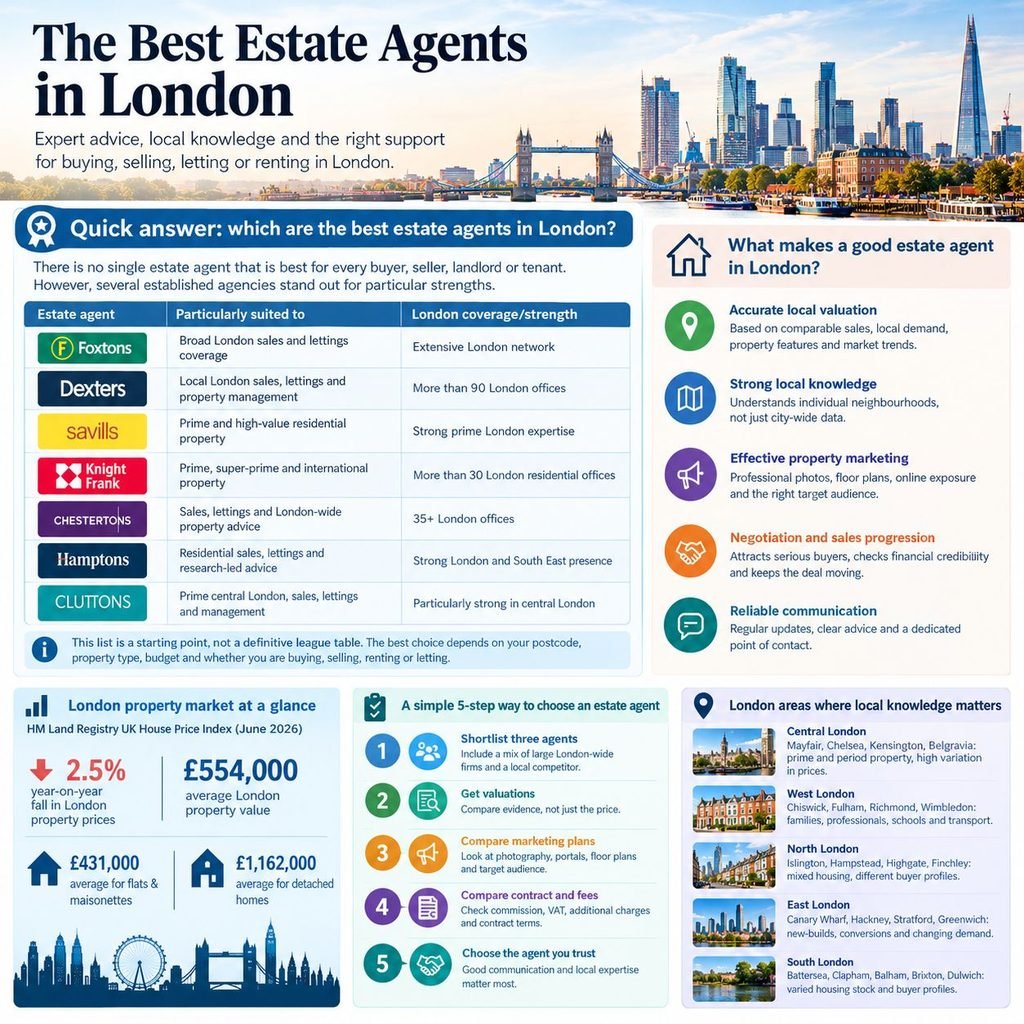
These should be treated as a starting shortlist rather than a definitive league table. The best choice depends on your postcode, property type, budget and whether you are buying, selling, renting or letting.
What makes a good estate agent in London?
A large branch network does not automatically make an agent better. Nor does a high valuation.
A good London estate agent should be able to demonstrate several things.
Accurate local valuation
The most important question for a seller is not simply, “How much can you list my property for?”
It is, “What price is realistically achievable, and what evidence supports it?”
A valuation should take into account recent comparable sales, competing properties currently on the market, condition, floor area, lease terms where relevant, outdoor space, parking, transport connections, and the particular demand within the postcode.
A valuation significantly above the market may sound attractive but can leave a property unsold, leading to price reductions.
Strong local knowledge
London is not one property market.
A flat near London Bridge has a very different buyer profile from a family house in Chiswick. The dynamics in Islington, Hampstead, Richmond, Greenwich, Canary Wharf, Wimbledon and Croydon can also differ substantially.
The strongest agents usually have negotiators who understand individual neighbourhoods rather than relying solely on city-wide statistics.
Effective property marketing
Photography, floor plans, descriptions and online exposure all influence the first impression a property makes.
For more expensive homes, the marketing strategy can become even more important. International buyers, relocation clients and specialist property portals may form part of the target audience.
Negotiation and sales progression
Getting an offer is only one stage of selling a home.
A good agent should also help establish whether a buyer is financially credible, communicate effectively between the parties and keep the transaction moving towards exchange and completion.
The Property Ombudsman says its residential sales service can deal with complaints concerning matters such as advice on asking price, advertising, viewing arrangements, handling offers and communication during a sale.
Reliable communication
Property transactions raise many questions.
Poor communication can create unnecessary stress even when the underlying deal is sound. Before instructing an agent, ask who will actually handle the property after the valuation and how often you should expect updates.
The best estate agents in London to consider
Foxtons — broad London coverage
Foxtons London Bridge Estate Agents is one of the most recognisable estate agency brands in the capital.
Foxtons says it has more than 40 years of property experience and operates across London, providing services including valuations, buying, selling, property marketing and advertising.
Its main advantage is scale. For sellers and landlords who want broad exposure across the capital, a large London network can be useful, particularly where potential buyers or tenants may come from outside the immediate neighbourhood.
Foxtons also publishes market and property information and has a substantial presence across different London districts.
Best suited to: sellers and landlords who value extensive London coverage and a large established agency network.
Potential limitation: a large agency is not necessarily the right fit for every property, so sellers should still compare the proposed marketing strategy and local valuation with those of competing agents.
Dexters — strong choice for local London coverage
Dexters London Bridge Estate Agent has built a particularly extensive network across London.
Dexters states that it has more than 90 offices across London, including 50 in Central London, and handles more than 20,000 sales and lettings transactions each year.
Its coverage includes areas such as Acton, Battersea, Blackheath, Bloomsbury, Brentford, Brockley, Canada Water, Canary Wharf, Chelsea, Chiswick and many other parts of the capital.
The breadth of this network can be useful for sellers who want their property promoted beyond a single neighbourhood. Dexters also offers property management, corporate lettings, international relocation and specialist services for different types of London property.
Best suited to: homeowners and landlords looking for extensive London coverage, particularly those who want sales, lettings or property management under one agency.
Potential limitation: compare the individual branch and negotiator, not just the wider brand.
Savills — particularly strong for prime London property
Savills is a major consideration for owners and buyers dealing with prime and higher-value London property.
Its London residential business covers sales and lettings, while its wider organisation also provides research, valuation and property advisory services. Savills has dedicated expertise across prime central London markets, including areas such as Chelsea, Kensington and other established prime districts.
That research capability can be particularly useful for clients who want more than a basic valuation. Prime London transactions can involve international buyers, complex properties and substantial differences between individual streets.
Best suited to: prime, high-value and internationally marketed London homes, as well as clients who value detailed market research.
Potential limitation: owners of more mainstream properties should compare whether a specialist prime agency’s approach is appropriate for their particular property.
Knight Frank — prime and international property
Knight Frank has a long-established presence in London’s prime residential market.
Its London residential operation says it has more than 30 offices across the capital and has advised owners and buyers on London residential property for more than 125 years.
The agency covers sales and lettings and forms part of a much wider international property network. That can be particularly relevant for prime London homes where buyers or tenants may be based overseas.
Knight Frank also produces regular market research, including updates on prime London sales and lettings.
Best suited to: prime and super-prime properties, international buyers, sellers and landlords, and clients looking for a combination of local and international reach.
Potential limitation: its strongest proposition is generally in higher-value and specialist markets, so compare its approach with more locally focused agents for ordinary residential properties.
Chestertons — established London sales and lettings network
Chestertons Westminster and Pimlico Estate Agents is another established name with substantial London coverage.
Chestertons currently states that it has a network of more than 35 London offices and provides services covering sales, lettings, property management and new homes.
Its Westminster and Pimlico operation, for example, handles both sales and lettings and has teams with detailed knowledge of the local market.
This combination of London-wide reach and local branches makes Chestertons worth considering for conventional residential transactions as well as properties in more central markets.
The company has also received industry recognition, including Estate Agency of the Year at the RESI Awards in 2026, according to its own published information.
Best suited to: buyers, sellers, landlords and tenants looking for an established London agency with both local branches and wider network coverage.
Potential limitation: compare branch-level expertise and proposed fees before making a decision.
Hamptons — strong residential and research credentials
Hamptons has a long history in the London and South East residential market and operates across sales and lettings.
The agency says it sells or lets more than 21,000 properties each year and has more than 157 years of experience. It also maintains a dedicated research operation covering economic and housing-market trends.
Its London branches cover a variety of markets. The City and West End office, for example, handles both sales and lettings and covers everything from mainstream residential property to prime homes.
Hamptons can therefore appeal to sellers and landlords who want an established brand combined with market research and London-wide knowledge.
Best suited to: residential sellers and landlords, including those dealing with prime property or looking for research-backed market advice.
Potential limitation: local branch performance still matters more than the national brand alone.
Cluttons — central London and specialist property expertise
Cluttons has particularly deep roots in London’s property market, tracing its history back to 1765.
The company provides residential sales, lettings and property management services. Its London coverage includes areas such as Belgravia, Chelsea, Islington, Highbury, SE1, Hanover Square, Holland Park and Old Street.
Its lettings service also highlights ARLA-qualified teams and an externally audited lettings process.
That combination can make Cluttons particularly relevant for clients dealing with central London property or landlords who want specialist lettings and management advice.
Best suited to: central London sales, lettings, property management and higher-value residential property.
Potential limitation: its geographical strengths are more concentrated than those of the very largest London-wide networks.
Which estate agent is best for selling a house in London?
For sellers, the best estate agent is usually the one that can demonstrate a realistic valuation, strong local buyer demand and a clear plan for getting the property from instruction to completion.
Do not choose an agent simply because it gives you the highest suggested asking price.
Ask each shortlisted agent:
- What recent comparable properties have you sold?
- What price would you realistically expect to achieve?
- How many similar properties are currently on your books?
- Who will conduct the viewings?
- How will the property be marketed?
- Which property portals will be used?
- What is the proposed agency fee?
- What contract period applies?
- What happens if the property does not sell?
- Who will manage the transaction after an offer is accepted?
It is sensible to obtain several valuations. The figures should then be compared alongside the evidence supporting them.
Which estate agents are best for renting in London?
Tenants should approach the search slightly differently.
A letting agent’s usefulness often depends on its coverage of the specific area and type of property you want.
For example, someone looking for a flat around Canary Wharf may benefit from an agency with strong Docklands coverage, while a family searching in Richmond, Wimbledon or Chiswick may want an agent with a deep local presence in south-west London.
Landlords have a different set of priorities. They should investigate:
- Tenant referencing procedures
- Rent collection
- Property management
- Maintenance arrangements
- Deposit handling
- Compliance procedures
- Tenancy renewal services
- Fees and management charges
- Communication arrangements
- Experience with the relevant property type
Chestertons, Dexters, Cluttons and the other agencies above offer different combinations of lettings and property management services, but landlords should compare the actual service agreement rather than relying on headline claims.
How much do estate agents charge in London?
There is no single standard London estate agent fee.
The amount can depend on the property value, service provided, agency agreement, whether the instruction is sole agency or multi-agency, and whether additional services are included.
For sellers, ask for the proposed fee in writing, including VAT and any additional charges.
For landlords, check whether the quoted fee covers only finding a tenant or includes full property management.
Before signing, clarify:
- Percentage or fixed fee
- Whether VAT is included
- Minimum fees
- Marketing costs
- Photography and floor-plan charges
- Renewal fees
- Property management fees
- Withdrawal fees
- Sole-agency terms
- Notice periods
- Additional administration charges
A slightly higher fee can be worthwhile if the service is substantially better, while a cheaper agent may be poor value if weak marketing or communication results in a failed transaction.
What should you check before choosing a London estate agent?
Check recent local results
Ask for examples of comparable properties sold or let recently.
The relevant comparison is not simply the number of properties an agent has sold across London. A firm selling hundreds of properties in unrelated postcodes may have less insight into your particular neighbourhood than a smaller local competitor.
Compare valuations carefully
If three agents value the same property at £600,000, £625,000 and £700,000, the £700,000 figure is not automatically the best news.
Ask each agent to explain the evidence behind the valuation.
Read reviews intelligently
Reviews can reveal patterns in communication, viewings and customer service. But do not rely on an average star rating alone.
Look for repeated comments about:
- Communication
- Valuation accuracy
- Sales progression
- Lettings administration
- Property management
- Responsiveness
- Professionalism
Check redress membership
Residential estate agents in the UK must belong to an approved redress scheme. The government identifies The Property Ombudsman and Property Redress Scheme as the approved schemes.
This provides an important consumer safeguard if a dispute cannot be resolved directly with the agent.
Understand the contract
Read the agency agreement before signing.
Pay particular attention to the definition of a successful introduction, commission triggers, contract length, termination arrangements and any continuing liability for fees.
Are estate agents regulated in London?
Estate agency is subject to legislation and consumer-protection requirements, but it is a misconception that every individual estate agent must hold a professional licence or qualification.
A recent House of Commons Library briefing explains that estate agents are not currently required by law to be licensed or qualified, although many practitioners belong to professional organisations such as RICS or Propertymark.
For consumers, this makes it particularly important to check the agency’s credentials, complaints process, redress membership and the experience of the team handling the transaction.
The Property Ombudsman’s sales and lettings codes are approved by the Chartered Trading Standards Institute and are intended to establish recognised standards for participating property businesses.
Best estate agents in London by property need
| Your situation | Agencies worth comparing | What to prioritise |
| Selling a standard London home | Foxtons, Dexters, Chestertons, Hamptons | Local sales record, valuation and marketing |
| Letting a London flat | Dexters, Chestertons, Hamptons, Cluttons | Tenant demand, compliance and management |
| Prime Central London | Savills, Knight Frank, Hamptons, Cluttons | Prime-market expertise and buyer network |
| High-value international property | Knight Frank, Savills | International reach and specialist marketing |
| Property management | Dexters, Chestertons, Cluttons | Maintenance, compliance and communication |
| Central London property | Savills, Knight Frank, Cluttons, Chestertons | Micro-market knowledge |
| Wide London coverage | Dexters, Foxtons, Chestertons | Branch network and cross-London buyer reach |
This table is a practical comparison rather than a formal ranking. Fees, staff and performance can change, so a seller or landlord should obtain current proposals before instructing an agent.
London areas where local knowledge matters most
A good estate agent should understand the differences between London’s neighbourhoods.
Central London
Mayfair, Marylebone, Belgravia, Chelsea, Westminster, Pimlico, Kensington and Knightsbridge contain a high proportion of prime and period property, alongside luxury apartments and new developments.
Pricing can vary sharply from one street to the next, making micro-market knowledge especially valuable.
West London
Chiswick, Fulham, Hammersmith, Ealing, Acton, Richmond and Wimbledon attract a wide range of buyers, including families and professionals.
Transport connections, schools, outdoor space and property condition can all have a significant influence on demand.
North London
Areas including Hampstead, Highgate, Islington, Highbury, Finchley and Barnet contain a mixture of period houses, flats and modern developments.
A local agent should understand the differences between individual neighbourhoods rather than treating North London as one market.
East London
Canary Wharf, Stratford, Hackney, Walthamstow, Bow, Greenwich and surrounding districts have experienced significant changes in housing stock and buyer demand over time.
New-build developments can sit alongside older terraces and converted industrial buildings, producing very different property markets within relatively short distances.
South London
Battersea, Clapham, Balham, Brixton, Dulwich, Peckham, Greenwich and surrounding districts have varied housing stock and buyer profiles.
Local branch knowledge can be particularly useful for understanding differences between individual roads and residential pockets.
A simple five-step way to choose an estate agent
- Step 1: Shortlist three agents: Choose a mixture of large London-wide firms and a respected local competitor.
- Step 2: Get valuations: Ask each agent to explain the evidence behind its suggested price.
- Step 3: Compare the marketing plan: Look beyond portal listings. Ask about photography, floor plans, viewings, database marketing, and follow-up.
- Step 4: Compare the contract and fees: Check commission, VAT, additional charges, and termination provisions.
- Step 5: Choose the agent you trust to handle the transaction: The best valuation is of little use if the agent cannot communicate properly, attract suitable buyers or progress the transaction.
Pros and cons of using a large London estate agent
Advantages
- Broad buyer and tenant databases
- Extensive London branch networks
- Strong brand recognition
- Potential cross-London referrals
- Established marketing systems
- Specialist departments in some firms
Disadvantages
- Service can vary between branches
- A large network does not guarantee local expertise
- Fees may not always be the lowest
- Sellers may deal with several members of a team
- Some smaller local agents may have stronger neighbourhood knowledge
Pros and cons of using an independent local agent
Advantages
- Strong knowledge of a particular neighbourhood
- Potentially more personal service
- Direct access to senior staff
- Local relationships with buyers and landlords
- May specialise in a particular property type
Disadvantages
- Smaller buyer database
- Less extensive geographical coverage
- Fewer specialist departments
- Potentially less useful for international or cross-London transactions
The right choice depends on the property rather than the size of the logo above the branch.
What is the biggest mistake sellers make?
One of the most common mistakes is choosing an estate agent solely because it promises the highest asking price.
A realistic strategy is usually more valuable than an optimistic valuation. If a property is overpriced when it first launches, it can lose momentum and become harder to market later.
London’s market is particularly diverse, and current conditions make realistic pricing even more important. HM Land Registry reported a 2.5% annual fall in London’s average property price in June 2026, although prices increased 1% between May and June.
That does not mean every London property is falling in value. Individual streets, property types and neighbourhoods can perform very differently.
What is the biggest mistake landlords make?
Landlords sometimes focus too heavily on the advertised rent.
The better question is the likely net return after void periods, management fees, maintenance and compliance costs.
A slightly lower rent from a reliable tenant who stays longer may be preferable to repeatedly achieving a higher headline rent followed by expensive vacancies.
Landlords should also ensure the agent understands current legal responsibilities and can explain which parts of the service it will handle.
FAQ
1. Who are the best estate agents in London?
There is no single best estate agent for every property. Foxtons, Dexters, Chestertons, Savills, Knight Frank, Hamptons and Cluttons are among the established firms worth comparing, with different strengths across London.
2. Which estate agent is best for selling a house in London?
The best agent depends on the property’s postcode, value and type. Compare at least three local valuations and examine recent comparable sales, marketing plans, fees and the experience of the negotiator who will handle the property.
3. Which estate agents are best for prime London property?
Savills and Knight Frank have particularly strong prime and international residential operations. Hamptons and Cluttons are also relevant for many prime London properties.
4. How much do estate agents charge in London?
There is no universal London fee. Sellers should compare the commission, VAT, marketing charges, contract terms, and any additional costs in writing before signing an agency agreement.
5. Should I choose a large or independent estate agent?
Neither is automatically better. Large agencies can offer extensive databases and London-wide reach, while independent agents may have deeper knowledge of a specific neighbourhood. Compare their actual local performance.
6. How many estate agents should I get valuations from?
Three is a sensible starting point. It gives you enough information to compare valuation evidence, marketing strategies, fees and the agents’ understanding of your local market.
7. How can I check whether an estate agent is legitimate?
Ask which approved redress scheme it belongs to and check its complaints procedure. Residential estate agents must belong to an approved redress scheme.
8. Are London estate agents regulated?
Estate agency is subject to legislation and consumer-protection requirements, but individual estate agents are not currently required by law to be licensed or qualified. Professional qualifications and memberships can therefore be useful factors when comparing firms.
Final thoughts: choosing the best estate agent in London
The best estate agents in London are not necessarily the ones with the biggest networks or the highest advertised valuations. The right choice is the firm that understands your property, knows your local market and can explain its strategy clearly.
For broad London coverage, firms such as Foxtons, Dexters and Chestertons are worth comparing. For prime and international property, Savills and Knight Frank have particularly strong specialist credentials. Hamptons combines a broad residential operation with substantial market research, while Cluttons has deep roots and specialist expertise across central London.
Before making a decision, speak to at least three agents, request written valuations, compare fees and marketing plans, check redress membership and ask who will actually manage your transaction.
That extra research can make a significant difference to the experience of selling, buying, letting or renting a property in one of the world’s most complex residential markets.