
Canary Wharf has changed dramatically over the past four decades. Once dominated by derelict docklands, it is now one of London’s leading financial centres, known for its modern skyline, luxury apartments and excellent transport links. While global banks and multinational companies helped shape the district, today’s Canary Wharf has grown into a genuine residential neighbourhood with parks, waterside walkways, shopping centres, restaurants and cultural spaces.
For buyers, renters and investors, the local property market offers something quite different from many other parts of London. High-rise apartments dominate the landscape, yet there are also converted warehouse homes, riverside developments and family houses in neighbouring districts. Demand remains strong thanks to employment opportunities, ongoing regeneration and improved transport connections across the capital.
This Property Guide to Canary Wharf explains how the local market works, what buyers and tenants should expect, typical property prices, the different neighbourhoods nearby and the practical factors worth considering before making a move.
Canary Wharf at a Glance
| Feature | Details |
| London Borough | Tower Hamlets |
| Postcode | Primarily E14 |
| Main Underground Station | Canary Wharf (Jubilee line) |
| Elizabeth line Station | Canary Wharf |
| DLR Stations | Canary Wharf, Heron Quays, South Quay, West India Quay |
| River Services | Canary Wharf Pier (Uber Boat by Thames Clippers) |
| Property Types | Apartments, penthouses, riverside homes, converted warehouses, townhouses nearby |
| Best Known For | Financial district, modern residential developments, shopping and riverside living |
Why Property in Canary Wharf Appeals to Buyers and Renters
The appeal of property in Canary Wharf extends well beyond its office towers. Although thousands of professionals continue to live within walking distance of their workplaces, the area increasingly attracts families, international buyers, downsizers and investors.
Several factors contribute to this popularity.
Excellent Transport Connections
One of Canary Wharf’s biggest advantages is connectivity.
Residents benefit from access to:
- Jubilee line
- Elizabeth line
- Docklands Light Railway (DLR)
- Uber Boat by Thames Clippers
- Extensive cycling routes
- Easy access to London City Airport
Journey times are among the fastest in London.
| Destination | Approximate Journey Time |
| London Bridge | Around 6 minutes |
| Waterloo | Around 11 minutes |
| Bond Street | Around 17 minutes (Elizabeth line) |
| Heathrow Airport | Around 40–45 minutes (Elizabeth line) |
| Stratford | Around 13 minutes |
Travel times vary depending on the route and service.
A Strong Employment Centre
Canary Wharf remains one of Europe’s largest business districts.
Major employers operate across sectors including:
- Banking
- Financial services
- Legal services
- Technology
- Insurance
- Consulting
- Media
The concentration of high-paying jobs creates sustained demand for nearby housing, particularly rental apartments.
Modern Lifestyle
Unlike many central London neighbourhoods, Canary Wharf was largely master-planned.
Residents benefit from:
- Wide pedestrian spaces
- Modern public squares
- Waterfront walking routes
- Landscaped parks
- Shopping malls
- Health clubs
- Entertainment venues
- Year-round public events
The estate is managed to maintain high standards of cleanliness, security and public spaces.
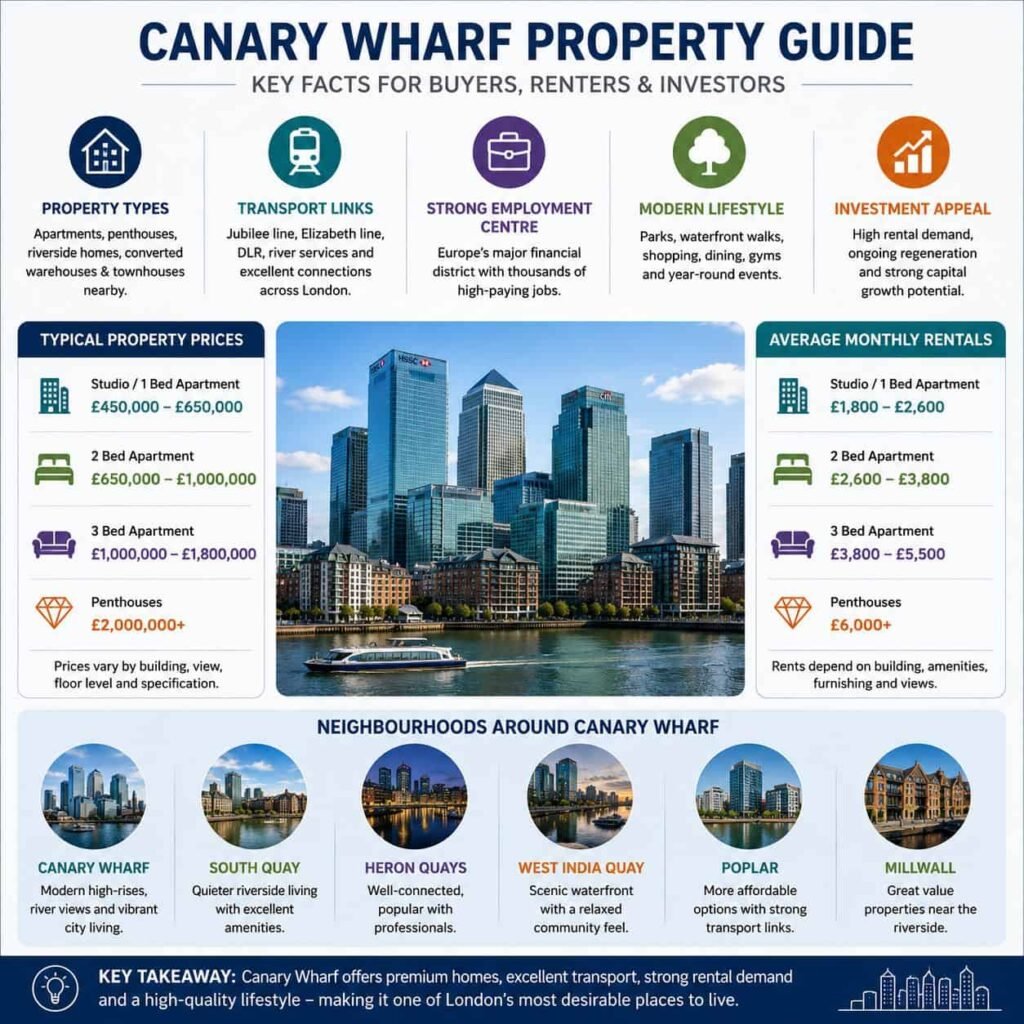
Understanding the Canary Wharf Property Market
Predominantly Apartment Living
One of the defining characteristics of Canary Wharf is the dominance of apartments.
Many developments include:
- Concierge services
- Residents’ gyms
- Swimming pools
- Roof terraces
- Co-working lounges
- Secure entry systems
- Underground parking
- Private gardens
Purpose-built residential towers account for much of the housing stock.
Popular apartment layouts include:
- Studio flats
- One-bedroom apartments
- Two-bedroom homes
- Three-bedroom family apartments
- Luxury penthouses
Riverside Living
Several developments overlook the River Thames, South Dock or West India Docks.
Waterfront properties often command premium prices because of:
- Dock views
- Larger balconies
- Better natural light
- Higher floors
- Marina outlooks
These homes appeal to professionals and overseas buyers seeking modern riverside living.
Family Housing Nearby
Although Canary Wharf itself contains relatively few traditional houses, neighbouring areas provide more family-oriented options.
Within a short distance are established residential districts including:
- Limehouse
- Poplar
- Blackwall
- Isle of Dogs
- Millwall
These neighbourhoods offer a broader mix of Victorian terraces, maisonettes, newer townhouses and converted period properties.
Canary Wharf Neighbourhood Guide
Buying in Canary Wharf isn’t simply about choosing a tower. Different parts of the district offer distinct lifestyles and price points.
Canary Wharf Estate
The central estate contains many of the newest residential developments.
Suitable for:
- Professionals
- Executives
- International buyers
- Investors
Typical characteristics include:
- High-rise apartments
- Concierge buildings
- Premium facilities
- Direct access to transport
- Proximity to offices and retail
Wood Wharf
Wood Wharf is one of London’s largest recent regeneration projects and extends the Canary Wharf district eastwards.
It has introduced:
- New residential buildings
- Restaurants
- Public squares
- Independent cafés
- Waterside spaces
- Flexible workspaces
The area has a quieter residential atmosphere while remaining within walking distance of Canary Wharf’s business core.
South Quay
South Quay has become one of the fastest-growing residential areas around Canary Wharf.
Residents benefit from:
- Excellent DLR access
- Modern apartment developments
- Waterside views
- Competitive pricing compared with the core estate
It remains particularly popular with first-time buyers purchasing apartments.
Isle of Dogs
Although often associated with Canary Wharf, the Isle of Dogs has its own character.
Property options include:
- Victorian terraces
- Modern apartment buildings
- Family townhouses
- Riverside developments
Many buyers choose the Isle of Dogs for slightly quieter residential streets while remaining close to Canary Wharf’s employment opportunities.
Average Property Prices in Canary Wharf
Property prices fluctuate according to market conditions, building quality, views and available amenities. Homes overlooking the docks or the River Thames generally command higher values than similar properties elsewhere in the district.
The table below provides a broad guide to the types of homes commonly available.
| Property Type | Typical Market Position |
| Studio Apartment | Entry point for many first-time buyers and investors |
| One-bedroom Apartment | Most common purchase among professionals |
| Two-bedroom Apartment | Popular with couples, sharers and small families |
| Three-bedroom Apartment | Limited supply, higher demand |
| Penthouse | Premium end of the market |
Actual prices vary considerably depending on factors such as:
- Floor level
- Building age
- Concierge and resident facilities
- Outdoor space
- Parking
- River or dock views
- Lease terms
- Overall market conditions
Before making an offer, buyers should compare recent sold prices for similar properties and review any service charges, ground rent arrangements (where applicable) and lease details.
Best Residential Developments in Canary Wharf
Canary Wharf is home to some of London’s most recognisable residential towers. Most developments are apartment-led and include facilities that are uncommon in many other parts of the capital, such as concierge services, residents’ lounges and fitness centres.
Rather than choosing a building based on appearance alone, buyers should compare lease terms, service charges, energy efficiency, management quality and transport access.
| Development | Property Type | Best For | Nearby Transport |
| One Park Drive | Luxury apartments | Owner-occupiers and premium buyers | Canary Wharf (Elizabeth line, Jubilee line) |
| Newfoundland | High-rise apartments | Professionals seeking modern living | Canary Wharf Underground Station |
| 10 Park Drive | Apartments | Investors and commuters | Canary Wharf Estate |
| South Quay Plaza | Apartments | Riverside living | South Quay DLR |
| Wardian London | Apartments | Buyers seeking extensive resident facilities | Canary Wharf and South Quay |
Facilities vary by development and individual apartment.
Renting Property in Canary Wharf
Is Canary Wharf a Good Place to Rent?
For many people, renting is the easiest way to experience the area before committing to a purchase.
The rental market remains active throughout the year because of demand from:
- Finance professionals
- Technology employees
- International workers
- Graduates
- Corporate relocations
- Couples sharing accommodation
The largest supply consists of one- and two-bedroom apartments.
What Renters Should Look For
Monthly rent is only one part of the overall cost of living.
Before signing a tenancy agreement, check:
- Council Tax band
- Utility costs
- Broadband availability
- Deposit requirements
- Building management
- Lift maintenance
- Security arrangements
- Bike storage
- Parking availability
- Pet policies
If the apartment is in a managed development, ask whether amenities such as gyms or lounges are included in the rent or require additional fees.
Renting Pros and Cons
| Advantages | Considerations |
| Excellent transport links | Premium rental prices compared with many outer London areas |
| Modern buildings | Competition for well-priced apartments |
| High standard of amenities | Limited availability of traditional houses |
| Strong security in many developments | Service quality varies between buildings |
Buying Property in Canary Wharf
Who Buys Here?
The buyer profile has broadened significantly over the past decade.
Typical buyers include:
- First-time buyers
- Young professionals
- Overseas purchasers
- Downsizers
- Buy-to-let investors
- Couples upgrading from smaller flats
Families are also becoming more common as the neighbourhood develops additional schools, parks and community facilities.
What Buyers Should Check
Apartment purchases often involve additional considerations beyond the purchase price.
Key points include:
Lease Length
A shorter lease can affect mortgage availability and future resale value. Buyers should understand the remaining lease term before making an offer.
Service Charges
Many developments include facilities such as:
- Concierge
- Residents’ gym
- Swimming pool
- Landscaped gardens
- Cinema room
- Roof terrace
These amenities contribute to annual service charges, which vary widely between developments.
Energy Performance
Modern buildings often achieve higher energy efficiency ratings than older conversions, potentially reducing heating costs.
Building Safety
For apartment buildings, buyers should ensure their solicitor investigates:
- Fire safety documentation
- Building management arrangements
- Major works plans
- Reserve funds where applicable
Professional legal advice is essential before exchanging contracts.
Is Canary Wharf a Good Place to Invest?
- Short Answer: For many investors, yes—but returns depend on the specific property, purchase price and long-term strategy.
- Why Investors Consider Canary Wharf: Several factors continue to support investment demand.
- Strong Rental Demand: The area’s concentration of major employers creates a consistent need for rental accommodation.
- International Appeal: Canary Wharf attracts buyers from the UK and overseas thanks to its reputation as a global business district.
- Ongoing Regeneration
- Projects such as Wood Wharf have expanded the residential offering, adding new homes, public spaces and leisure facilities.
- Excellent Infrastructure: The arrival of the Elizabeth line significantly improved journey times across London, increasing the area’s accessibility.
Potential Challenges
Every investment carries risk.
Buyers should consider:
- Market fluctuations
- Mortgage costs
- Service charges
- Changes in rental demand
- Future maintenance expenses
- Tax implications
Independent financial and legal advice should always form part of an investment decision.
Schools Near Canary Wharf
Families moving to the area often prioritise access to education.
Nearby options include a mix of:
- State primary schools
- State secondary schools
- Independent schools
- Nurseries
- Further education providers
School admissions depend on several factors, including catchment areas and availability.
Before purchasing a property, parents should consult the relevant local authority and the school’s admissions information rather than relying solely on distance.
Getting Around Canary Wharf
Transport is one of the area’s strongest selling points.
Underground
The Jubilee line provides direct connections to destinations including:
- London Bridge
- Waterloo
- Westminster
- Bond Street (via interchange)
- Stratford
Elizabeth Line
The Elizabeth line has transformed east-west travel.
Direct journeys are available towards:
- Paddington
- Heathrow Airport
- Liverpool Street
- Farringdon
- Reading (via through services)
Journey times depend on the destination and service pattern.
Docklands Light Railway (DLR)
Several stations serve the area, including:
- Canary Wharf
- Heron Quays
- South Quay
- West India Quay
The DLR provides convenient links to:
- Bank
- Stratford
- Lewisham
- London City Airport
River Transport
Canary Wharf Pier is served by Uber Boat by Thames Clippers, offering river services to destinations along the Thames, including central London and Greenwich.
Cycling and Walking
Dedicated cycle routes and riverside paths make active travel a practical option for many residents.
Public cycle hire facilities are also available nearby.
Shopping, Dining and Everyday Amenities
One reason many residents rarely need to leave the area for day-to-day essentials is the wide range of facilities within walking distance.
Shopping
Canary Wharf Shopping Centre and surrounding malls include:
- Supermarkets
- Fashion retailers
- Beauty stores
- Homeware shops
- Convenience stores
Seasonal markets and pop-up retail events also take place throughout the year.
Restaurants and Cafés
The dining scene has expanded considerably in recent years.
Residents can find:
- British cuisine
- Italian restaurants
- Japanese dining
- Indian restaurants
- Mediterranean food
- Coffee shops
- Bakeries
- Street food vendors
Health and Fitness
Facilities include:
- Private gyms
- Fitness studios
- Yoga classes
- Healthcare clinics
- Dental practices
- Pharmacies
Parks, Green Spaces and Leisure
Although Canary Wharf is known for its skyline, it also offers a surprising amount of public open space.
Popular places to relax include:
- Jubilee Park
- Canada Square Park
- Crossrail Place Roof Garden
- Thames Path
- West India Quay waterfront
These spaces host seasonal events, outdoor art installations and community activities throughout the year.
Living in Canary Wharf: Pros and Cons
| Advantages | Limitations |
| Outstanding transport links | Property prices are among the higher end of the London market |
| Modern residential developments | Service charges can be significant in premium buildings |
| Excellent shopping and dining | Fewer traditional houses within the core estate |
| Strong employment opportunities | Some areas are quieter outside office hours |
| Attractive riverside environment | Larger family homes are limited compared with suburban locations |
Practical Tips Before Buying or Renting
Before making a decision, consider the following:
- Visit the neighbourhood at different times of day, including weekends.
- Compare service charges between similar developments.
- Review lease details carefully with a solicitor.
- Check transport routes for your regular commute.
- Research planned developments nearby that could affect views or construction activity.
- Compare sold property prices rather than relying only on asking prices.
- Speak with local estate agents to understand current market conditions.
- If renting, confirm which amenities are included in the tenancy agreement.
The final part of this guide covers future regeneration, who Canary Wharf is best suited to, a quick-reference summary, frequently asked questions, and publication-ready SEO assets including internal link suggestions, image recommendations and schema markup.
Future Development and Regeneration in Canary Wharf
Canary Wharf continues to evolve from a business district into a mixed-use neighbourhood. While its reputation is rooted in banking and finance, recent developments have introduced more homes, public spaces, leisure venues and community facilities.
The largest ongoing transformation is Wood Wharf, an extension of the Canary Wharf estate that is adding thousands of new homes alongside offices, retail units, restaurants and landscaped public areas. The aim is to create a neighbourhood where people can live, work and spend their leisure time without needing to travel elsewhere.
Other long-term improvements include:
- New residential developments
- Additional public squares and green spaces
- Improved walking and cycling routes
- Expanded retail and dining options
- Continued investment in cultural events and public art
Prospective buyers should also keep an eye on planning applications in the surrounding area. New developments can enhance local amenities but may also affect views, traffic or nearby construction activity in the short term.
Who Should Consider Living in Canary Wharf?
Canary Wharf appeals to a broad range of residents, but it isn’t the perfect fit for everyone.
Ideal for
Professionals
The area’s proximity to major employers, excellent transport links and abundance of modern apartments make it one of London’s most convenient places to live for those working in the City or Docklands.
Investors
Strong rental demand and an established international profile continue to make Canary Wharf attractive to many long-term property investors. As with any investment, returns depend on market conditions, purchase price and ongoing costs.
First-Time Buyers
Although entry prices can be high, buyers may find smaller apartments or properties in neighbouring areas such as Poplar or Blackwall more accessible while still benefiting from Canary Wharf’s transport links and amenities.
International Buyers
Modern developments, professional building management and strong global recognition have made Canary Wharf a popular choice for overseas purchasers seeking a London base.
May Be Less Suitable For
The area may not suit buyers who prioritise:
- Large private gardens
- Detached or semi-detached homes
- Period cottages or Victorian streetscapes
- A village-style atmosphere
- Lower ongoing service charges
Neighbouring parts of East London may offer a wider choice of traditional housing while remaining close to Canary Wharf.
Buying Checklist
Before making an offer on a property in Canary Wharf, take time to review the following:
- Compare recent sold prices for similar homes.
- Check the remaining lease length.
- Understand annual service charges and what they include.
- Ask about planned major works within the building.
- Review the property’s Energy Performance Certificate (EPC).
- Confirm transport options for your daily commute.
- Visit the area during weekdays, evenings and weekends.
- Read the management company’s information pack.
- Speak to an independent mortgage adviser if finance is required.
- Instruct an experienced conveyancing solicitor before exchanging contracts.
Frequently Asked Questions
1. Is Canary Wharf a good place to buy property?
Yes. Canary Wharf offers modern homes, excellent transport links and strong demand from buyers and renters. Before purchasing, compare service charges, lease terms and recent sold prices to ensure the property represents good value.
2. What types of property are available in Canary Wharf?
Most homes are purpose-built apartments ranging from studios to luxury penthouses. Nearby areas such as the Isle of Dogs, Limehouse and Poplar also offer townhouses, Victorian terraces and converted warehouse properties.
3. Is Canary Wharf expensive?
Property prices are generally above the London average due to the area’s prime location, modern developments and strong transport connections. Costs vary depending on the building, size, facilities and views.
4. Is Canary Wharf suitable for families?
It can be. Families benefit from parks, riverside walks, shopping, healthcare facilities and nearby schools. However, those looking for larger houses with gardens may prefer neighbouring residential areas.
5. Is Canary Wharf a good place for property investment?
Many investors are attracted by consistent rental demand and ongoing regeneration. Like any investment, potential returns depend on purchase price, financing costs, service charges and wider market conditions.
6. Which Underground lines serve Canary Wharf?
Canary Wharf is served by the Jubilee line and the Elizabeth line. Nearby Docklands Light Railway (DLR) stations provide additional connections across East and Central London.
7. Are there green spaces in Canary Wharf?
Yes. Residents can enjoy Jubilee Park, Canada Square Park, the Crossrail Place Roof Garden (when open to the public), riverside paths and several landscaped public squares throughout the estate.
8. What should I check before buying an apartment?
Review the lease length, annual service charges, building management arrangements, planned maintenance works, Energy Performance Certificate (EPC) rating and any restrictions affecting the property.
Final Thoughts
Canary Wharf has developed into one of London’s most distinctive residential markets. Its combination of modern homes, fast transport links, extensive amenities and ongoing regeneration continues to attract professionals, investors and buyers from across the UK and overseas.
No single property or development will suit everyone. Taking time to compare neighbourhoods, review lease terms, understand service charges and research local market conditions will help you make a more informed decision. If you’re still exploring your options, consider visiting nearby areas such as the Isle of Dogs, Limehouse and Poplar to see how they compare in terms of housing, lifestyle and value.
With careful research and realistic expectations, Canary Wharf offers a compelling choice for those seeking contemporary London living with excellent connectivity and long-term appeal.