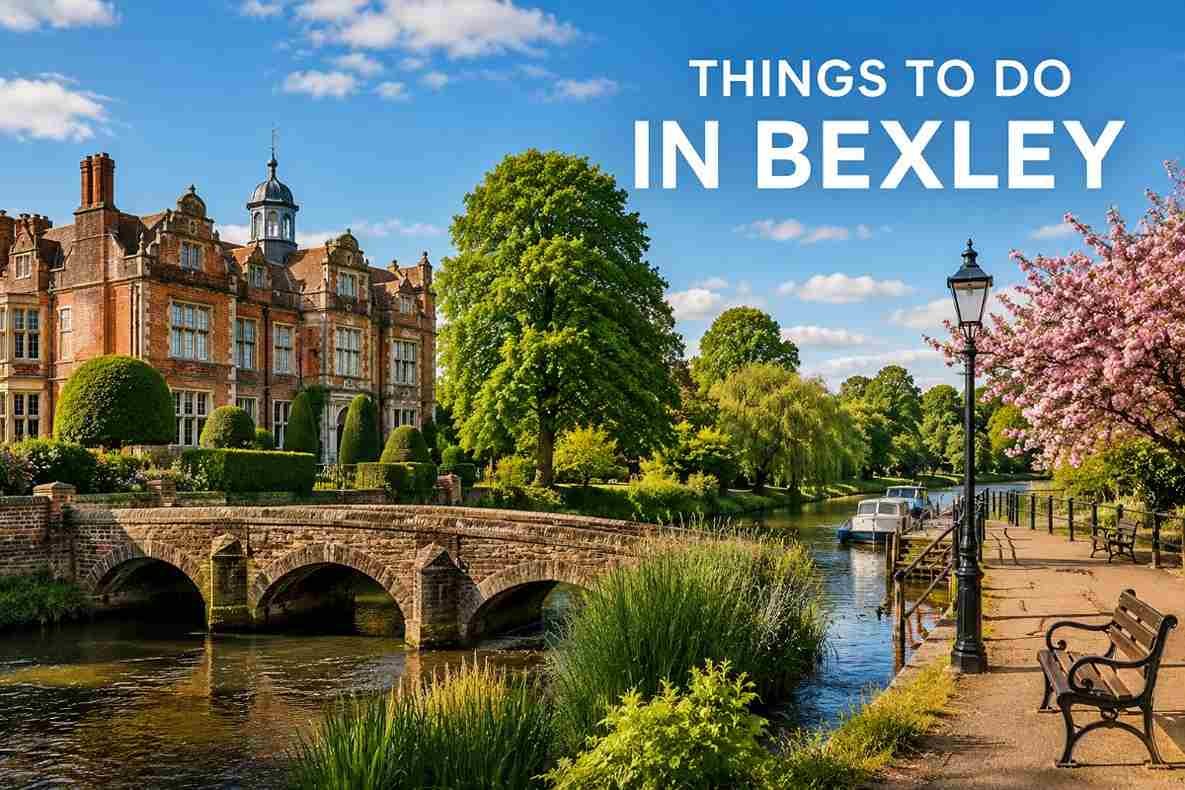
If you are searching for things to do in Bexley, there is considerably more to see than its distance from central London might suggest. The south-east London borough combines historic houses, large landscaped parks, ancient woodland, riverside spaces and several distinctive town centres.
Bexley also has a useful advantage for visitors: its attractions are spread across very different landscapes. You can spend a morning exploring Tudor architecture at Hall Place, walk along the River Cray in the afternoon, and finish the day by the Thames at Erith. In Abbey Wood, ancient woodland and the remains of Lesnes Abbey provide a very different experience again.
For families, there are playgrounds, gardens and outdoor activities. History enthusiasts have Hall Place, Red House, Danson House and Crossness Pumping Station. Walkers have the Thames Path, Foots Cray Meadows and Lesnes Abbey Woods. And if shopping, cafés or a traditional high street are more your style, Bexley Village and Bexleyheath offer plenty of places to stop.
This guide brings together the best things to do in Bexley, with practical advice on what each area is best suited to and how to make the most of a visit.
The best things to do in Bexley at a glance
| Attraction or area | Best for | What to expect |
| Hall Place and Gardens | History, gardens and families | Tudor house, formal gardens, exhibitions and seasonal attractions |
| Danson Park | Walks, families and outdoor activities | Large park, lake, playground and Grade I-listed Danson House |
| Red House | Architecture and art | William Morris’s Arts and Crafts home and garden |
| Lesnes Abbey Woods | Woodland walks and history | Ancient woodland and the ruins of Lesnes Abbey |
| Foots Cray Meadows | Walking and nature | River Cray, open meadows and Five Arch Bridge |
| Erith Riverside | Thames views and walking | Riverside gardens, pier and Thames Path |
| Crossness Pumping Station | Industrial heritage | Victorian pumping station and restored beam engines |
| Bexley Village | Food, cafés and local character | High Street, independent businesses and nearby countryside |
| Crayford | Riverside walks and local history | River Cray, Cray Gardens and town-centre amenities |
| Bexleyheath | Shopping and leisure | Main town centre, Broadway, restaurants and nearby attractions |
The Best things to do in Bexley

1. Explore Hall Place and Gardens
Hall Place is the obvious starting point for anyone interested in the history of Bexley.
The Grade I-listed house on Bourne Road incorporates a 16th-century section and later additions, giving it an unusually layered architectural history. Historic England records that the current house was built in the 1530s and 1540s, while later owners altered and enlarged it.
The house is only part of the attraction. Hall Place sits within a large estate containing formal gardens, glasshouses, lawns and the River Cray.
The gardens are free to enter and open year-round, although seasonal opening arrangements apply. The site includes notable topiary, including the Queen’s Beasts, while the wider grounds provide plenty of space for a leisurely walk.
There are also changing attractions within the glasshouses. The London Butterfly Gardens provide a tropical environment with free-flying butterflies, while Jambs Owls Experience operates seasonally. Hall Place also hosts a miniature railway during its summer season.
Why visit: Hall Place works particularly well when you want several activities in one stop. You can combine heritage, gardens, wildlife and refreshments without having to travel between different parts of the borough.
Practical tip: The historic house is not simply a walk-in museum. Guided tours are offered on selected dates, so check the official Hall Place information before travelling if seeing the interior is your priority.
2. Walk around Danson Park and see Danson House
For a classic London park day, Danson Park is one of the strongest choices in Bexley.
The park covers a substantial area around its lake and is home to Danson House, an elegant Grade I-listed Georgian villa designed by Sir Robert Taylor in the 1760s. Historic England describes the house and its associated landscape as an important example of an 18th-century country estate.
Danson Park is open 24 hours, 365 days a year, according to Bexley Council. The park includes a lake, playground and spaces for recreation, while water-based activities are available through local operators.
The park is particularly good for families because you can combine a walk with playtime and outdoor activities. It also works for a quieter visit: the lake and landscaped areas give you plenty of room to walk without needing a fixed itinerary.
Danson House itself requires a little more planning. Public heritage tours are offered on selected Sundays between April and August, with free access to the principal floor at designated times and guided tours available later in the day.
Why visit: It is one of the best places in Bexley for combining architecture and open space.
Best for: Families, walkers, photographers, history enthusiasts and anyone looking for a relaxed half-day outdoors.
3. Visit Red House, the William Morris landmark
Red House in Bexleyheath is one of the most significant cultural attractions in the borough.
Built in 1860 for William Morris and his wife Jane, the house was designed by architect Philip Webb and became an important meeting place for Morris’s circle of artists, including members of the Pre-Raphaelite movement. The National Trust describes it as the only house commissioned, created and lived in by William Morris.
The interior is particularly interesting because it was not conceived simply as a conventional Victorian residence. Morris and his friends contributed decoration, furniture, murals, stained glass and other artistic details.
Visitors can see features including the staircase, painted decoration, murals and surviving objects associated with the house’s creative history. The garden has also been developed to reflect the relationship between the house and its surroundings, including a reconstructed Garden Snug, orchard and planting inspired by the Arts and Crafts approach.
The practical point to remember is that Red House visits require pre-booking for guided tours. Current National Trust information lists tours from May to October, Thursday to Saturday, with slots released in advance.
There is also a temporary exhibition, The Positive Necessities of Life, scheduled for 11–25 September 2026, bringing contemporary objects and William Morris’s ideas together at Red House.
Why visit: If you are interested in design, architecture, Victorian history or William Morris, this is arguably the most distinctive cultural attraction in Bexley.
4. Walk through Lesnes Abbey Woods
Lesnes Abbey Woods offers a different side of Bexley.
The site combines 88 hectares of ancient woodland, open parkland and the remains of Lesnes Abbey, making it one of the borough’s most substantial natural and historic landscapes. Bexley Council lists it among the borough’s principal visitor attractions.
The woodland makes this a useful destination when you simply want to walk without following a heavily developed visitor attraction. The abbey ruins add historical interest, while the surrounding greenery provides space for a longer outdoor outing.
The site is in Abbey Wood, close to the town centre and Abbey Wood station. That makes it particularly convenient for visitors arriving by public transport.
Abbey Wood itself has become easier to reach from central London since the arrival of the Elizabeth line. Transport for London’s station information confirms Abbey Wood as an Elizabeth line station with direct services towards Heathrow and Reading.
Why visit: It is one of the better choices in Bexley for combining woodland, archaeology and a substantial outdoor walk.
Good to know: Woodland paths can become muddy after wet weather, so suitable footwear makes a difference.
5. Follow the River Cray through Foots Cray Meadows
Foots Cray Meadows is one of the best places to go when you want a walk with water, trees and open grassland.
The River Cray runs through the meadows, creating a natural route through the landscape. The area also features the Five Arch Bridge, which is a familiar local landmark and one of the borough’s recognised scenic spots. Bexley Council specifically identifies Foots Cray Meadows as one of its popular locations for wedding photography, highlighting the bridge and river setting.
The meadows are useful for different types of visits. You can make a short riverside stroll or spend longer exploring the open areas.
The River Cray also has environmental importance. Thames21 has worked with local communities on projects involving the river habitat, riverside walkways and biodiversity around Foots Cray Meadows.
Why visit: It is one of the strongest options for a quieter walk away from busy town centres.
Best for: Walkers, photographers, families and people who enjoy riverside scenery.
6. See the Thames at Erith Riverside
Erith provides one of the clearest reminders that Bexley is a riverside borough.
The town has almost half a mile of frontage on the River Thames and a long association with the river, from its history as a naval location to its industrial past. Today, the waterfront offers a very different experience.
The riverside area includes Riverside Gardens, Pier Square and Erith Pier, while the Thames Path provides an opportunity to continue walking beyond the immediate town centre.
Riverside Gardens have recently undergone a major refurbishment. The completed improvements include new seating, a playground, an outdoor fitness area, community gardening space and a Thames promenade route. The council says the transformed gardens opened to the public in stages from July 2026.
Erith Pier is another useful stopping point. The pier reaches out over the river and provides a distinctive perspective on the Thames landscape.
Why visit: Go for riverside walking, open views and a different perspective on London’s eastern edge.
Best for: Walkers, photographers, families and visitors interested in the Thames.
7. Visit Crossness Pumping Station
Crossness Pumping Station is one of the more unusual things to do in and around Bexley.
The Victorian site was built as part of London’s historic sewer infrastructure and contains enormous beam engines. Bexley Council describes it as a 19th-century sewage pumping station that has been partly restored to its original High Victorian appearance. Four James Watt beam engines remain on site, including one fully restored engine.
It is an attraction for people who enjoy industrial heritage rather than conventional museums.
The building itself is an important part of the experience, with elaborate Victorian decoration contrasting with the engineering function of the machinery.
Visits need planning because Crossness Engines Trust operates booked tours, steaming days and special events rather than functioning like a conventional drop-in attraction. Its visitor guidance states that tickets must be booked in advance.
Why visit: It provides an unusual insight into the engineering that helped transform London’s public health and sanitation.
Practical tip: Check the current events and booking calendar before making a special journey.
8. Spend time in Bexley Village
Bexley Village is a good choice when the aim is less about a single attraction and more about enjoying a local neighbourhood.
The High Street has a traditional character, with independent and family-owned shops, cafés, restaurants and pubs. Bexley Council describes the village as having a winding High Street and notes that Foots Cray Meadows is nearby.
This makes Bexley Village particularly useful as part of a wider day out.
For example, you could visit Hall Place first and then continue towards Bexley Village for food or coffee. Alternatively, use the village as a base for exploring the surrounding countryside and River Cray.
The area is close to the Kent boundary, which also gives it a slightly different feel from the more densely developed parts of inner London.
Why visit: Choose Bexley Village if you enjoy independent shops, local cafés and traditional high-street character rather than major tourist attractions.
9. Explore Crayford and the River Cray
Crayford has a strong connection with the River Cray and has a history stretching back much further than its modern shopping areas suggest.
The town developed around an ancient crossing of the river and has historical links to Watling Street and later industrial activity. Bexley Council highlights Cray Gardens, a small green space beside the River Cray, as one of the area’s attractions.
Cray Gardens can be combined with a walk through the town and along sections of the river.
Crayford is also a useful location for visitors who want to explore the northern part of the borough, with Hall Place and Crayford Meadows within the wider area.
Why visit: Crayford is best approached as part of a wider local itinerary rather than as a single major attraction.
10. Go shopping and eat around Bexleyheath
Bexleyheath is the borough’s main town centre and is the most straightforward choice for shopping, restaurants and everyday leisure.
The Broadway and surrounding pedestrianised areas contain independent businesses alongside national retailers. The town centre also has restaurants, a cinema and other entertainment options.
Bexleyheath is particularly useful as a base because several major attractions are nearby. Danson Park is close by, while Red House is also in the area.
If you are planning a day with different interests, Bexleyheath can therefore work as the practical middle of the itinerary: sightseeing during the day, followed by food or entertainment in the town centre.
Why visit: It is the best part of Bexley for combining shopping, food and leisure with nearby heritage attractions.
11. Look for outdoor activities at Danson Park
Danson Park is more than a place for walking.
The park has facilities for outdoor recreation, including a playground, while water-based activities are available through Danson Park Adventures. Bexley Council says the operator offers activities and courses for people aged eight and over, with different levels of ability catered for.
The park is therefore one of the better choices for families with older children who want something more active than a conventional park visit.
There are also outdoor fitness opportunities across the borough. Bexley Council’s current Our Parks programme lists coached sessions at locations including Danson Park, Foots Cray Meadows and Hall Place. Availability changes, so check the council’s current programme before travelling specifically for a session.
12. Take a walk along the Thames Path
The Thames Path is one of the most interesting options for anyone who prefers exploring on foot.
Erith provides access to a section of the riverside environment, with Riverside Gardens, Erith Pier and the wider Thames frontage forming useful landmarks along the way. The council specifically highlights the Thames Path as part of Erith’s recreational offer.
The appeal is less about ticking off an attraction and more about seeing a side of London that many visitors miss.
The river changes character around this part of the capital, with industrial infrastructure, open water, mudflats and large-scale river traffic creating a very different landscape from central London.
Tip: Check the route and weather before setting out on a longer riverside walk. The experience is much better when you allow enough time rather than trying to squeeze it between other attractions.
13. Visit Bexley’s historic parks and open spaces
One of the borough’s biggest strengths is the sheer amount of green space.
Bexley Council says the borough has more than 100 parks and woodland areas. Four historic parks and gardens in the borough are included on the Register of Historic Parks and Gardens: Lamorbey Park, Danson Park, Hall Place and Foots Cray Place.
That gives visitors plenty of alternatives if the major attractions are busy.
Some of the other named open spaces include Foots Cray Common, Erith Recreation Ground, Franks Park, Golden Acre and various local recreation grounds.
For visitors, the useful lesson is that you do not always need to pay for an attraction to have a worthwhile day out in Bexley.
Combine several attractions into a Bexley day out
Bexley is easier to explore when attractions are grouped geographically rather than treated as a single sightseeing circuit.
Morning: Hall Place and Gardens
Lunch: Bexley Village
Afternoon: Foots Cray Meadows
Late afternoon: Explore the River Cray
This is the strongest option for history, gardens and walking.
Option 2: Bexleyheath family day
Morning: Danson Park
Midday: Danson House, if a tour is available
Afternoon: Red House
Evening: Bexleyheath for food or entertainment
This works well when several generations are travelling together.
Option 3: Abbey Wood and Thames day
Morning: Lesnes Abbey Woods
Midday: Abbey Wood
Afternoon: Travel towards Erith
Late afternoon: Riverside Gardens and Erith Pier
This itinerary combines woodland, history and the Thames.
Option 4: Industrial heritage day
Morning: Crossness Pumping Station, subject to tour availability
Afternoon: Erith Riverside
Evening: Erith town centre
This is a particularly good choice for anyone interested in London’s engineering and industrial history.
Which parts of Bexley are best for different visitors?
| If you want… | Head to… | Why |
| Historic buildings | Hall Place | Grade I-listed Tudor house and gardens |
| Arts and Crafts history | Red House | William Morris and Philip Webb |
| A large park | Danson Park | Lake, gardens, recreation and Danson House |
| Woodland | Lesnes Abbey Woods | Ancient woodland and abbey ruins |
| A riverside walk | Erith | Thames frontage, pier and Riverside Gardens |
| River and countryside | Foots Cray Meadows | River Cray and Five Arch Bridge |
| Industrial history | Crossness Pumping Station | Victorian engineering |
| Shopping | Bexleyheath | Main town centre and Broadway |
| Cafés and local character | Bexley Village | Independent businesses and traditional High Street |
| A quieter local outing | Crayford | Cray Gardens and River Cray |
Getting around Bexley
Bexley is not served by the Underground, so visitors should think in terms of National Rail, Elizabeth line services and buses rather than Tube stations.
Abbey Wood is on the Elizabeth line, with services towards central London, Heathrow and Reading.
Other parts of the borough are served by National Rail. Bexleyheath station, for example, has services towards London Victoria, London Charing Cross and London Cannon Street as well as destinations in Kent and south-east London.
For individual attractions, it is sensible to check the walking distance from the nearest station before setting out. Bexley is a large borough, and two attractions that appear close together on a borough map can still require a bus journey or a substantial walk.
If you are visiting several attractions, check current TfL and National Rail information on the day, particularly at weekends when engineering works can affect services.
What are the best things to do in Bexley for free?
Several of Bexley’s strongest outdoor attractions are free to visit.
Free or generally free attractions include:
- Hall Place gardens
- Danson Park
- Lesnes Abbey Woods
- Foots Cray Meadows
- Erith Riverside public spaces
- Many of the borough’s parks and open spaces
However, some activities within these locations cost extra. Hall Place’s gardens are free, but attractions such as the London Butterfly Gardens and owl experiences are ticketed.
Similarly, Red House and Crossness Pumping Station have their own admission and booking arrangements.
This makes Bexley a useful destination for visitors who want to keep costs down: you can build a full day around parks, walking routes and public spaces without paying an admission fee at every stop.
When is the best time to visit Bexley?
Spring and summer are particularly good for the parks and gardens, when Hall Place, Danson Park, Red House and Foots Cray Meadows are at their most appealing.
Autumn can be excellent for woodland walks at Lesnes Abbey Woods, and riverside walks along the Cray.
Winter is better suited to heritage attractions and shorter outdoor walks, although the gardens at Hall Place remain open through the year.
For attractions with guided tours, seasonal experiences or limited opening dates, the calendar matters more than the time of year. Red House, Danson House and Crossness Pumping Station all require visitors to check current arrangements rather than simply turning up and expecting full access.
What makes Bexley different from other parts of London?
Bexley occupies an unusual position within Greater London.
It has a substantial amount of open space, several historic estates, the River Cray and a long stretch of Thames frontage. The borough’s own information records more than 100 parks and woodland areas, alongside listed buildings, museums, theatres and cultural venues.
That combination is the main reason to visit.
Bexley is not the place to come for a concentrated collection of famous central-London landmarks. Its appeal is more spread out. You get historic houses in landscaped settings, riverside walks, woodland, traditional town centres and attractions that tell the story of how London’s outer districts developed.
For visitors who enjoy exploring beyond the obvious tourist circuit, that is precisely what makes it interesting.
Quick summary: the best things to do in Bexley
If you only have time for a few places, start with these:
- Hall Place and Gardens for the borough’s strongest combination of history and gardens.
- Danson Park and Danson House for a large park, lake and Georgian architecture.
- Red House for William Morris and Arts and Crafts history.
- Lesnes Abbey Woods for woodland and medieval ruins.
- Foots Cray Meadows for a riverside walk and Five Arch Bridge.
- Erith Riverside for the Thames, pier and newly improved public spaces.
- Crossness Pumping Station for Victorian industrial heritage.
The right choice depends on what sort of day you want. Families may prefer Danson Park or Hall Place, while history enthusiasts should prioritise Red House and Hall Place. Walkers have plenty to choose from, particularly Foots Cray Meadows, Lesnes Abbey Woods and the Thames Path.
Conclusion
The best things to do in Bexley are spread across a borough where London’s urban landscape meets rivers, woodland and historic estates.
Hall Place provides the standout heritage experience, while Danson Park offers one of the area’s best all-round days outdoors. Red House brings an important chapter of British design history to life, and Lesnes Abbey Woods provides a much wilder setting. Around Erith, the Thames gives Bexley a distinctly riverside character, while Foots Cray Meadows shows how much countryside-style scenery can still be found within Greater London.
The easiest approach is to choose one part of the borough and explore it properly rather than trying to see everything in one day. Check opening arrangements for ticketed attractions, particularly Red House, Danson House and Crossness Pumping Station, then build the rest of the visit around nearby parks, walking routes and town centres.
For a first visit, Hall Place, Danson Park and Red House make a strong introduction to Bexley. If you have another day, head towards Lesnes Abbey Woods and Erith for a very different side of the borough.