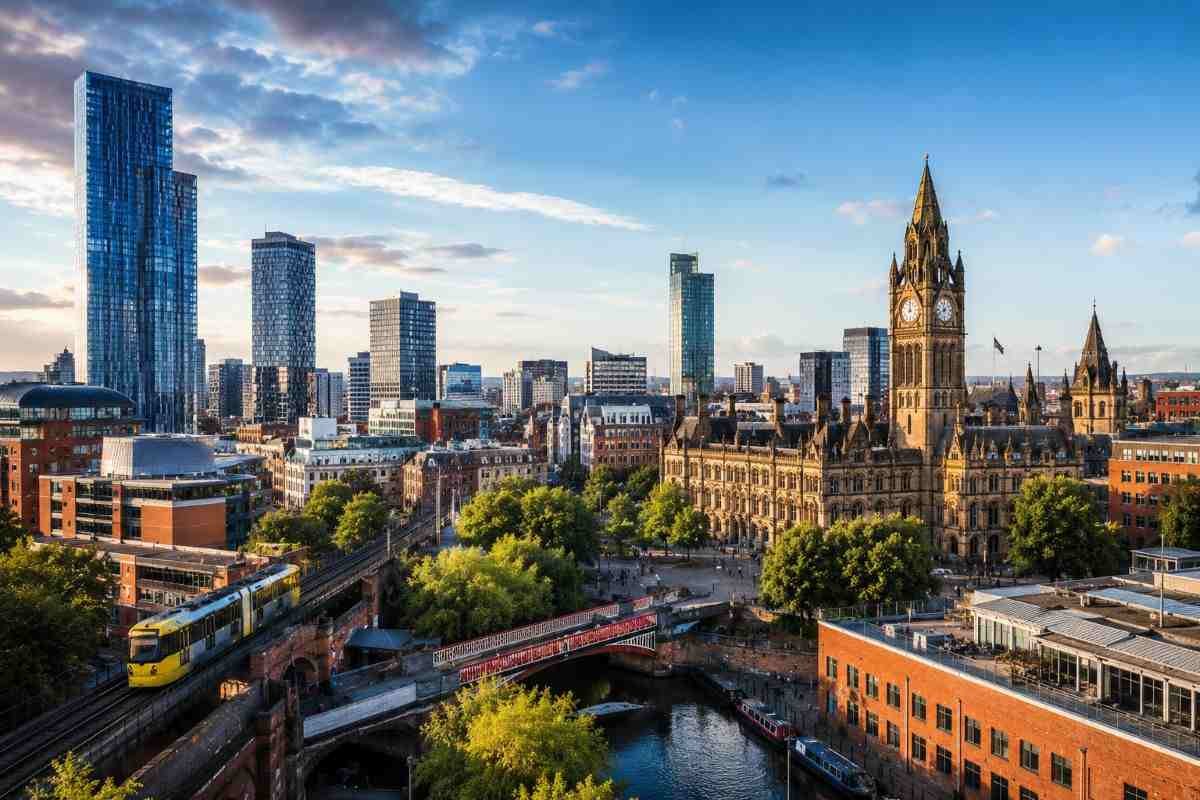
Manchester has become one of the UK’s most desirable cities to call home. Strong employment opportunities, excellent universities, major transport links and a thriving cultural scene continue to attract young professionals, families, students and retirees from across Britain and overseas.
Choosing where to settle, however, is rarely straightforward. Every neighbourhood offers something different. Some areas are known for period homes and highly regarded schools, while others appeal for their independent cafés, green spaces or easy commute into the city centre. Budget also plays a significant role, with property prices varying considerably between districts.
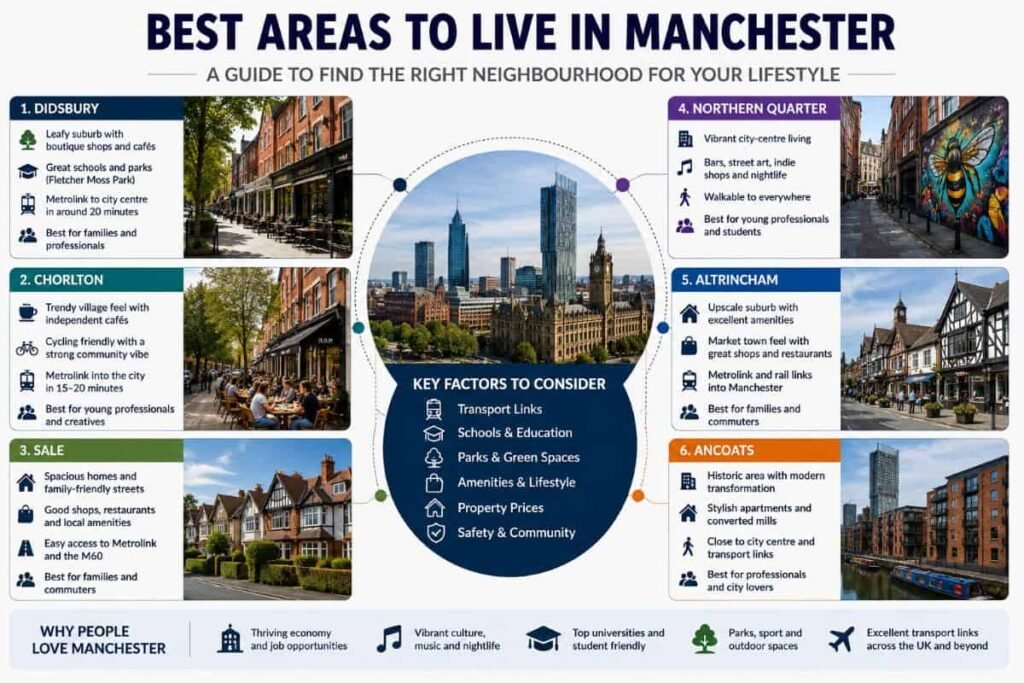
This guide explores the best areas to live in Manchester, looking beyond house prices alone. You’ll find practical information on transport, community feel, local amenities and the type of resident each neighbourhood tends to suit. Rather than ranking areas simply by popularity, the aim is to help you identify the part of Manchester that best matches your lifestyle and priorities.
Quick Summary
| Area | Best For | Property Character | Transport |
| Didsbury | Families & professionals | Victorian terraces, detached homes, apartments | Metrolink, buses |
| Chorlton | Young professionals | Period terraces, modern flats | Metrolink, cycling |
| Sale | Families | Semi-detached homes, new developments | Metrolink, M60 access |
| Altrincham | Families & commuters | Detached homes, townhouses | Metrolink, rail |
| Northern Quarter | City living | Apartments, converted warehouses | Walkable, trams |
| Ancoats | Professionals | Modern apartments, mills | Walking, Metrolink |
| Prestwich | Families | Traditional family homes | Tram, road links |
| Castlefield | Professionals | Waterside apartments | Walkable, tram |
What Makes a Good Place to Live in Manchester?
There is no single “best” neighbourhood for everyone. The right choice depends on your priorities, daily routine and long-term plans.
When comparing Manchester neighbourhoods, consider:
- Journey time to work
- Public transport options
- Access to parks and open spaces
- Local schools
- Shopping and healthcare
- Property prices and rental costs
- Crime levels
- Community atmosphere
- Future regeneration plans
Someone working in the city centre may value quick tram access above all else, while a growing family may prioritise larger homes and well-performing schools.
Manchester also benefits from one of the UK’s largest Metrolink tram networks, making many suburbs convenient even without a car.
Manchester at a Glance
Before choosing a neighbourhood, it helps to understand the city’s layout.
Manchester city centre consists of districts including:
- Northern Quarter
- Ancoats
- Castlefield
- Deansgate
- Spinningfields
Outside the centre are established suburbs spread across Greater Manchester, including Trafford, Stockport, Salford, Bury and beyond. Many of these areas offer quieter residential streets while remaining within a 20–40 minute commute.
One reason Manchester consistently attracts new residents is its balance between urban convenience and suburban living. Excellent rail connections, multiple motorways and Manchester Airport also make travel around the UK and internationally relatively straightforward.
Best Areas to Live in Manchester
Didsbury
Few neighbourhoods appear on as many “best places to live” lists as Didsbury, and for good reason.
Located around five miles south of the city centre, Didsbury combines leafy streets, attractive Victorian architecture and a thriving independent high street with reliable transport links.
The area is often divided into:
- West Didsbury
- East Didsbury
- Didsbury Village
Each has its own character, although all enjoy easy access to cafés, restaurants, supermarkets and green spaces.
Why people choose Didsbury
- Excellent selection of cafés and independent shops
- Good access to Fletcher Moss Park
- Metrolink connections
- Popular with professionals
- Highly regarded schools nearby
- Strong sense of community
Housing ranges from converted Victorian apartments to substantial detached homes, making Didsbury suitable for buyers with different budgets.
The popularity of the area means property prices tend to sit above the Manchester average, but demand has remained consistently strong.
Best suited for:
- Families
- Professionals
- Couples
- Long-term homeowners
Chorlton
Chorlton has developed a reputation as one of Manchester’s most characterful suburbs.
Its independent businesses, weekend markets and relaxed atmosphere attract people looking for an alternative to city-centre living without sacrificing convenience.
The area retains much of its original Victorian housing stock while adding carefully designed apartment developments in recent years.
Highlights
- Independent cafés
- Local restaurants
- Chorlton Water Park nearby
- Excellent cycling routes
- Metrolink access
- Active local community
Residents often describe Chorlton as having a village feel despite being only a short journey from central Manchester.
Green space is another major advantage, with nearby parks making the area especially attractive for dog owners and families with young children.
Best suited for:
- Young professionals
- Families
- Creative industries
- Remote workers
Pros and Cons
| Pros | Cons |
| Excellent community feel | Higher property prices |
| Great cafés and restaurants | Parking can be limited |
| Strong transport links | Popular rental market |
| Plenty of parks | Busy at weekends |
Sale
Situated within the Metropolitan Borough of Trafford, Sale has become one of the most sought-after commuter towns in Greater Manchester.
Its appeal lies in offering more space than many inner-city neighbourhoods while remaining well connected via both road and tram.
Sale combines established residential streets with modern developments, attracting buyers at different stages of life.
Why Sale remains popular
- Trafford schools
- Bridgewater Canal
- Walkable town centre
- Metrolink station
- Easy access to the M60
- Wide range of supermarkets and local shops
Families particularly appreciate the area’s parks, sports facilities and community events throughout the year.
Property choices include:
- Edwardian homes
- Semi-detached houses
- New-build developments
- Apartments for first-time buyers
Best suited for:
- Families
- Commuters
- First-time buyers
- Professionals seeking more space
Altrincham
Frequently recognised as one of the most desirable places to live in the North West, Altrincham blends a thriving market town atmosphere with excellent commuter connections.
Located roughly eight miles south-west of Manchester city centre, it offers an attractive balance between independent retail, green space and high-performing schools.
The award-winning market has become a destination in its own right, drawing visitors from across Greater Manchester.
What makes Altrincham stand out?
- Attractive town centre
- Well-established independent businesses
- Extensive dining options
- Excellent schools
- Metrolink and rail services
- Access to Dunham Massey nearby
Housing ranges from stylish apartments close to the centre to substantial detached family homes in quieter residential roads.
Demand remains consistently high, particularly among families relocating from other parts of the UK.
Pros and Cons
| Pros | Cons |
| Excellent schools | Higher house prices |
| Strong transport links | Competitive housing market |
| Attractive town centre | Busy during weekends |
| Good long-term investment | Premium property values |
Best suited for:
- Families
- Senior professionals
- London commuters relocating north
- Buyers seeking long-term value
Northern Quarter
For those who prefer city-centre living, the Northern Quarter remains one of Manchester’s most recognisable neighbourhoods.
Former warehouses have been transformed into apartments, creative workspaces, cafés, independent shops and music venues, giving the district a distinctive identity.
Living here means having many of Manchester’s attractions within walking distance.
Lifestyle
Residents enjoy easy access to:
- Independent coffee shops
- Boutique retailers
- Live music venues
- Art galleries
- Restaurants
- Co-working spaces
The housing stock is dominated by:
- Warehouse conversions
- Modern apartment blocks
- Loft-style developments
Parking can be limited, but many residents rely on walking, cycling or public transport instead.
Best suited for
- Young professionals
- Graduates
- City workers
- Investors
- Those wanting an urban lifestyle
Ancoats
Once at the heart of Manchester’s industrial revolution, Ancoats has evolved into one of the city’s most desirable places to live. Former cotton mills now sit alongside contemporary apartment developments, while canals, independent cafés and restaurants have helped create a neighbourhood that attracts professionals from across the region.
Despite its transformation, Ancoats has retained much of its industrial heritage, with many historic buildings carefully restored rather than replaced.
Why choose Ancoats?
- Walking distance to Manchester city centre
- Attractive canal-side setting
- Converted mill apartments and modern developments
- Excellent restaurants and cafés
- Strong cycling and walking routes
- Close to Manchester Piccadilly station
The area’s popularity has increased demand for both rental and owner-occupied properties, making it one of Manchester’s more competitive housing markets.
Best suited for:
- Young professionals
- Couples
- First-time buyers
- City centre commuters
Pros and Cons
| Pros | Cons |
| Walkable location | Premium apartment prices |
| Modern developments | Limited family housing |
| Excellent food scene | Busy during evenings |
| Strong investment potential | Parking may be restricted |
Prestwich
Located north of Manchester city centre within the Metropolitan Borough of Bury, Prestwich has steadily become one of Greater Manchester’s most popular residential areas.
Its appeal comes from a combination of traditional housing, expanding independent businesses and easy access to green space.
One of the area’s biggest attractions is Heaton Park, one of the largest municipal parks in Europe, offering woodland walks, lakes, sports facilities and seasonal events.
What residents appreciate
- Heaton Park nearby
- Metrolink connections
- Independent cafés and bakeries
- Good selection of local schools
- Established residential neighbourhoods
- Strong community atmosphere
Property options include Victorian terraces, semi-detached homes and larger detached properties on quieter roads.
Best suited for:
- Families
- Professionals
- Dog owners
- Buyers seeking more space
Castlefield
Castlefield combines modern city living with one of Manchester’s oldest historic districts.
The area is recognised for its canals, converted warehouses and Roman heritage, offering a quieter alternative to the busy commercial core while remaining within walking distance of Deansgate and Spinningfields.
Many apartment developments overlook the canal network, creating a distinctive waterside setting rarely found in city centres.
Key advantages
- Attractive canal walks
- Close to Deansgate railway station
- Walking distance to offices
- Historic surroundings
- Restaurants and bars nearby
- Well-connected by Metrolink
Castlefield particularly appeals to buyers looking for a calmer city-centre environment without giving up the convenience of central Manchester.
Best suited for:
- Professionals
- Couples
- Downsizers
- Investors
Salford Quays
Although technically located within the City of Salford, Salford Quays forms part of Greater Manchester’s wider urban area and remains one of the region’s most sought-after waterfront neighbourhoods.
The regeneration of the former docklands has transformed the area into a major residential, cultural and business destination.
Key landmarks include:
- MediaCity
- The Lowry
- Imperial War Museum North
Excellent tram services make commuting into central Manchester straightforward.
Why Salford Quays appeals
- Waterfront apartments
- Modern developments
- Strong employment opportunities
- Excellent transport links
- Walking and cycling routes
- Cultural attractions
While apartments dominate the housing market, nearby residential districts provide more traditional family homes.
Best suited for:
- Media professionals
- Young professionals
- Investors
- Couples
Withington
Situated between Fallowfield and Didsbury, Withington offers a more affordable alternative to some of south Manchester’s better-known suburbs.
Its mix of students, young professionals and long-term residents gives the area a varied character.
Independent businesses continue to grow along Wilmslow Road, while regular bus services provide easy access to the city centre.
Why consider Withington?
- Lower property prices than neighbouring Didsbury
- Good public transport
- Growing café scene
- Access to nearby parks
- Variety of housing options
Housing includes Victorian terraces, converted flats and family homes.
Best suited for:
- First-time buyers
- Graduates
- Young professionals
- Small families
Heaton Moor
Located within the Metropolitan Borough of Stockport, Heaton Moor regularly features among Greater Manchester’s most desirable suburbs.
Its tree-lined streets, independent businesses and attractive period properties have helped create a strong reputation among families and professionals alike.
Highlights
- Characterful Victorian homes
- Independent restaurants
- Parks and green spaces
- Railway connections to Manchester
- Established community feel
Demand remains consistently high, particularly for larger family homes.
Best suited for:
- Families
- Professionals
- Long-term homeowners
Comparing Manchester’s Most Popular Neighbourhoods
| Area | Best For | Property Prices | Green Space | Nightlife | Family Friendly |
| Didsbury | Families | High | Excellent | Good | Excellent |
| Chorlton | Professionals | High | Excellent | Good | Excellent |
| Sale | Families | Medium-High | Excellent | Moderate | Excellent |
| Altrincham | Families | High | Excellent | Moderate | Excellent |
| Northern Quarter | Professionals | High | Limited | Excellent | Moderate |
| Ancoats | Professionals | High | Moderate | Excellent | Moderate |
| Prestwich | Families | Medium | Excellent | Moderate | Excellent |
| Castlefield | Professionals | High | Moderate | Good | Moderate |
| Salford Quays | Professionals | Medium-High | Good | Good | Good |
| Withington | First-time buyers | Medium | Good | Moderate | Good |
| Heaton Moor | Families | Medium-High | Excellent | Moderate | Excellent |
How to Choose the Right Area
No neighbourhood suits everyone. Before making a decision, think about how you expect to use your local area over the next five to ten years.
Ask yourself:
- How often will you commute into Manchester city centre?
- Do you need quick access to rail or Metrolink services?
- Are good schools a priority?
- Would you prefer a house with a garden or a city apartment?
- Is access to parks important?
- Will you mainly walk, cycle or drive?
- Are you buying for the long term or looking for investment potential?
Visiting an area at different times of the day can also provide a clearer picture of traffic, parking, noise levels and the general atmosphere.
Understanding Property Costs
Property values vary considerably across Greater Manchester, even between neighbouring districts.
Several factors influence prices:
- Proximity to the city centre
- Access to Metrolink and railway stations
- School catchment areas
- Availability of period homes
- Regeneration projects
- Local amenities
It’s also worth factoring in ongoing costs such as council tax, parking permits, service charges for apartments and commuting expenses when setting your budget.
Schools and Education
For families, school catchment areas often play a major role in deciding where to live.
Neighbourhoods including Didsbury, Sale, Altrincham and parts of Trafford are well known for their mix of highly regarded state and independent schools. Admission policies and catchment boundaries can change, so it’s advisable to check directly with the relevant local authority or school before purchasing a property.
If you’re moving with older children or planning for higher education, Manchester is also home to leading institutions including the University of Manchester, Manchester Metropolitan University and the Royal Northern College of Music, making many neighbourhoods popular with academics and university staff.
Getting Around Manchester
One of Manchester’s biggest strengths is its transport network.
Residents can choose from:
- Metrolink tram services connecting many suburbs
- National Rail services across Greater Manchester and beyond
- Extensive bus routes
- Cycle lanes in many districts
- Major road links including the M60, M56 and M62
- Manchester Airport, offering domestic and international flights
For commuters, journey times can vary significantly depending on where you live, so it’s worth testing your route during peak travel hours before committing to a purchase or tenancy.
Pros and Cons of Living in Manchester
| Advantages | Considerations |
| Strong employment market | House prices have risen in many popular areas |
| Excellent universities | Traffic can be busy during peak hours |
| Extensive public transport | Some neighbourhoods are highly competitive |
| Diverse cultural attractions | Parking is limited in parts of the city centre |
| Good choice of housing | Rental demand remains high |
| Access to parks and countryside | Prices vary significantly between districts |
Quick Recommendations by Lifestyle
| If you’re looking for… | Consider |
| Best for families | Didsbury, Sale, Altrincham, Heaton Moor |
| Best for young professionals | Ancoats, Northern Quarter, Castlefield |
| Best value | Withington, Prestwich |
| Best commuter location | Sale, Altrincham, Didsbury |
| Best nightlife | Northern Quarter, Ancoats |
| Best green spaces | Prestwich, Didsbury, Chorlton |
Manchester offers a wide variety of neighbourhoods, each with its own strengths. Whether you’re seeking a lively urban lifestyle, a quieter suburb with excellent schools or a well-connected commuter area, taking the time to compare locations against your priorities will help you make a more informed choice.
Frequently Asked Questions
1. What is the best area to live in Manchester?
There isn’t a single best area—it depends on your priorities.
For families, Didsbury, Altrincham and Sale are consistently popular because of their schools, green spaces and transport links. Young professionals often prefer Ancoats, the Northern Quarter or Castlefield for their proximity to the city centre, while Prestwich and Withington offer a balance of affordability and community.
2. Which part of Manchester is best for families?
Didsbury, Sale, Altrincham and Heaton Moor are among the strongest choices.
These areas offer a combination of family housing, parks, leisure facilities and well-regarded schools. They also have good public transport connections, making commuting into Manchester city centre relatively straightforward.
3. Where do young professionals choose to live in Manchester?
Ancoats, the Northern Quarter and Castlefield are popular with young professionals.
These neighbourhoods are close to major employment hubs and offer a wide choice of cafés, restaurants, bars and apartments. Walking or cycling to work is possible for many residents.
4. Which Manchester areas are generally more affordable?
Withington, Prestwich and parts of Salford often provide better value than the city’s premium neighbourhoods.
Affordability varies according to property type and market conditions, so it’s worth comparing several locations before making a decision.
5. Is Manchester a good city for commuters?
Yes. Manchester has one of the UK’s best public transport networks outside London.
The Metrolink tram system, National Rail services, extensive bus routes and motorway connections make commuting practical from many surrounding towns and suburbs.
6. Which Manchester neighbourhoods have the most green space?
Prestwich, Chorlton and Didsbury stand out for access to parks.
Residents can enjoy locations such as Heaton Park, Fletcher Moss Botanical Garden, Chorlton Water Park and numerous local parks and riverside walks.
7. Is it better to live in Manchester city centre or the suburbs?
It depends on your lifestyle.
City-centre living suits those who value convenience, nightlife and a short commute, while the suburbs generally provide larger homes, quieter streets and more outdoor space. Families often favour suburban neighbourhoods, whereas professionals may prefer central districts.
8. Which areas have the best transport links?
Didsbury, Sale, Altrincham, Castlefield and Salford Quays all benefit from excellent public transport.
Many are served by Metrolink trams, while others have direct rail services and convenient road access.
9. Is Manchester a good place to buy property?
Manchester continues to attract buyers because of its strong economy and diverse housing market.
The city offers everything from converted warehouse apartments to Victorian terraces and detached family homes. Buyers should consider local market conditions, commuting needs and long-term affordability before purchasing.
Editorial Wrap-Up
Finding the best areas to live in Manchester comes down to matching a neighbourhood with your lifestyle, budget and long-term plans rather than chasing a single “best” postcode.
If you’re raising a family, places such as Didsbury, Sale, Altrincham and Heaton Moor offer established communities, good transport links and access to parks. Those looking for a city-centre lifestyle may feel more at home in Ancoats, the Northern Quarter or Castlefield, where apartments, independent businesses and cultural venues are all within easy reach. Buyers seeking a balance between affordability and convenience should also consider areas such as Prestwich and Withington.
Before making a decision, spend time exploring your shortlisted neighbourhoods at different times of the week, compare commuting options, check local school catchments if relevant, and review recent property market data. A little extra research can make a significant difference when choosing a place to call home.
If you’re relocating or planning your next move, you may also find it useful to explore related guides on commuting, property buying, local amenities and neighbourhood profiles to build a fuller picture of life in Greater Manchester.