Luxury shopping in London is often associated with one name above all others: Mayfair’s Bond Street. But if you want more than a row of designer boutiques, choosing where to base a shopping day can make a considerable difference.
Soho sits at the centre of London’s West End, bordered by Oxford Street, Regent Street, Chinatown and Charing Cross Road. That position puts some of the capital’s most important retail districts within a manageable walk, while Soho itself offers independent shops, specialist retailers, restaurants, cafés, theatres and a distinctive collection of historic streets.
That makes Luxury Shopping Near Soho less about finding every luxury label on a single street and more about having several different retail experiences close together.
From Soho, shoppers can move towards Regent Street and Carnaby for major brands and distinctive retail concepts, continue towards Mayfair and Bond Street for established luxury houses and fine jewellery, or head towards Oxford Street for flagship stores and department-store shopping. Covent Garden, Leicester Square and Piccadilly Circus are also within walking distance.
For visitors who want designer fashion, jewellery, beauty, premium gifts and good places to stop for lunch or coffee without spending the entire day in one retail district, Soho offers a particularly useful starting point.
What makes Soho a good base for luxury shopping?
The simplest answer is location.
Soho is compact enough to explore on foot, yet it sits between several of London’s major shopping areas. Visit London describes the neighbourhood as covering roughly 2.6 square kilometres, with Oxford Street, Regent Street, Chinatown and Charing Cross Road forming its main boundaries.
That geography matters because luxury retail in central London is not concentrated in one place.
A shopper starting in Soho can build a route around several different retail environments:
| Area | Best suited to | Character |
| Soho | Independent shops, specialist retail, fashion and lifestyle | Creative, mixed and informal |
| Carnaby | Fashion, independent retailers and contemporary brands | Pedestrianised and design-led |
| Regent Street | Flagship fashion and established international brands | Grand architecture and major stores |
| Oxford Street | Department stores and major high-street flagships | Large-scale retail |
| Bond Street & Mayfair | Luxury fashion, jewellery and watches | High-end and traditionally prestigious |
| Covent Garden | Fashion, beauty, lifestyle and speciality shopping | Leisure-led and pedestrian-friendly |
This variety is one of Soho’s strongest advantages.
A luxury shopping trip does not have to mean spending six hours visiting only designer boutiques. You may want to compare a premium fashion collection with independent brands, browse jewellery, stop for lunch, look at beauty products and finish with a theatre show.
Soho makes that kind of itinerary practical.
Luxury shopping near Soho: where should you go?
The phrase “luxury shopping near Soho” covers a surprisingly large part of London’s West End.
The most useful way to understand it is to think in terms of shopping zones rather than individual streets.
1. Regent Street: the natural first stop
Regent Street is one of the most obvious places to begin a higher-end shopping route from Soho.
The street’s grand architectural setting is part of the experience. The current Regent Street organisation notes that the street was developed in the early 19th century under architect John Nash, with its distinctive Grade II-listed façades forming one of London’s best-known architectural sequences.
Retail here ranges from luxury fashion to beauty, lifestyle and specialist flagship stores.
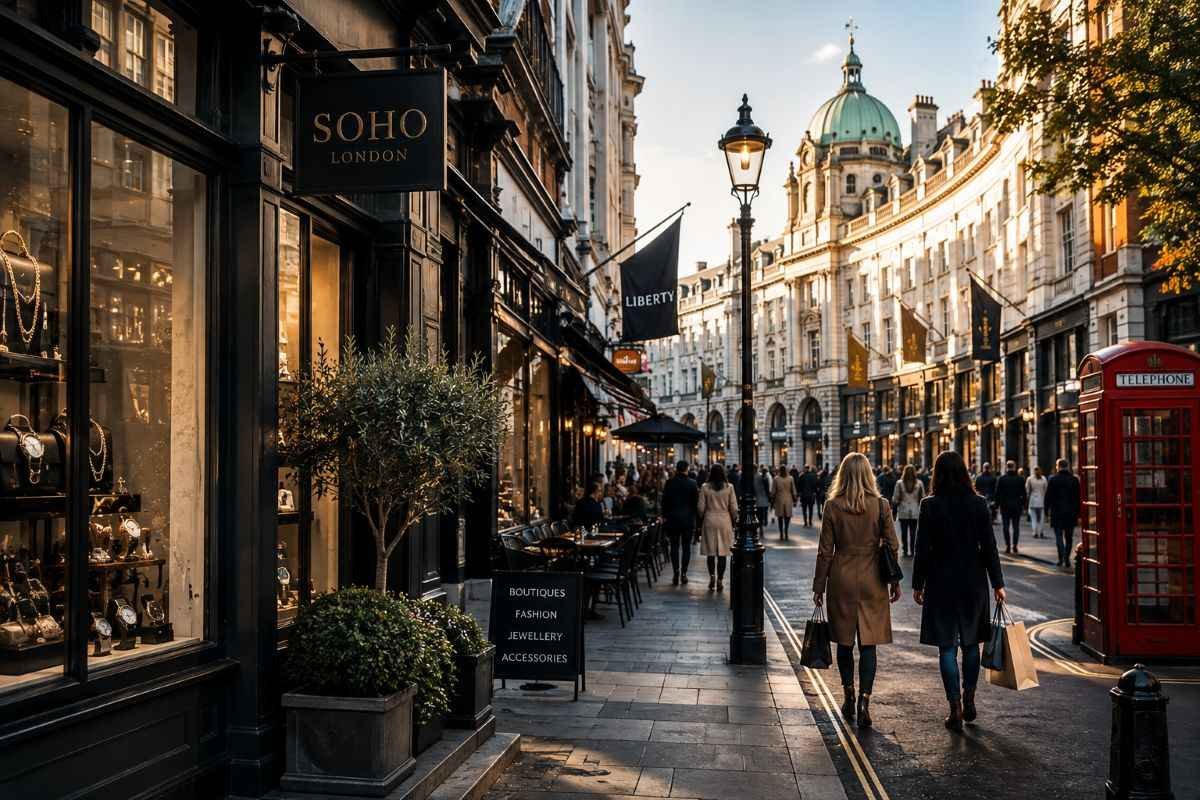
The area also includes Liberty London, the historic department store at 208–222 Regent Street. Its current retail offer spans fashion, beauty, homeware and fabrics across six floors.
For shoppers interested in British heritage and premium goods, Liberty adds something different from the conventional designer-store experience.
Regent Street is also useful because it connects naturally with other parts of the West End. Walk south towards Piccadilly Circus or north towards Oxford Circus, and you can continue your shopping without needing another Tube journey.
2. Carnaby: luxury with a more independent feel
Carnaby is technically within Soho and is particularly useful for shoppers who prefer a mixture of recognisable brands, independent retailers and smaller fashion concepts.
Visit London describes Carnaby as a collection of 14 streets with shops, restaurants and pedestrianised areas, while the official Carnaby information highlights its combination of global brands, concept stores and independent boutiques.
This makes Carnaby a useful contrast to Bond Street.
The shopping experience feels less formal and more exploratory. You can browse Carnaby Street, then continue through the surrounding streets and Newburgh Quarter rather than following one conventional luxury-shopping strip.
It is particularly useful for people who are interested in fashion but do not want their entire day centred on traditional luxury houses.
3. Bond Street and Mayfair: the destination for traditional luxury
For the most concentrated luxury-shopping experience close to Soho, walk west towards Mayfair and Bond Street.
Bond Street is firmly established as one of London’s principal luxury destinations. Visit London lists major fashion houses, jewellery retailers, specialist luxury brands and auction houses in and around the street.
This is where shoppers are more likely to find the traditional luxury categories:
- Designer fashion
- Fine jewellery
- Luxury watches
- Premium leather goods
- High-end accessories
- Bespoke and specialist services
- Art and auction houses
The character is also different from Soho. Bond Street is more formal and polished, while Soho is more mixed and informal.
That difference is precisely why the two work well together.
You can spend part of the day browsing Soho and Regent Street before moving into Mayfair when you want a more concentrated luxury experience.
4. Oxford Street: flagship retail and department stores
Oxford Street is not exclusively a luxury destination, but it remains an important part of shopping in Soho London because of its scale.
Visit London describes Oxford Street as home to more than 300 stores, including flagship stores and major department stores.
For a shopper, that means choice.
Oxford Street can be particularly useful when members of a shopping group have different budgets or interests. One person may be looking for premium fashion while another wants beauty products, electronics or mainstream brands.
It also gives shoppers access to major department-store environments where several categories can be compared under one roof.
For that reason, it works best as part of a wider West End shopping route rather than as the sole destination for a luxury-focused day.
Why Soho works better than a single luxury shopping district
There is a temptation to assume that the best luxury shopping experience must happen in the most expensive-looking part of London.
That is not necessarily true.
A good shopping base needs more than expensive shops. It needs choice, accessibility, places to eat, things to do and easy connections to neighbouring areas.
Soho provides those elements.
A wider range of shopping styles
Soho itself includes fashion, jewellery, specialist shops, food retailers, music-related businesses and other independent stores. Visit London’s current shopping listings show the area covering categories from clothes and jewellery to food, music and specialist retail.
That gives shoppers a chance to move between established brands and smaller retailers.
For someone interested in luxury, this can be valuable. The most memorable purchase is not necessarily the most expensive one.
A well-designed independent shop or specialist retailer can offer something that a global flagship cannot.
You can build a flexible itinerary
Starting in Soho means you do not have to commit to one shopping district.
A simple route could look like:
Soho → Carnaby → Regent Street → Mayfair/Bond Street → Soho
Another option is:
Tottenham Court Road → Soho → Carnaby → Oxford Circus → Regent Street → Mayfair
The exact route will depend on the stores you want to visit, but the principle is straightforward: use Soho as the centre of the day rather than treating it as an isolated shopping destination.
Food and leisure are close by
Shopping for several hours is tiring, particularly when carrying bags or trying on clothes.
Soho’s restaurants, cafés, bars and entertainment venues make it easier to take breaks without leaving the central West End.
Carnaby alone has restaurants and cafés spread across its streets, while the wider Soho area offers a large selection of dining and entertainment options.
This matters for luxury shopping because the experience can be structured around the whole day rather than simply the transaction.
A late breakfast, several hours of shopping, lunch in Soho, an afternoon around Mayfair and an evening theatre performance is entirely realistic from this location.
Soho versus Bond Street: which is better for luxury shopping?
The answer depends on what you mean by luxury.
If you want the highest concentration of traditional luxury brands, Bond Street and Mayfair have the advantage.
If you want variety and the ability to combine luxury with independent shopping, food and entertainment, Soho has the advantage.
| Feature | Soho | Bond Street/Mayfair |
| Luxury fashion | Good nearby | Excellent |
| Fine jewellery | Good nearby | Excellent |
| Independent shops | Excellent | More limited |
| Major flagships | Excellent nearby | Excellent |
| Dining choice | Excellent | Excellent |
| Street atmosphere | Informal and mixed | Polished and formal |
| Variety of budgets | Excellent | More luxury-focused |
| Walking access to other districts | Excellent | Excellent |
| Best for | Full-day West End shopping | Dedicated luxury shopping |
The important point is that these are not competing destinations in practical terms.
They are close enough to combine.
The streets worth exploring around Soho
The main shopping streets are only part of the attraction.
Soho’s identity comes from its network of smaller streets and historic routes. Westminster City Council identifies streets including Greek Street, Frith Street, Dean Street, Wardour Street, Berwick Street, Broadwick Street, Beak Street, Great Marlborough Street, Brewer Street and others as part of Soho.
Carnaby Street and surrounding streets
Carnaby is particularly useful for fashion and lifestyle shopping.
Do not stop at the main street. The surrounding pedestrianised areas and smaller streets provide a broader selection of shops, restaurants and cafés.
Berwick Street
Berwick Street provides a different experience from the large West End thoroughfares.
It is known for its market and independent retail environment, making it a useful diversion for shoppers who want something less conventional.
Brewer Street and Beak Street
These streets help connect Soho with the retail areas around Regent Street and Mayfair.
They are useful when creating a walking route because you can move gradually between different retail environments rather than making a series of separate journeys.
Dean Street, Frith Street and Greek Street
These are among Soho’s historic north-south routes.
Westminster’s heritage assessment notes the survival of historic Georgian and Victorian buildings along these streets, giving the area much of its distinctive character.
For visitors, this means the journey between shops can itself be part of the London experience.
How easy is Soho to reach?
Transport is another reason Soho works well as a shopping base.
Tottenham Court Road
Tottenham Court Road is particularly useful for the northern side of Soho.
TfL confirms that the station is served by the Central, Northern and Elizabeth lines.
This makes it a valuable arrival point for shoppers coming from different parts of London.
Oxford Circus
Oxford Circus connects the Bakerloo, Central and Victoria lines, according to TfL.
It is especially convenient for Carnaby, Regent Street and the northern part of Soho.
Leicester Square
Leicester Square is served by the Northern and Piccadilly lines, making it useful for the southern side of Soho and for visitors continuing towards Covent Garden or the West End theatres.
Piccadilly Circus
Piccadilly Circus provides another useful access point, particularly for the southern end of Regent Street and the western side of Soho.
The exact best station depends on your starting point and destination, so checking TfL before travelling is sensible, particularly when planned engineering works or temporary closures affect the network.
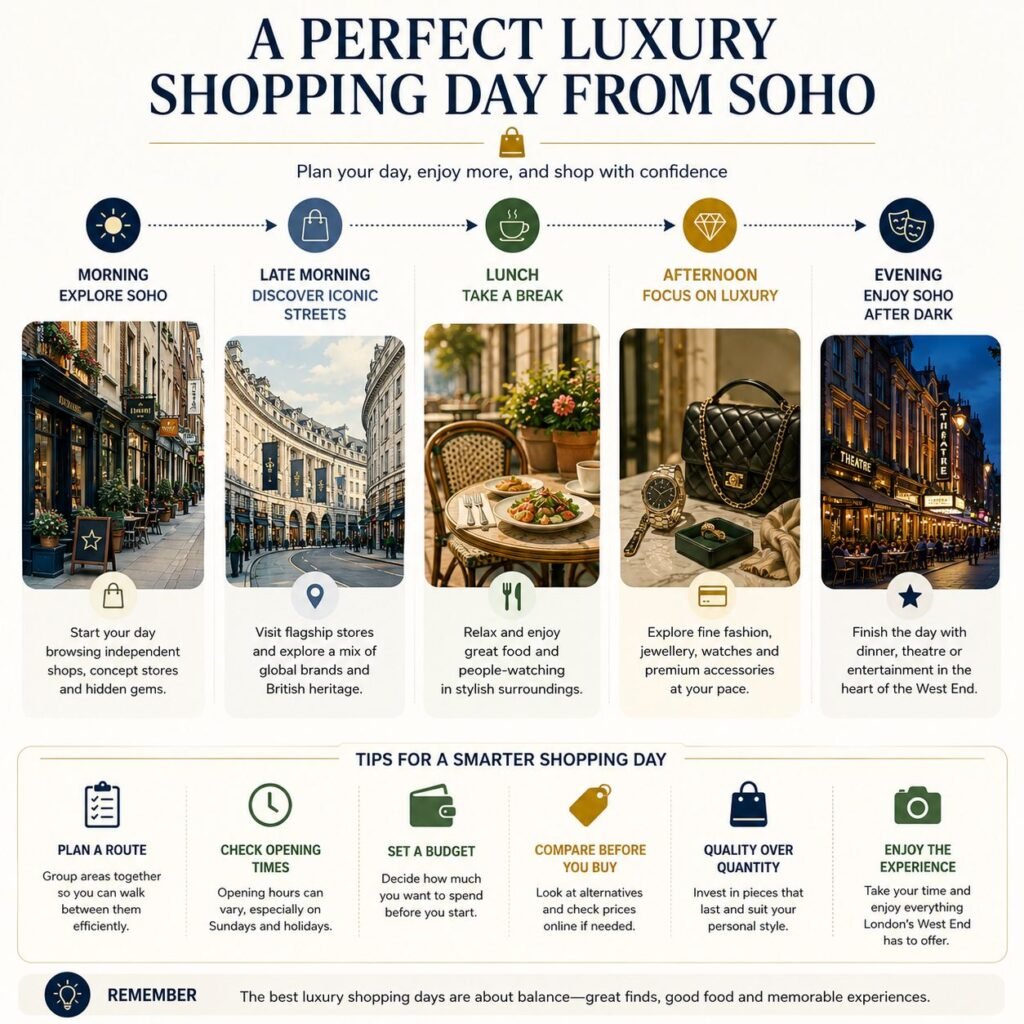
A practical luxury shopping itinerary from Soho
If you have one day and want to combine luxury retail with the wider West End, avoid trying to visit every street.
A more comfortable itinerary is:
Morning: start in Soho
Begin around Soho and explore smaller retailers before the busiest part of the day.
Carnaby is a sensible first area because it connects directly with Regent Street and offers a mixture of independent and international brands.
Allow time to browse rather than simply walking from one shop to the next.
Late morning: Regent Street
Move towards Regent Street and focus on the flagship stores that match your shopping list.
Liberty is particularly worthwhile if you are interested in British design, fashion, beauty, fabrics and homeware rather than a single designer category.
Lunch: return to Soho or stay around Regent Street
Choose somewhere convenient rather than planning a long cross-London journey.
Soho’s central position means there is little reason to leave the West End simply to find somewhere to eat.
Afternoon: Mayfair and Bond Street
Use the afternoon for the more concentrated luxury experience.
This is the point to focus on designer fashion, jewellery, watches, leather goods and specialist services.
Bond Street’s luxury offer includes fashion houses, jewellers and specialist retailers, while the surrounding Mayfair streets provide further high-end shopping and hospitality.
Early evening: return to Soho
Head back towards Soho for dinner or entertainment.
If shopping has been the main purpose of the day, this final leg allows you to step away from the retail environment before deciding whether to continue into the West End’s evening entertainment.
Tips for making a luxury shopping trip around Soho easier
Make a shortlist before leaving
Central London has too many shops to browse efficiently without some idea of what you want.
Divide your list into categories:
- Fashion
- Jewellery
- Watches
- Beauty
- Accessories
- Homeware
- Gifts
- Independent designers
Then identify which area is most likely to meet each requirement.
Wear comfortable shoes
This sounds obvious, but it matters.
Soho, Carnaby, Regent Street and Mayfair are best experienced on foot. TfL’s walking map also illustrates the short walking connections between several central London stations, including Oxford Circus, Bond Street, Tottenham Court Road and Piccadilly Circus.
A shopping itinerary can involve considerably more walking than expected.
Check individual retailers before travelling
Opening hours vary by retailer and can change around Sundays, public holidays and special events.
Even major shopping streets have different schedules between individual stores. Check the retailer’s own website before making a special journey.
Leave room for independent shops
A luxury itinerary becomes repetitive if every stop is another international brand.
Soho is at its best when you mix established names with smaller specialist retailers and independent businesses.
Consider weekday mornings
If you want a calmer experience, starting earlier on a weekday can make browsing easier.
Carnaby, for example, can become busier during afternoons and weekends, according to Visit London’s current area guidance.
Plan around your bags
If you are buying several items, think about where you want to finish.
It is much easier to carry shopping bags for a short distance than across several additional neighbourhoods.
For particularly expensive purchases, ask the retailer about collection, delivery or appointment arrangements where available.
Pros and cons of choosing Soho for luxury shopping
Pros
- Excellent central-West End location
- Close to Regent Street and Carnaby
- Easy walking access to Mayfair and Bond Street
- Oxford Street provides additional flagship and department-store choice
- Wide range of restaurants and cafés
- Strong independent retail scene
- Several Underground and Elizabeth line connections nearby
- Easy to combine shopping with theatres, dining and sightseeing
Cons
- Soho itself is not London’s most concentrated luxury district
- Some luxury shopping requires walking into Mayfair
- The area can be busy, particularly at peak times
- Soho’s streets are mixed-use rather than exclusively retail
- Luxury shoppers looking for a quiet, highly formal atmosphere may prefer Mayfair
The final point is worth stressing.
Choosing Soho does not mean choosing Soho instead of London’s luxury districts. It means choosing a location that gives you access to several of them.
Who should choose Soho for a luxury shopping day?
Soho is particularly suitable for:
- First-time London visitors: You can combine shopping with major West End attractions without spending the day travelling between districts.
- Couples and groups: Different shopping interests can be accommodated because Soho sits close to several contrasting retail areas.
- Fashion-conscious shoppers: Carnaby, Regent Street and nearby independent retailers offer a broader mix than a purely luxury-focused itinerary.
- Visitors interested in British design: Regent Street and Liberty provide a useful connection to established British retail heritage.
- Shoppers who value dining and entertainment: Soho’s restaurants, cafés, theatres and nightlife make it easy to build a full day around shopping.
- Luxury shoppers who want flexibility: You can move towards Bond Street when you want high-end designer retail and return to Soho when you want a more informal setting.
Quick summary: why choose Soho?
If you are asking whether Soho is London’s single best luxury-shopping district, the answer is no.
Bond Street and Mayfair are stronger for concentrated luxury retail.
But if the question is why choose Soho for luxury shopping experiences, the answer is more interesting.
Soho gives you a strategic base in the heart of the West End. From there, you can reach Carnaby, Regent Street, Oxford Street, Mayfair, Bond Street, Piccadilly Circus, Leicester Square and Covent Garden on foot or with short public-transport connections.
That combination of accessibility, retail variety, independent businesses, restaurants and entertainment makes Soho particularly useful for a full-day London shopping itinerary.
The best approach is to treat Soho as your starting point, rather than limiting yourself to its boundaries.
FAQ
Is Soho good for luxury shopping?
Yes. Soho is a good base for luxury shopping because it is close to Regent Street, Carnaby, Oxford Street, Mayfair and Bond Street. Soho itself has a more mixed retail character, while Bond Street provides the most concentrated luxury offer nearby.
Where is the best luxury shopping near Soho?
Bond Street and Mayfair are the strongest choices for concentrated luxury fashion, jewellery and premium accessories. Regent Street is another major option, particularly for flagship stores and established brands.
Is Carnaby Street in Soho?
Yes. Carnaby is part of Soho and consists of Carnaby Street and surrounding streets containing shops, restaurants and other businesses.
Is Bond Street within walking distance of Soho?
Yes. Bond Street and Mayfair are neighbouring central London shopping areas and can be incorporated into a walking itinerary from Soho. The exact walking time depends on the starting point in Soho and destination on Bond Street.
What is the best Tube station for shopping in Soho?
There is no single best station for every itinerary. Tottenham Court Road is useful for the northern part of Soho and has Central, Northern and Elizabeth line services. Oxford Circus is useful for Carnaby and Regent Street, with Bakerloo, Central and Victoria line services. Leicester Square is convenient for the southern side of Soho and connects with the Northern and Piccadilly lines.
Is Soho better than Bond Street for luxury shopping?
It depends on your priorities. Bond Street is better for concentrated traditional luxury retail. Soho is better if you want to combine luxury shopping with independent shops, Carnaby, restaurants, entertainment and other West End shopping areas.
What can you combine with luxury shopping in Soho?
A shopping day can easily include Carnaby, Regent Street, Oxford Street and Mayfair, followed by restaurants or theatre in the West End. Soho’s central position makes it particularly convenient for combining retail with leisure.
Is Soho suitable for independent luxury brands?
Yes. Soho and Carnaby have a mixture of independent shops, concept stores and international brands. This gives shoppers an alternative to the large luxury houses concentrated around Mayfair and Bond Street.
How long should you spend shopping around Soho?
Allow at least half a day for a focused itinerary and a full day if you want to combine Soho, Carnaby, Regent Street and Mayfair. Serious shoppers may want additional time for appointments or specialist purchases.
Here is a polished conclusion that fits the article’s informative, local-editorial tone:
Final Words
Soho is a strong choice for a luxury shopping day because it puts several of London’s best retail destinations within easy reach. From the independent shops of Soho and Carnaby to the flagship stores of Regent Street and the established luxury houses of Mayfair and Bond Street, there is plenty of choice without spending the day travelling across London.
The real advantage is flexibility. You can browse premium fashion, jewellery and beauty retailers, stop for lunch, explore historic streets and finish with dinner or a West End show, all within a relatively compact area.
For Luxury Shopping Near Soho, the smartest approach is to use Soho as your starting point and explore the surrounding districts according to what you want to buy. Check individual retailers before travelling, plan a comfortable walking route and leave some time to explore beyond the major shopping streets. That way, your day becomes about experiencing London’s West End as well as finding the right purchase.