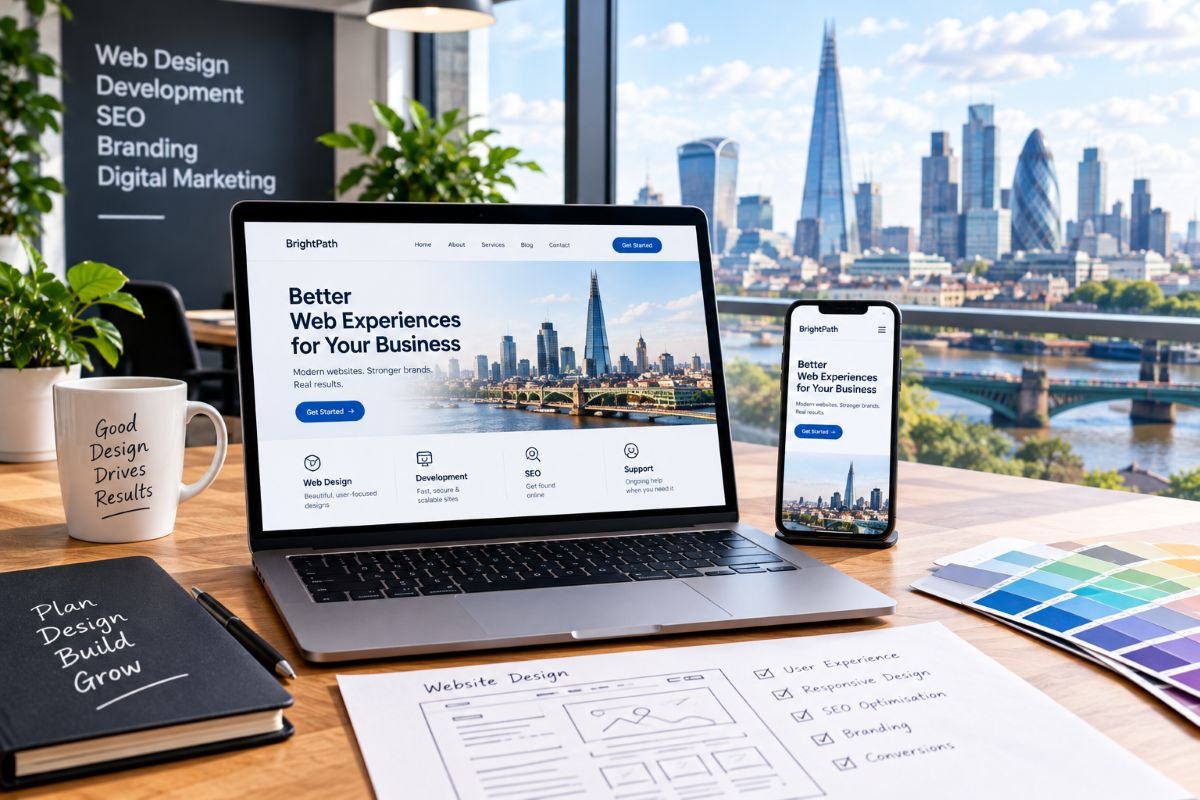
Choosing web designers in London is rarely just about finding someone who can make a website look good. A business website has to explain what you offer, work properly on phones, load efficiently, be easy to navigate, and give visitors a clear reason to get in touch or buy.
London has a large and varied web design market, ranging from small independent studios to established digital agencies that handle UX, branding, development, e-commerce, and SEO. Current industry directories show agencies working across very different budgets, team sizes and specialisms, so comparing them on appearance alone can be misleading.
This guide looks at a selection of established London web design companies and explains what each type of provider may be suited to. It also covers the questions to ask before commissioning a new site, the difference between web design and web development, accessibility, SEO, platforms and ongoing support.
The companies below are presented as a shortlist rather than a definitive ranking. The right choice depends on the type of website you need, your budget, the level of technical complexity, and how much support you want after launch.
What does a web designer do?
A web designer plans and creates the visual and user-facing experience of a website.
That can include:
- Page layouts
- Navigation
- Typography
- Colour and visual hierarchy
- Mobile layouts
- User experience (UX)
- User interface (UI)
- Wireframes and prototypes
- Calls to action
- Content structure
- Design systems
- Website imagery and visual assets
Web design and web development overlap, but they are not the same thing.
Web design is primarily concerned with how a website looks, feels, and works from the user’s perspective. Web development turns that design into a functioning website using technologies such as HTML, CSS, JavaScript, PHP, and content management systems.
Many London agencies provide both services, which can simplify a project by allowing the design and development teams to work together.
For a straightforward business website, you may not need a large digital product studio. For a complex platform, customer portal, or e-commerce operation, however, UX research, interface design, and development expertise can become much more important.
A shortlist of web designers in London
There is no single agency that is right for every business. The following companies illustrate the range of services available in London’s web design market.
| Web design company | London focus | Services particularly relevant to | Notable services |
| CreativeWeb | Central London | Business and organisational websites | Web design, WordPress, UX/UI, SEO, e-commerce |
| First Rate Marketing | City of London | SMEs and growing businesses | Web design, WordPress, branding, SEO |
| Reactive | Soho / W1 | B2B, professional and premium brands | Web design, development, branding, WordPress |
| Browser London | London | Digital products and complex websites | User research, UX/UI, development |
| Creative Navy | London | Digital products and complex user experiences | UX, UI, research, prototyping, web development |
| AGMA Studio | London | Businesses wanting design and digital services together | Web design, development, branding, marketing |
The services and positioning above are based on information published by the companies themselves and current industry directories.
Best Web Designers in London:
CreativeWeb
CreativeWeb is a London-based web design and development agency offering bespoke website work alongside SEO, branding, e-commerce and UX/UI services.
Its published portfolio covers sectors including finance, charity, travel, property, education, law, health and professional services. The agency lists its London address as New Cavendish Street, W1W, and industry listings currently identify it as a London web design provider.
Consider CreativeWeb if: you want web design combined with development and search-related services rather than dealing with several separate suppliers.
First Rate Marketing
First Rate Marketing is based at 100 Bishopsgate in the City of London and provides web design alongside branding, SEO and marketing strategy.
Its website says it works with businesses at different stages and approaches website projects around business objectives, user experience, messaging and performance. It also offers custom WordPress development.
Companies House records show First Rate Marketing Ltd as an active UK private limited company, incorporated in 2019.
Consider First Rate Marketing if: your website project is closely tied to branding, SEO and wider digital marketing.
Reactive
Reactive operates from Poland Street in Soho and provides web design, web development, branding and related digital services. Its published work includes projects for financial, property and professional-sector organisations.
Reactive says it has launched more than 100 brands and websites and has been established for more than 20 years. Those are company-reported figures, so they are best treated as information supplied by the business rather than an independent industry measurement.
Its services include WordPress, e-commerce and web development, making it relevant to businesses that need more than visual design alone.
Consider Reactive if: you want a London studio combining branding, web design and development, particularly for a professional or B2B-focused business.
Browser London
Browser London takes a more UX-led approach to digital design.
The agency says its work combines user research, UX/UI design, front-end development and integrations. Its case studies include work for organisations such as the British Library, Vantage Health and Bahrain International Circuit.
Browser London’s process includes research, journey mapping, prototyping, interface design, development and testing. The company says it has worked in digital product design since 2008.
Consider Browser London if: your project involves a complicated user journey, digital service, application or website where usability research matters as much as visual presentation.
Creative Navy
Creative Navy specialises in UX and UI design for digital products, including web interfaces, mobile experiences and embedded systems. Its published services include user research, UX design, UI design, prototyping, usability testing and web development.
The company says its work has covered 278 clients across 36 countries. Its case-study portfolio includes projects in areas such as healthcare, fintech, cybersecurity and government.
Consider Creative Navy if the project is a digital product or complex web platform where research, interaction design and usability are central requirements.
AGMA Studio
AGMA Studio combines web design with development, branding and digital marketing.
Industry information describes the London-based agency as working across creative design and technical development, giving businesses the option of handling several parts of a digital project through one provider.
Current Clutch listings identify AGMA Studio among London’s web design and development companies, with web design and development forming significant parts of its listed service mix.
Consider AGMA Studio if: you need website design alongside development, branding or digital marketing rather than a design-only service.
How to choose the right web designer in London
The phrase “best web designers” can mean very different things to different businesses.
A sole trader looking for a five-page brochure website has different requirements from a retailer launching a Shopify store or a financial company rebuilding a complex B2B website.
Start by defining the project.
1. Decide what the website needs to achieve
Before contacting agencies, write down the primary purpose of the website.
It might be to:
- Generate enquiries
- Sell products
- Take bookings
- Build brand awareness
- Provide information
- Generate leads
- Support an existing sales team
- Publish editorial content
- Provide online customer service
- Replace an outdated website
This makes agency proposals much easier to compare.
A designer should be able to explain how the proposed structure supports the objective rather than simply showing you attractive layouts.
2. Look beyond the homepage
A polished homepage can hide problems elsewhere.
When reviewing a designer’s portfolio, look at:
- Service pages
- Contact forms
- Mobile navigation
- Blog or editorial sections
- Product pages
- Search functionality
- Calls to action
- Footer navigation
- Accessibility features
- Page-loading behaviour
Ask yourself whether the websites are actually easy to use.
A visually impressive site that makes basic information difficult to find can create more problems than it solves.
3. Check mobile design
A website should be designed for smaller screens rather than simply squeezed into a mobile format at the end of the project.
Ask prospective web designers:
- Is the design mobile-first?
- Will navigation work comfortably on a phone?
- How will images be handled?
- Are forms easy to complete?
- Will buttons remain usable on smaller screens?
- Has the site been tested on different devices?
First Rate Marketing, for example, states that its websites use a mobile-first approach.
What should a London web design project include?
A typical website project may involve several stages.
- Discovery: The designer learns about your business, audience, competitors, and objectives.
- Information architecture: Pages and navigation are planned so visitors can find information efficiently.
- Wireframing: Basic page structures are produced before detailed visual design begins.
- Visual design: Typography, colour, imagery, spacing and interface components are developed.
- Development: The approved designs are built into a functioning website.
- Content: Copy, images, videos, products and other information are added.
- Testing: The website is checked across browsers and devices, with usability, technical, and accessibility issues identified.
- Launch: The website is transferred to its live environment.
- Post-launch support: Maintenance, security, content updates, hosting, analytics, and future improvements may be provided.
Not every agency includes every stage in the same package. Ask for the scope in writing.
Web design and SEO should work together
A website can look excellent and still struggle to attract organic traffic.
SEO considerations should be addressed during planning rather than added after launch.
Important areas include:
- Logical site structure
- Search-friendly URLs
- Page titles
- Meta descriptions
- Heading hierarchy
- Internal links
- Image alt text
- Mobile usability
- Page performance
- Crawlability
- Structured data where appropriate
- Useful, original content
A web designer does not necessarily need to be your SEO specialist, but the two disciplines should work together.
This matters particularly for London businesses competing for searches such as “plumber in Camden”, “dentist in Kensington” or “estate agent in Islington”. Local landing pages need useful information and sensible architecture rather than pages created simply to repeat a location keyword.
Accessibility should be part of the brief
Accessibility is sometimes treated as an optional extra. It should instead be considered during the design and development process.
WCAG 2.2 is the current published version of the Web Content Accessibility Guidelines, and government guidance describes accessibility around four principles: content should be perceivable, operable, understandable and robust.
For UK public-sector websites, the accessibility regulations require WCAG 2.2 AA and an accessibility statement. Those specific regulations apply to public-sector bodies, so businesses should not assume that every private-sector website has the same legal obligations.
When discussing accessibility with a web designer, ask about:
- Colour contrast
- Keyboard navigation
- Visible focus states
- Form labels
- Image alternative text
- Heading structure
- Link text
- Screen-reader compatibility
- Zoom and text resizing
- Accessible error messages
Accessibility can also improve usability for people who do not consider themselves disabled.
Which website platform should you choose?
The platform should follow the requirements, not the other way around.
WordPress
WordPress can be suitable for:
- Service businesses
- Professional firms
- Publishers
- Local businesses
- Organisations that need frequent content updates
A custom WordPress build can provide considerably more control than a generic template.
First Rate Marketing, for example, offers custom WordPress development using Advanced Custom Fields and describes its approach as focused on performance, maintainability, and content management.
Shopify
Shopify is commonly considered when selling physical or digital products is the central purpose of the site.
Its strength is its e-commerce infrastructure, although businesses still need to consider design, navigation, product information, SEO, integrations, and ongoing costs.
Custom development
A custom-built solution can make sense when the website has unusual functionality or needs to integrate with internal systems.
The trade-off is usually greater development complexity and a greater need for technical support.
Website builders
For a small business with straightforward requirements, a website builder can sometimes be sufficient.
The key question is not whether a website was built with an expensive technology stack. It is whether the solution provides the functionality, control, performance, and scalability the business actually needs.
Questions to ask web designers before signing a contract
Use your first consultation to establish what you are actually buying.
Ask:
- Who will design and build the website?
- Will I have a named project manager?
- What platform do you recommend and why?
- Is the design custom or template-based?
- Is copywriting included?
- Who supplies photography and graphics?
- Is SEO included?
- Will the website be mobile responsive?
- How will accessibility be tested?
- Who owns the website and its content?
- Can I access the CMS myself?
- What happens after launch?
- Are hosting, security, and maintenance included?
- How are additional changes charged?
- What happens if I decide to leave the agency?
The last two questions are particularly useful. A low initial quote can become expensive if routine changes are difficult or every amendment generates another invoice.
What affects the cost of web design in London?
There is no reliable single “London web design price”.
Current industry directories show substantial differences in minimum project budgets, hourly rates, team sizes, and service mixes among London providers.
For example, current Clutch listings include London agencies with published minimum project budgets ranging from below $10,000 to $10,000-plus, while rates and team sizes also vary considerably.
The final cost can depend on:
| Factor | Why it affects cost |
| Number of pages | More templates and content require more work |
| Custom design | Bespoke layouts require more design time |
| Development | Complex functionality increases build time |
| E-commerce | Products, payments and order systems add complexity |
| Integrations | CRM, booking and other systems need technical work |
| Content | Copywriting, photography and video may be additional |
| SEO | Research, content and technical optimisation add scope |
| Accessibility | Testing and remediation require additional work |
| Migration | Moving an existing site can require redirects and data work |
| Maintenance | Ongoing updates create continuing costs |
Treat unusually low quotes carefully if they leave out important parts of the project.
London areas with a strong web design presence
You do not necessarily need a designer located in your own borough. Most website work can be carried out remotely.
However, London’s digital businesses are spread across areas including:
- Soho
- Shoreditch
- Clerkenwell
- Fitzrovia
- Covent Garden
- City of London
- South Bank
- Camden
- Islington
- Canary Wharf
Reactive, for example, lists its office at Poland Street in Soho, while First Rate Marketing gives its address at Bishopsgate in the City.
A local office can be useful if you value face-to-face meetings, but location should not replace checking portfolio quality, project process and technical capability.
Pros and cons of hiring a London web design agency
Pros
- Access to established design and development talent
- Wide range of specialist agencies
- Experience across many industries
- Easier access to branding, SEO and development under one roof
- Potential for face-to-face meetings
- Strong choice for complex digital projects
Cons
- Agency fees can vary considerably
- Large teams may be unnecessary for a small website
- Some agencies specialise in projects beyond the needs of a small business
- Ongoing support costs can add up
- A London address does not automatically mean better design
The final point is worth keeping in mind. A designer’s location tells you where they operate; it does not tell you whether their approach suits your project.
A practical way to compare web designers
Create a shortlist of three to five providers.
Then send each one the same brief.
Include:
- Business description
- Target audience
- Existing website
- Main problems with the current site
- Desired pages
- Required functionality
- Examples of websites you like
- SEO requirements
- Content requirements
- Approximate launch date
- Budget range
- Ongoing support requirements
Compare the proposals against the same criteria.
| Area to compare | What to look for |
| Portfolio | Relevant projects, not just attractive visuals |
| Process | Clear stages from discovery to launch |
| UX | Evidence of user-focused thinking |
| Development | Appropriate technical approach |
| SEO | Technical foundations and content considerations |
| Accessibility | Testing and remediation process |
| CMS | Easy content management |
| Support | Clear post-launch arrangements |
| Ownership | Access to website, domain and content |
| Communication | Defined contacts and response expectations |
| Cost | Transparent scope and exclusions |
This approach gives you a more useful comparison than simply asking which agency has the most impressive homepage.
Quick summary
If you are looking for web designers in London, start with the type of website you need rather than a list of agency names.
- Business website: look for strong UX, content structure, SEO and CMS skills.
- WordPress website: check how much of the build is genuinely customised.
- E-commerce: examine product, checkout and integration experience.
- Complex digital service: prioritise UX research, prototyping and development.
- Rebrand plus website: consider an agency that handles both brand identity and web design.
- Local business website: make sure SEO, location pages and conversion paths are included in the planning.
- Accessibility-sensitive project: ask specifically about WCAG testing and remediation.
London has providers ranging from small specialist studios to larger UX and digital product agencies. Current industry directories demonstrate that the market varies considerably in service focus, cost, and team size.
The strongest brief is usually the simplest one: explain what the website needs to achieve, who will use it and what functionality is required. Once those points are clear, it becomes much easier to identify the web designer whose skills match the project.
7. FAQ
Who are the best web designers in London?
There is no single best web designer for every type of project. Companies such as CreativeWeb, First Rate Marketing, Reactive, Browser London, Creative Navy and AGMA Studio represent different approaches, from business websites and WordPress to UX research and complex digital products.
How much does a website designer in London cost?
Costs vary according to the size and complexity of the project. Current London agency directories show significant differences in minimum project budgets and hourly rates, so request a detailed proposal rather than relying on a generic price.
Should I use a freelancer or a web design agency?
A freelancer may suit a relatively straightforward website with a limited scope. An agency can be useful when the project requires several disciplines, such as UX, branding, development, SEO, and ongoing support.
What should a good business website include?
At minimum, it should provide clear information about the business, intuitive navigation, mobile-friendly layouts, accessible content, strong calls to action, and an easy way for visitors to contact or buy from the business.
Should SEO be included in web design?
SEO should be considered from the beginning. Site structure, URLs, headings, internal links, performance, mobile usability, and content all influence how a website can be discovered and understood by search engines.
Is WordPress a good choice for a London business?
WordPress can be a practical option for businesses that need control over content and regular publishing. The quality of the implementation matters more than the platform name itself.
What is the difference between UX and UI design?
UX, or user experience, concerns how people complete tasks and interact with a website or digital product. UI, or user interface, concerns the visual interface through which they do it. Strong projects generally consider both.
Should a web designer handle website maintenance?
They can, but it depends on the agreement. Ask whether hosting, software updates, security, backups, technical fixes, and content changes are included and what they cost after launch.
What should I own after my website is launched?
Ideally, your business should retain appropriate control of its domain, website content, accounts and other essential digital assets. Confirm ownership and access arrangements in the contract before work starts.
Editorial wrap-up
Finding web designers in London is less about choosing the agency with the most impressive portfolio and more about matching the provider to the job. A local service business, e-commerce company, and complex digital platform can need very different skills.
Start with your objectives, establish the functionality you need, check relevant case studies, and ask exactly what is included in the quotation. Pay particular attention to SEO, accessibility, mobile usability, ownership, and post-launch support.
That gives you a much clearer basis for comparing London web designers and choosing a team that can build a website that remains useful after launch.