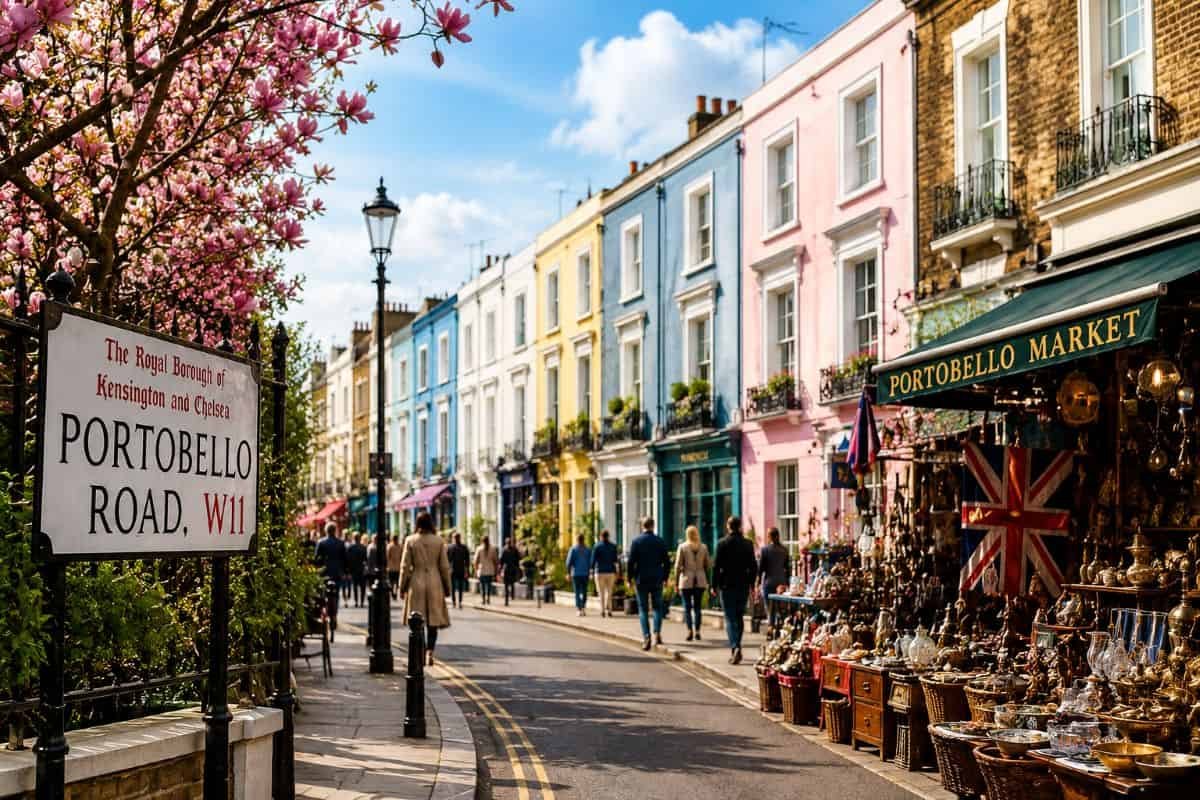
Notting Hill is one of west London’s most recognisable neighbourhoods, but the area offers much more than pastel-coloured houses and the famous Portobello Road. A good day here can take in an antiques market, Caribbean culture, independent shops, small museums, leafy streets, cinema history and one of London’s best-known public parks.
The appeal is partly the variety. Portobello Road gives the neighbourhood its market identity, while streets around Westbourne Grove, Ladbroke Grove and Lancaster Road reveal a more residential side. The annual Notting Hill Carnival adds another important layer, rooted in Caribbean culture and the area’s post-war community history.
If you are researching the best things to do in Notting Hill, the key is to allow enough time to explore on foot. The main attractions are relatively close together, but they offer very different experiences.
The best things to do in Notting Hill at a glance
| Experience | Best for | Allow |
| Portobello Road Market | Antiques, vintage shopping and food | 2–3 hours |
| Walk around Notting Hill | Architecture and photography | 1–2 hours |
| Notting Hill film locations | Film fans | 1–2 hours |
| Museum of Brands | History, design and nostalgia | 1–2 hours |
| Golborne Road | Independent shopping and food | 1–2 hours |
| Notting Hill Carnival | Music, Caribbean culture and community | Several hours |
| Kensington Gardens | Walking, gardens and family days out | 2–3 hours |
| Independent galleries and shops | Art and design | 1–2 hours |
| Westbourne Grove | Shopping, cafés and people-watching | 1–2 hours |
Times are indicative rather than fixed. Portobello Road and the surrounding streets are particularly different depending on the day of the week.
Amazing Things to Do in Notting Hill:
1. Explore Portobello Road Market
For most first-time visitors, Portobello Road is the obvious starting point.
The market stretches through the heart of Notting Hill and is particularly associated with antiques, vintage goods, clothing, food and collectables. Saturday is the principal market day and generally offers the broadest experience for visitors looking specifically for antiques and second-hand items.
The official Portobello Road Market site currently lists the market as open daily, with traders generally operating during daytime hours. Individual stalls can have different trading patterns, so arriving earlier is sensible if you have something specific in mind.
What can you buy at Portobello Road?
Depending on the day, you can find:
- Antiques and collectables
- Vintage clothing
- Jewellery
- Second-hand goods
- Home accessories
- Fresh produce
- Street food
- Books and unusual gifts
The market is not simply one long row of identical stalls. Its character changes as you walk between different parts of Portobello Road and towards Golborne Road.
If antiques are your priority, Saturday morning is the obvious choice. If food, browsing and the atmosphere matter more, a weekday visit can be less demanding.
How to get to Portobello Road Market
Ladbroke Grove is one of the most convenient stations for the market, while Notting Hill Gate is also within walking distance. The market’s official visitor information places Ladbroke Grove about five minutes away on foot and Notting Hill Gate around ten minutes away.

2. Walk through Notting Hill’s famous streets
Some of the best things to do in Notting Hill cost nothing at all.
Walking between Portobello Road, Westbourne Grove, Ladbroke Grove and the surrounding residential streets gives you a much better sense of the neighbourhood than simply visiting the market.
The area’s architecture ranges from grand Victorian terraces to smaller residential streets and brightly painted homes. The famous coloured houses are attractive to photograph, but visitors should remember that many are private homes.
A practical Notting Hill walking route
A useful self-guided route is:
Notting Hill Gate → Pembridge Road → Portobello Road → Lancaster Road → Golborne Road → Westbourne Park
This route lets you combine architecture, shops, the market and food without spending the entire day retracing your steps.
Give yourself time to turn off the main roads. Some of the quieter streets around Notting Hill are where the contrast between the visitor-facing market area and the residential neighbourhood becomes most obvious.
Avoid blocking pavements for photographs, entering private driveways or treating residential properties as attractions.
3. Visit the locations made famous by Notting Hill
The 1999 film Notting Hill, starring Hugh Grant and Julia Roberts, put the neighbourhood on the international tourism map.
Several scenes were filmed in and around the area, making the film locations a natural addition to a Notting Hill itinerary. Visit London also highlights walking tours that cover locations including the famous blue door and the travel bookshop associated with the film.
The film is now more than 25 years old, so some locations have changed, and not every shop or business shown in the film remains as it was.
That is part of the fun of doing the walk today: you can compare the film’s version of Notting Hill with the neighbourhood as it exists now.
Is the Notting Hill film tour worth doing?
It depends on your interest.
Pros
- Gives context to the film locations
- Covers several places efficiently
- Useful if you are visiting for the first time
- Adds local history and anecdotes
Cons
- Some locations are ordinary streets rather than attractions
- Certain businesses shown in the film have changed
- Walking independently is cheaper
Film fans can easily create their own route, while visitors who want background stories may prefer a guided walk.
4. Step inside the Museum of Brands
For something quite different from the market and film locations, head to the Museum of Brands on Lancaster Road.
The museum explores around 200 years of consumer culture through packaging, advertising and everyday products. Its collection is designed around the way brands and consumer habits have changed over time.
It is particularly good for visitors interested in graphic design, advertising, social history and nostalgia.
The museum is currently open Monday to Saturday from 10 am to 5 pm and Sunday from 11 am to 5 pm, although visitors should check for temporary closures before travelling. Its 2026 adult admission is £14, with concessions and family tickets also available.
The museum also says its 2026 admission ticket allows visitors to revisit for free for a year, making it more useful for residents than a conventional one-off attraction.
5. Explore Golborne Road
Golborne Road lies north of the main Portobello Road stretch and is one of the most useful places to explore if you want to see a different side of the neighbourhood.
The street and surrounding area are known for independent traders, food, vintage goods and a strong North African and Caribbean influence. Visit London highlights North African and Caribbean food among the market’s offerings around Golborne Road.
It is a good place to combine shopping with lunch or an informal food stop.
Golborne Road also makes sense as part of a wider walk rather than a standalone destination. Start around Notting Hill Gate, follow Portobello Road northwards and continue towards Golborne Road before heading back through Westbourne Park.
That route gives you a broader impression of west Notting Hill and avoids spending your entire visit around the busiest section of Portobello Road.
6. Browse the independent shops around Westbourne Grove
Westbourne Grove provides a different shopping experience from Portobello Market.
The area has independent retailers, cafés, restaurants and fashion and lifestyle businesses, alongside more familiar high-street names. It is a useful place to wander after visiting the market because the streets are less focused on stalls and antiques.
For visitors who do not want to spend hours bargain hunting, Westbourne Grove can make a more relaxed part of a Notting Hill afternoon.
It is also a useful route between the neighbourhood and nearby Bayswater and Kensington.
7. See Notting Hill’s art and creative side
Notting Hill has long attracted artists, designers, musicians and creative businesses.
Small galleries and independent creative spaces can be found around the neighbourhood, particularly away from the main tourist routes. Visit London’s area guide highlights Graffik Gallery among Notting Hill’s independent art spaces.
The important point for visitors is that gallery opening hours can vary considerably. If you are visiting specifically to see an exhibition, check the individual venue before setting out rather than relying on a general area guide.
For a casual afternoon, however, combining galleries with Portobello Road, Westbourne Grove and local cafés works well.
8. Catch a performance at the Gate Theatre
The Gate Theatre is small in Notting Hill with a reputation for new and international work.
Its intimate scale makes it quite different from London’s large West End venues. Visit London’s local guide describes it as an important part of Notting Hill’s entertainment scene and notes its reputation for developing theatrical talent.
If you enjoy theatre, check the current programme before your visit. A performance can turn a daytime neighbourhood trip into a full evening out.
This is also a useful option when the weather is poor, since much of the classic Notting Hill experience is outdoors.
9. Spend time in Kensington Gardens
Kensington Gardens is not strictly within the central Notting Hill neighbourhood, but it is close enough to make sense as part of a longer west London day out.
The park has links to Kensington Palace and includes formal gardens, monuments, the Round Pond and the Peter Pan statue. The Royal Parks describes it as a place combining history, gardens, wildlife, leisure and open space.
It is particularly useful if you are travelling with children or simply need a quieter break after several hours of shopping.
Kensington Gardens opens from 6 am and closes at dusk, with the exact closing time changing through the year.
What to see in Kensington Gardens
Among the better-known features are:
- Kensington Palace
- The Round Pond
- Peter Pan statue
- Albert Memorial
- Formal gardens
- Open lawns and walking routes
You do not need to turn the park into a separate full-day attraction. Two hours can be enough for a walk and a few major sights.
10. Take a Notting Hill photography walk
Notting Hill is particularly suited to photography because the visual interest changes from one street to the next.
Good subjects include:
- Painted Victorian terraces
- Portobello Road market stalls
- Shopfronts and signs
- Street art
- Market architecture
- The streets around Westbourne Grove
- Historic terraces around Ladbroke Grove
Early morning tends to be easier for photographing residential streets and market architecture before the busiest period.
The same rule applies as elsewhere in London: attractive residential buildings are homes, not public attractions. Photographing from the pavement is generally less intrusive than standing outside a property for an extended period.
11. Experience Notting Hill Carnival
Notting Hill Carnival is one of the defining cultural events associated with the area.
The event began as a community celebration in the 1960s and has grown into a major celebration of Caribbean culture featuring mas bands, steel bands, sound systems, calypso, soca, food and street performance.
The history matters. The modern Carnival developed against a backdrop of racial tension and discrimination in post-war Notting Hill. Claudia Jones organised an indoor Caribbean Carnival in 1959, while the first Notting Hill street Carnival took place in 1966.
That history is one reason Carnival should be approached as a cultural and community event rather than simply a large London party.
Notting Hill Carnival 2026
The 2026 Carnival marks its 60th anniversary.
The official programme is:
- Saturday 29 August: Panorama and Junior Panorama steel band competition
- Sunday 30 August: J’ouvert, Children’s Day and Carnival activities
- Monday 31 August: Main Parade and adult Carnival
Sunday and Monday’s main Carnival activities are free to attend, while the Saturday Panorama competition requires a ticket.
If you are attending, plan transport carefully. The event covers a large part of west London, roads are closed, and some stations can be closed or operate with restrictions. Visit London recommends checking current transport information before travelling.
12. See Notting Hill beyond Carnival
One of the easiest mistakes visitors can make is treating Notting Hill Carnival as the entire story of the neighbourhood.
The Carnival is an important part of its identity, but the area’s Caribbean heritage, migration history and community life extend throughout the year.
Walking around Ladbroke Grove and north towards Golborne Road provides a better opportunity to understand the neighbourhood’s multicultural character without the scale of the August event.
For a deeper historical visit, combine the walk with research into the history of Claudia Jones, the early Caribbean community and the social changes that shaped west London after the Second World War.
13. Make time for food
Notting Hill is a strong choice for visitors who want to combine sightseeing with food.
Portobello Road and the streets around the market offer international options, while Golborne Road is particularly useful for North African and Caribbean flavours. Visit London’s market guide also highlights food stalls serving global dishes on Fridays and Saturdays.
Rather than planning every meal around a famous restaurant, consider building food into the walk.
For example:
Morning: Coffee and breakfast near Notting Hill Gate
Late morning: Portobello Road Market
Lunch: Golborne Road or Portobello Road
Afternoon: Museum of Brands or Westbourne Grove
Evening: Theatre or dinner
That approach leaves room for spontaneous stops without turning the day into a restaurant itinerary.
14. Plan a rainy-day visit
Notting Hill is often presented as an outdoor destination, but there are enough indoor options to make it worthwhile in poor weather.
A sensible wet-weather itinerary could include:
- Museum of Brands
- Lunch around Portobello Road or Golborne Road
- Independent shops and galleries
- A cinema or theatre performance
- Dinner around Westbourne Grove
The Museum of Brands is particularly useful because it provides a substantial indoor attraction close to Ladbroke Grove.
15. Plan a family day in Notting Hill
Families can enjoy Notting Hill without trying to visit every attraction.
Portobello Road gives children plenty to look at, particularly the unusual objects and food stalls. The Museum of Brands offers a visual approach to history through familiar packaging and products, while Kensington Gardens provides space to run around and explore.
Kensington Gardens also contains the Diana Memorial Playground, although families should check the current visitor information before making a special journey.
A good family day is therefore less about ticking off landmarks and more about mixing short indoor and outdoor activities.
How long do you need in Notting Hill?
For a first visit, half a day is enough to see the highlights, but a full day gives you time to explore properly.
Half-day itinerary
9:30 am: Arrive at Notting Hill Gate
10 am: Walk towards Portobello Road
10:30 am: Explore the market
12 pm: Walk towards Golborne Road
1 pm: Lunch
2 pm: Museum of Brands or Westbourne Grove
Full-day itinerary
9:30 am: Notting Hill Gate
10 am: Residential streets and Portobello Road
11:30 am: Market browsing
1 pm: Lunch
2 pm: Museum of Brands
3:30 pm: Golborne Road and Westbourne Park
5 pm: Westbourne Grove
Evening: Theatre, cinema or dinner
The exact order should change depending on the day. Saturday is particularly suited to the market, while a quieter weekday can work better for museums, shopping and photography.
Best things to do in Notting Hill by interest
| If you enjoy… | Start with… | Add… |
| Markets | Portobello Road | Golborne Road |
| Film | Notting Hill locations | Portobello Road |
| History | Museum of Brands | Local walking route |
| Caribbean culture | Notting Hill Carnival | Golborne Road |
| Photography | Residential streets | Portobello Road |
| Shopping | Westbourne Grove | Portobello Market |
| Art | Independent galleries | Theatre |
| Families | Kensington Gardens | Museum of Brands |
| Food | Portobello Road | Golborne Road |
| A quiet afternoon | Kensington Gardens | Westbourne Grove |
Getting around Notting Hill
Notting Hill is easy to explore on foot once you arrive.
Notting Hill Gate is served by the Central, District and Circle lines. Ladbroke Grove and Westbourne Park provide useful alternatives on the Circle and Hammersmith & City lines.
The best station depends on your destination.
| Destination | Useful station |
| Portobello Road | Ladbroke Grove |
| Central Notting Hill | Notting Hill Gate |
| Museum of Brands | Ladbroke Grove |
| Kensington Gardens | Bayswater / Queensway / Lancaster Gate |
| Carnival area | Check official travel advice |
For ordinary sightseeing, walking is usually the easiest way to move between the main attractions.
For Carnival, do not rely on normal journey patterns. Transport arrangements can change because of road closures and crowd management.
What is the best day to visit Notting Hill?
- Saturday is best if your main reason for visiting is Portobello Road Market.
- Weekdays are better if you prefer a slower pace, museums, shopping and photography.
- Sunday can work well for a relaxed combination of food, walking and nearby parks, but individual traders and attractions may operate different schedules.
- August Bank Holiday weekend is completely different because of Notting Hill Carnival. It is ideal if you specifically want the Carnival experience, but it is not the best time for a quiet neighbourhood walk.
What should you avoid doing in Notting Hill?
A little planning makes the visit considerably better.
Avoid:
- Assuming every colourful house is a public attraction
- Visiting Portobello Road late and expecting every trader to be operating
- Treating Carnival as an ordinary sightseeing day
- Relying on old opening-hours information
- Photographing residents or private homes intrusively
- Trying to drive around the market area
- Planning too many attractions in one day
Notting Hill works best when you leave some space in the itinerary.
A simple Notting Hill day that works
For a first visit, there is no need to overcomplicate the route.
Start at Notting Hill Gate, walk through the residential streets towards Portobello Road, spend time browsing the market and continue north towards Golborne Road. Stop for lunch, then visit the Museum of Brands or head back towards Westbourne Grove for shops and cafés.
If you have more time, continue towards Kensington Gardens. In the evening, consider a theatre performance or dinner before heading home.
This route combines the neighbourhood’s best-known sights with places that show how the area works beyond its tourist image.
Quick summary: the best things to do in Notting Hill
If you only have a few hours, prioritise:
- Portobello Road Market – the essential first stop for most visitors.
- Walk around Notting Hill’s residential streets – especially around Portobello Road and Ladbroke Grove.
- Visit the Museum of Brands – an unusual indoor attraction with a strong social-history angle.
- Explore Golborne Road – particularly for food and independent shopping.
- Follow Notting Hill film locations – worthwhile for fans of the 1999 film.
- Walk through Kensington Gardens – a good extension to a longer west London day.
- See Notting Hill Carnival – if you want to experience the neighbourhood’s major Caribbean cultural celebration.
Notting Hill is at its best when these experiences are combined rather than treated as isolated attractions. The market may be the obvious starting point, but the quieter streets, community history, food and cultural venues give the neighbourhood much of its character.
FAQ
What is Notting Hill famous for?
Notting Hill is famous for Portobello Road Market, Notting Hill Carnival, its colourful Victorian streets and the 1999 film Notting Hill. The neighbourhood also has a long Caribbean cultural history and a substantial independent retail and creative scene.
Is Notting Hill worth visiting?
Yes. It is particularly worthwhile for visitors interested in markets, architecture, food, film locations, museums and Caribbean culture. Portobello Road and the surrounding streets can comfortably fill half a day, while adding Kensington Gardens or a cultural venue can make a full-day itinerary.
What is the best day to visit Portobello Road Market?
Saturday is the main trading day and is particularly suitable for antiques and vintage shopping. Some traders operate on weekdays too, so a quieter weekday visit can work better if you are more interested in walking and browsing than the full Saturday market experience.
Is Portobello Road Market open every day?
The official market website currently lists Portobello Road Market as open Monday to Sunday, although individual traders have their own operating patterns. The main Saturday market remains the busiest and most extensive trading day.
How long should I spend in Notting Hill?
Allow at least half a day for Portobello Road, the surrounding streets and lunch. A full day is preferable if you want to include the Museum of Brands, Golborne Road, Kensington Gardens or an evening performance.
Is Notting Hill good for families?
Yes. Families can combine the market with the Museum of Brands and nearby Kensington Gardens. The best approach is to mix outdoor walking with an indoor attraction rather than trying to cover too many shops and streets.
Where is the Museum of Brands?
The Museum of Brands is at 111–117 Lancaster Road, Notting Hill, W11 1QT. It is around a five-minute walk from Ladbroke Grove station.
When is Notting Hill Carnival in 2026?
Notting Hill Carnival’s 2026 programme runs from Saturday 29 August to Monday 31 August. Saturday is the Panorama steel band competition, Sunday is Children’s Day and Carnival Sunday, and Monday is the main adult Carnival day.
Is Notting Hill Carnival free?
The main Carnival activities on Sunday and Monday are free to attend. The Saturday UK National Panorama Steel Band Competition is ticketed.
Which Tube station is best for Notting Hill?
Notting Hill Gate is convenient for the central part of the neighbourhood, while Ladbroke Grove is particularly useful for Portobello Road. Westbourne Park is another option for the northern side. All three provide useful access to different parts of the area.
Conclusion
Notting Hill is a neighbourhood best explored with a little time and curiosity. Portobello Road Market may be its most famous attraction, but the area’s real appeal comes from the combination of markets, colourful streets, independent shops, food, museums, creative spaces and a rich Caribbean cultural history.
For a first visit, start with Portobello Road, then explore the streets towards Golborne Road and Westbourne Grove. Add the Museum of Brands if you want an indoor attraction, or continue towards Kensington Gardens for a quieter change of pace. Film fans can follow locations from Notting Hill, while theatre and art enthusiasts have plenty of cultural options to extend the day.
The best time to visit depends on what you want from the neighbourhood. Saturday is ideal for experiencing the full market, weekdays offer a calmer atmosphere, and the August Bank Holiday brings the very different experience of Notting Hill Carnival.
Most importantly, do not rush from one landmark to another. Some of the most rewarding parts of Notting Hill are found in the quieter streets, local food spots and small details you notice while walking. Allow yourself time to wander, respect the residential character of the area and let the neighbourhood reveal more than its familiar postcard image.