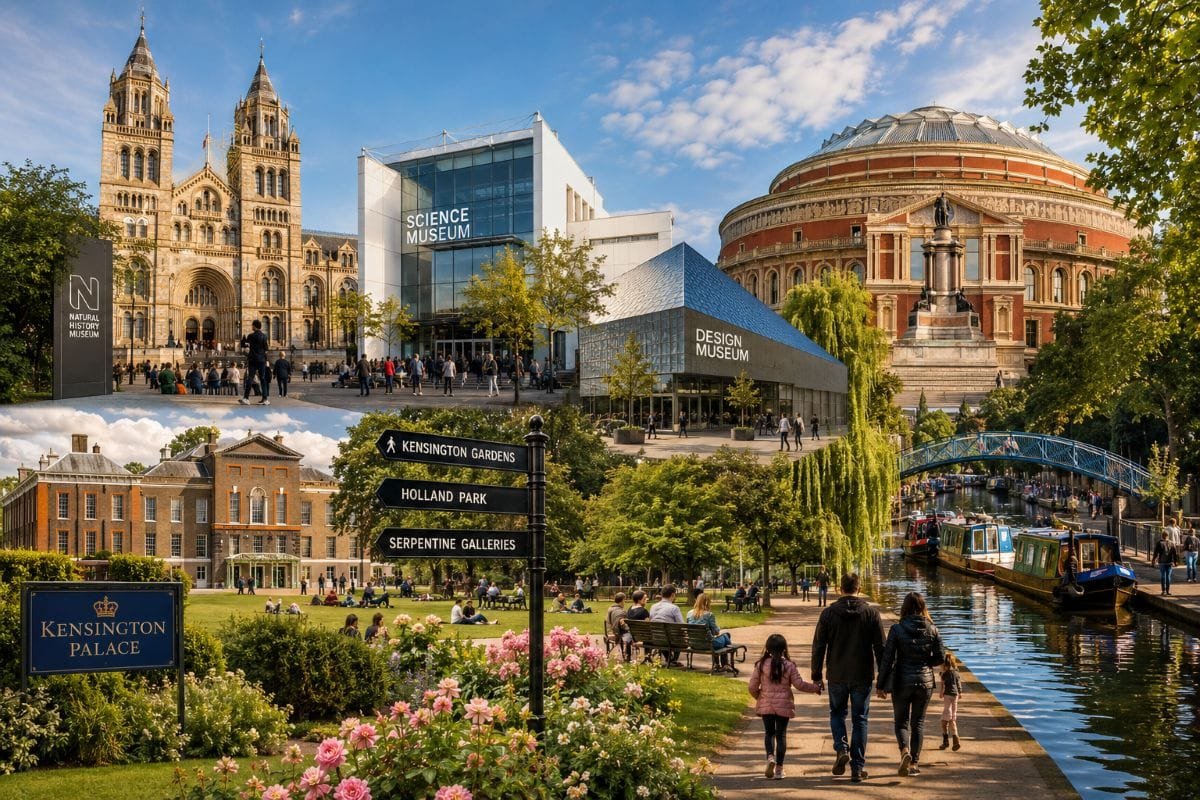
Kensington is one of the most rewarding parts of west London to explore on foot. Within a relatively compact area, you can move from royal history and world-class museums to quiet garden squares, Victorian artists’ homes, independent cultural venues and some of the capital’s best-known shopping streets.
For first-time visitors, the obvious attractions are the Natural History Museum, Victoria and Albert Museum, Science Museum, Kensington Palace and Royal Albert Hall. They deserve their reputations, but Kensington is more interesting when you allow time to look beyond the headline attractions.
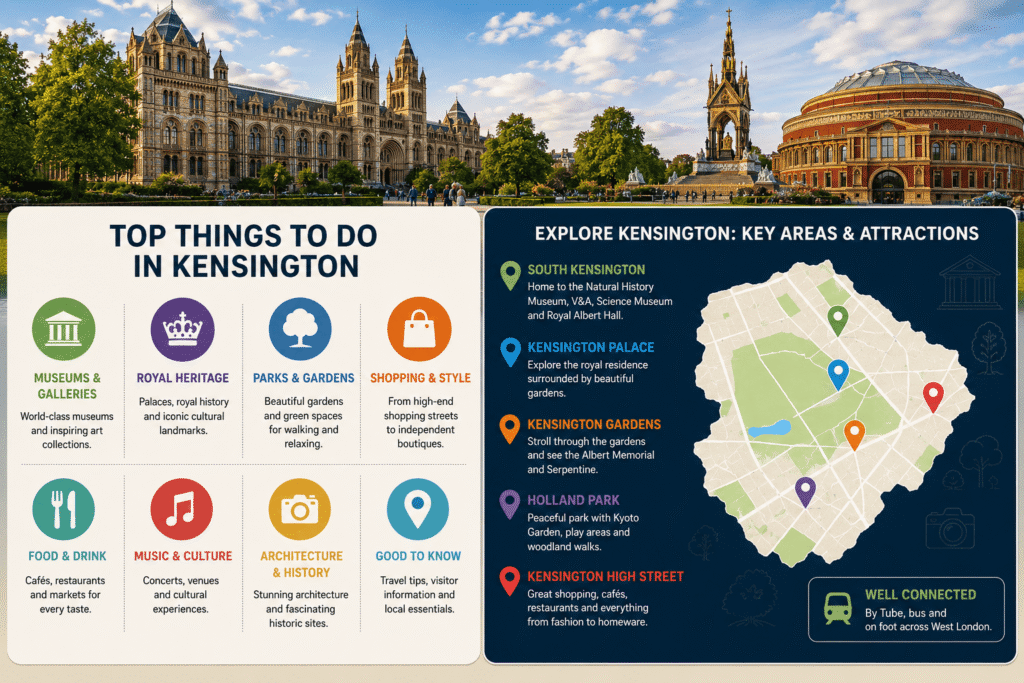
This guide to Things to Do in Kensington covers the major sights as well as quieter places worth adding to a day out. It also explains how the area fits together, which attractions work well together, what can be visited for free and how to plan your time.
Quick guide to the best things to do in Kensington
| Attraction | Best for | Cost | Time to allow |
| Natural History Museum | Families, science and natural history | Free general admission | 2–3 hours |
| Victoria and Albert Museum | Art, design and fashion | Free general admission | 2–3 hours |
| Science Museum | Science and families | Free general admission | 2–3 hours |
| Kensington Palace | Royal history | Paid admission | 1.5–2.5 hours |
| Kensington Gardens | Walking, gardens and monuments | Free | 1–3 hours |
| Royal Albert Hall | Concerts, architecture and tours | Varies | 1.5–3 hours |
| Design Museum | Modern design | Free permanent display; exhibitions may charge | 1–2 hours |
| Japan House London | Japanese art, culture and design | Free | 1–2 hours |
| Leighton House | Victorian art and interiors | Paid admission | 1–1.5 hours |
| Holland Park | Gardens, woodland and outdoor space | Free | 1–2 hours |
| Serpentine Galleries | Contemporary art | Free | 1–2 hours |
Times and admission arrangements can change, particularly for temporary exhibitions and special events, so check the attraction’s official website before travelling.
Things to Do in Kensington
1. Visit the Natural History Museum
The Natural History Museum on Cromwell Road is one of Kensington’s essential stops, particularly for families and anyone interested in the natural world.
Its galleries cover subjects ranging from dinosaurs and fossils to volcanoes, earthquakes, minerals and biodiversity. The building itself is also part of the experience, with its elaborate Victorian architecture and large central hall.
General admission to the museum is free. The museum currently opens daily from 10 am to 5.50 pm, with last entry at 5.30 pm. The museum advises that weekends and school holidays can be busy and that visitors may need to queue; free tickets can be booked to guarantee entry.
How to make the most of it
Don’t try to see everything in one visit. The collection is too large for that.
For a shorter visit, choose a few galleries before arriving. Families may want to concentrate on dinosaurs and other large specimens, while adults interested in geology can spend more time with the Earth-related collections.
The Natural History Museum also works particularly well as part of a South Kensington museum day, since the Science Museum and V&A are within easy walking distance.
2. Explore the Victoria and Albert Museum
The Victoria and Albert Museum, usually called the V&A, is one of the strongest choices for visitors interested in art, design, fashion, architecture and decorative arts.
Its collection spans thousands of years and includes objects from many different cultures and periods. The scale can initially seem daunting, so it is better to choose an area that genuinely interests you rather than attempting to cover the whole building.
General admission to V&A South Kensington is free and does not require booking. Temporary exhibitions and some events are separately ticketed. The museum is open daily from 10 am to 5.45 pm, with later opening on Fridays until 10 pm, although some galleries close earlier.
Why the V&A is different
The museum rewards repeat visits. A first trip might focus on fashion or design, while another could concentrate on sculpture, photography, furniture or historic objects.
The building itself is also worth exploring. Give yourself time to look at the architecture rather than treating the V&A simply as a series of galleries.
3. Take a science-filled trip to the Science Museum
Across Exhibition Road, the Science Museum offers a very different experience.
Its collections tell the story of scientific and technological development, with subjects including space, engineering, medicine, communications and computing. Interactive areas make it particularly suitable for children and teenagers.
General admission is free, although the museum recommends booking a free ticket in advance. It currently opens daily from 10 am to 6 pm, with last entry at 5.15 pm. Some attractions and experiences carry additional charges.
Is the Science Museum good for children?
Yes, especially if you plan around the interactive parts of the museum rather than expecting young children to spend hours reading display panels.
The Science Museum also has paid experiences such as its IMAX cinema and interactive attractions, so check the programme before visiting if there is something specific you want to see.
4. Step inside Kensington Palace
Kensington Palace provides one of the clearest links between modern Kensington and Britain’s royal history.
The palace began as Nottingham House before William III and Mary II selected it as a royal retreat in 1689. It was subsequently developed by successive monarchs, and Queen Victoria was born there in 1819 and spent her childhood at the palace.
Visitors can explore historic rooms and exhibitions, including displays relating to Queen Victoria and the royal occupants of the palace.
The palace is inside Kensington Gardens, making it easy to combine with a walk through the park.
Allow time for the gardens too
A common mistake is to treat Kensington Palace as a standalone attraction. The surrounding gardens provide an important part of the experience.
After visiting the palace, walk towards the Round Pond, Albert Memorial or Serpentine Galleries rather than immediately leaving the park.
5. Walk through Kensington Gardens
Kensington Gardens is one of the easiest ways to add some open space to a museum-heavy day.
The 265-acre Royal Park contains Kensington Palace, the Italian Gardens, Albert Memorial, Serpentine Galleries and other historic and cultural features. It was originally part of Hyde Park before being separated as a garden for Kensington Palace.
The park is free to enter. The Royal Parks currently lists pedestrian gates as opening from 6 am until the evening, with closing times varying by season and location.
What should you see in Kensington Gardens?
Start around Kensington Palace and then choose your route.
- Round Pond – one of the park’s most recognisable features.
- Albert Memorial – an ornate Victorian memorial to Prince Albert.
- Italian Gardens – historic formal gardens near Lancaster Gate.
- Serpentine Galleries – contemporary art in the park.
- Diana Memorial Playground – a major family attraction, subject to current opening arrangements.
- The Long Water – a good route for a quieter walk.
If you have two or three hours, there is no need to hurry. Kensington Gardens is at its best when treated as a walk rather than something to tick off a list.
6. See contemporary art at the Serpentine Galleries
The Serpentine Galleries offer a useful contrast to Kensington’s historic museums.
The galleries are in Kensington Gardens and focus on modern and contemporary art, architecture and cultural programming. Admission is free.
The Serpentine currently operates two gallery spaces, Serpentine South and Serpentine North. Opening times vary by day, so check the gallery’s current schedule before setting out.
The galleries are particularly easy to combine with a walk through Kensington Gardens. You can visit an exhibition and then continue towards the Long Water or Hyde Park.
7. See a performance at the Royal Albert Hall
The Royal Albert Hall is one of Kensington’s defining landmarks.
Opened by Queen Victoria in 1871, the building has hosted an extraordinary range of performances. Its programme includes classical music, rock and pop, opera, dance, comedy and other events, with the BBC Proms among its best-known annual fixtures.
You do not necessarily need to attend a concert to see inside. The venue also offers tours that explain its architecture and history.
What is the best way to visit?
If you are already in South Kensington, check the Royal Albert Hall’s programme first. A daytime tour can work well alongside the museums, while an evening performance can turn a museum-and-park day into a full Kensington itinerary.
Event prices and availability vary considerably, so book directly with the venue for a specific performance.
8. Explore the Design Museum
On Kensington High Street, the Design Museum concentrates on design in its many forms, from architecture and fashion to graphics, products and technology.
Its permanent collection display, Designer Maker User, is free to visit, while temporary exhibitions can require tickets. The museum is at 224–238 Kensington High Street.
This is a good choice when you want something more focused than the enormous South Kensington museums.
It also fits naturally into a west Kensington itinerary alongside Holland Park, Leighton House and the shops and cafés around Kensington High Street.
9. Visit Japan House London
Japan House London is one of the more distinctive cultural stops on Kensington High Street.
It presents Japanese art, design, food, innovation and culture through exhibitions, talks, workshops, screenings and other activities. Admission is free, although selected events have a charge.
The venue is less than 100 metres from High Street Kensington station, making it particularly convenient if you are travelling by Tube.
Opening hours currently run from 10 am to 8 pm Monday to Saturday and noon to 6 pm on Sundays and bank holidays.
Allow time for more than the exhibition
Japan House also has spaces devoted to food and retail, so it can be a useful stop during a walk along Kensington High Street rather than requiring a separate half-day visit.
10. Step inside Leighton House
Leighton House is one of the best choices for visitors who want to see a very different side of Kensington’s history.
The former home and studio of Victorian artist Frederic, Lord Leighton, the house reveals how an artist of his standing lived and worked. Its interiors, particularly the Arab Hall, are central to the experience.
The museum is at 12 Holland Park Road and is close to both High Street Kensington and Kensington Olympia. Current opening hours are Monday and Wednesday to Sunday, 10 am to 5.30 pm, with last entry at 4.30 pm; it is closed on Tuesdays.
Why it deserves a place on your Kensington list
Leighton House provides context that the larger museums cannot. Instead of seeing an isolated painting or object, you are entering the domestic and creative environment of a Victorian artist.
There are also guided tours and free volunteer-led tours at selected times.
11. Walk around Holland Park
Holland Park sits on Kensington’s western side and provides a different atmosphere from the formal avenues around Kensington Gardens.
The 54-acre park contains woodland, formal gardens, sports facilities, playgrounds and the Kyoto Garden. It also includes the remains of Holland House, parts of which were damaged during the Second World War.
The park is free to enter and currently opens from 7.30 am until dusk, with closing times displayed at its entrances.
See the Kyoto Garden
The Kyoto Garden is perhaps the most recognisable feature within Holland Park.
It was created through a collaboration between the Royal Borough of Kensington and Chelsea and the Kyoto Chamber of Commerce and was donated by the Chamber of Commerce of Kyoto. The garden includes traditional Japanese landscaping and water features.
Dogs are not permitted in the Japanese Garden, so visitors with pets should plan their route accordingly.
12. Look for Kensington’s Victorian artists’ houses
Kensington’s architectural history goes beyond palaces and museums.
The area around Holland Park Road and Melbury Road became associated with the so-called Holland Park Circle of Victorian artists, including Frederic Leighton and other prominent artists, sculptors and architects.
RBKC Museums currently runs free Artists Houses walking tours on selected Thursdays and Sundays. The tours last around 90 minutes and begin and end outside Leighton House.
This is one of the better options for visitors who enjoy architecture and local history but do not want another conventional museum visit.
13. Browse Kensington High Street
Kensington High Street is the area’s main commercial artery and provides a useful break between cultural attractions.
The street connects the area around High Street Kensington station with Kensington’s western neighbourhoods and offers shops, cafés, restaurants and everyday services.
Rather than treating it purely as a shopping destination, use it as a route between attractions. Japan House and the Design Museum are two obvious cultural stops along or close to the street.
The side streets also reveal some of Kensington’s residential architecture, including attractive mews and garden squares.
14. Explore Kensington’s quieter streets and mews
Some of the best things to do in Kensington cost nothing at all.
Away from the main roads, streets such as Kynance Mews provide a glimpse of the area’s distinctive mews architecture. These are residential streets, however, so visitors should treat them as neighbourhoods rather than attractions designed for crowds.
Photography is best kept discreet and respectful. Do not block entrances or photograph residents unnecessarily.
A walking route around the mews, garden squares and older terraces can add an hour to a Kensington day without requiring another ticket.
15. Spend an evening at Opera Holland Park
Opera Holland Park stages productions in the grounds of Holland Park during its seasonal programme.
The venue combines opera with the setting of the historic Holland House ruins, creating a very different evening from a performance in a conventional theatre.
Opera Holland Park operates seasonally, so the programme and ticket arrangements change from year to year. The borough’s 2026 information confirms that the company stages productions from May to October.
If opera is on your list, check the current season before planning your visit rather than assuming performances take place throughout the year.
16. Make time for South Kensington’s museum quarter
One of the strongest features of Kensington is the concentration of major museums around Exhibition Road and Cromwell Road.
The Natural History Museum, Science Museum and V&A are close enough to combine, but trying to see all three properly in a few hours is unrealistic.
A better approach is to choose one major museum and one smaller attraction, then leave time for lunch and a walk.
A useful one-day combination
Morning: Natural History Museum
Lunch: South Kensington
Afternoon: V&A
Late afternoon: Kensington Gardens
Evening: Royal Albert Hall or dinner around Kensington
For a family, replace the V&A with the Science Museum if interactive displays are likely to hold everyone’s attention for longer.
Find free things to do in Kensington
Kensington can be expensive if you fill your day with ticketed attractions, but some of its strongest experiences are free.
Good free options include:
- Kensington Gardens
- Hyde Park
- Serpentine Galleries
- Natural History Museum general admission
- Science Museum general admission
- V&A general admission
- Japan House London
- Design Museum’s permanent collection
- Walking around Kensington High Street
- Exploring the area’s architecture and mews
- Selected public events and tours
The key is to distinguish free general admission from free access to everything. Temporary exhibitions, cinemas, special events, palace admission and some museum experiences can cost extra.
Best things to do in Kensington for families
Kensington is particularly strong for family days out because several attractions combine education with things children can actually engage with.
The strongest choices are:
- Natural History Museum – dinosaurs, fossils and natural science.
- Science Museum – interactive science and technology.
- Kensington Gardens – outdoor space and family facilities.
- Royal Albert Hall – selected family performances and tours.
- Japan House London – family-friendly cultural programming at selected times.
- Holland Park – playgrounds, gardens and outdoor space.
For younger children, avoid trying to pack three large museums into one day. One major museum followed by outdoor time is usually more manageable.
Best things to do in Kensington for couples
Kensington also works well for a slower day.
A couple could start with the V&A, walk through Kensington Gardens, visit the Royal Albert Hall or Serpentine Galleries, then continue towards Kensington High Street or Holland Park.
For something more unusual, combine Leighton House with a walk through the Victorian artists’ streets around Holland Park.
An evening performance at the Royal Albert Hall or Opera Holland Park can provide a natural finish to the day.
How to plan a Kensington day without rushing
Kensington is compact enough to walk between many attractions, but the museums are large enough to consume several hours.
If you have half a day
Choose one major attraction:
- Natural History Museum
- Science Museum
- V&A
- Kensington Palace
Then spend the remaining time walking through Kensington Gardens or along Kensington High Street.
If you have one full day
Option A – museums and royal history
- Morning: Natural History Museum
- Lunch: South Kensington
- Afternoon: V&A
- Late afternoon: Kensington Gardens
- Evening: Royal Albert Hall
Option B – gardens and local history
- Morning: Kensington Palace
- Late morning: Kensington Gardens
- Lunch: Kensington High Street
- Afternoon: Design Museum
- Late afternoon: Holland Park
- Evening: Opera Holland Park, when in season
Option C – quieter Kensington
- Morning: Leighton House
- Walk through the Holland Park artists’ area
- Lunch around Kensington High Street
- Japan House London
- Design Museum
- Holland Park and Kyoto Garden
Getting around Kensington
The main Tube stations serving the area include South Kensington, Gloucester Road, High Street Kensington, Kensington (Olympia), Holland Park, Queensway and Lancaster Gate, depending on which part of Kensington you are visiting.
South Kensington is particularly useful for the major museums on Exhibition Road. High Street Kensington works well for Kensington High Street, Japan House, the Design Museum and access towards Kensington Gardens and Holland Park.
Kensington Gardens itself is also accessible from several stations. The Royal Parks lists Queensway, Lancaster Gate and Bayswater among the nearby Underground options, while Paddington is the closest mainline station.
For individual journeys, check Transport for London’s live service information before setting out, particularly during weekends, engineering works or major events.
What is the best area to stay in Kensington?
The answer depends on what you want to do.
| Area | Best for | Character |
| South Kensington | Museums | Cultural and residential |
| High Street Kensington | Shopping and central access | Commercial and well connected |
| Kensington Gardens | Parks and palace | Historic and green |
| Holland Park | Quieter stays | Residential and leafy |
| Kensington Olympia | Events and western Kensington | Practical and well connected |
For a first visit focused on museums, South Kensington is particularly convenient. If parks and quieter streets matter more, the area around Holland Park can be a better fit.
Practical tips for visiting Kensington
Book popular attractions when necessary
Free does not always mean you can simply walk straight in. The Science Museum recommends booking free general admission, while the Natural History Museum says free tickets can guarantee entry during busy periods.
Do not underestimate museum sizes
The V&A, Natural History Museum and Science Museum are all substantial institutions. Pick specific galleries rather than trying to see everything.
Wear comfortable shoes
A Kensington itinerary can involve considerably more walking than it appears on a map, particularly if you combine museums with Kensington Gardens or Holland Park.
Check temporary closures
Museum galleries, palace rooms, gardens and public spaces can occasionally close for maintenance, private events or exhibitions.
Use the parks as natural breaks
If your group is getting tired after a museum, don’t immediately add another indoor attraction. Kensington Gardens or Holland Park can provide a useful change of pace.
A simple comparison: which Kensington attraction should you choose?
| If you enjoy… | Start with… |
| Dinosaurs and natural science | Natural History Museum |
| Engineering and technology | Science Museum |
| Art, fashion and design | V&A |
| Royal history | Kensington Palace |
| Gardens and walking | Kensington Gardens |
| Contemporary art | Serpentine Galleries |
| Modern design | Design Museum |
| Japanese culture | Japan House London |
| Victorian art and architecture | Leighton House |
| Classical music and live performance | Royal Albert Hall |
| Japanese gardens and woodland | Holland Park |
Why Kensington is worth more than a quick museum visit
The great advantage of Kensington is the way its attractions connect.
A visitor can spend the morning among fossils and dinosaurs, walk through Kensington Gardens in the afternoon, look at contemporary art at the Serpentine and finish the day at the Royal Albert Hall. Another day could focus entirely on design, architecture and Victorian artistic history.
That variety is what makes Kensington particularly useful for repeat visits. The major museums provide the headline attractions, but the parks, mews, artists’ houses, galleries and cultural venues give the neighbourhood its local character.
For visitors searching for the best Things To Do in Kensington, the most sensible approach is not to build the longest possible list. Pick two or three places that match your interests, group them geographically, and leave some unplanned time for walking.
FAQ
What are the best things to do in Kensington?
The Natural History Museum, V&A, Science Museum, Kensington Palace, Kensington Gardens and Royal Albert Hall are among the area’s main attractions. Holland Park, Leighton House, Japan House London and the Design Museum are strong alternatives for a less conventional itinerary.
Is Kensington good for a day out?
Yes. Kensington has enough museums, parks, historic buildings and cultural venues to fill a full day without travelling across London. The South Kensington museums alone can occupy several hours.
What can you do for free in Kensington?
Kensington Gardens, Holland Park and the Serpentine Galleries are free to visit. General admission to the Natural History Museum, Science Museum and V&A is also free, although some exhibitions and experiences charge separately. Japan House London and the permanent collection display at the Design Museum are also free.
Is Kensington good for families?
Yes. The Natural History Museum and Science Museum are particularly strong family attractions, while Kensington Gardens and Holland Park provide outdoor space between museum visits.
How long should I spend in Kensington?
Allow at least half a day for a focused visit. A full day is better if you want to visit a major museum, explore Kensington Gardens and add another attraction.
Can you walk around Kensington?
Yes. Several major attractions are within walking distance of one another, particularly around South Kensington and Exhibition Road. Kensington Gardens and Holland Park also make walking a natural part of a visit.
Is Kensington expensive to visit?
It can be, but it does not have to be. Several major museums and parks have free general admission, allowing visitors to build a full day around free attractions and spend money only on selected exhibitions, food or entertainment.
What is the nearest Tube station for the Kensington museums?
South Kensington is the most useful station for the Natural History Museum, Science Museum and V&A. Gloucester Road is another nearby option. Always check the specific museum’s travel advice before travelling.
Is Kensington Palace worth visiting?
For visitors interested in royal and British history, it is one of the area’s most relevant attractions. The palace also sits within Kensington Gardens, making it easy to combine the visit with a walk through the park.
What should I do in Kensington when it rains?
The museums are the obvious choice. The Natural History Museum, Science Museum and V&A can each provide several hours indoors. The Design Museum, Japan House London and Leighton House are useful alternatives if you want a smaller-scale visit.
Final thoughts
Kensington is at its best when you mix its major attractions with time outdoors.
Start with the museum or historic site that interests you most, then walk rather than immediately taking another Tube. Kensington Gardens, Holland Park and the streets around High Street Kensington reveal a quieter side of the district that can easily be missed on a tightly scheduled sightseeing trip.
For a first visit, the safest combination is one major museum, Kensington Gardens and one evening attraction. For a second trip, look towards Leighton House, Japan House London, the Design Museum, Holland Park and Kensington’s Victorian architecture.
Check official attraction websites before travelling for current opening arrangements, exhibitions, ticket requirements and event schedules.