
Harrow is often associated with its famous school, but there is considerably more to the north-west London borough than Harrow on the Hill. Its neighbourhoods combine old village streets, historic churches, parks, cultural venues and some surprisingly open landscapes.
For visitors, the appeal is that you can put together very different days out without travelling far. A walk around Harrow on the Hill can take in centuries of history, while Headstone Manor & Museum offers a much deeper look at the area’s past.
Pinner, Hatch End, Canons Park and Rayners Lane each have their own character, while Harrow’s extensive network of parks gives families, walkers and anyone wanting some fresh air plenty of options.
This guide to the Things To Do in Harrow focuses on places that offer something genuinely worth seeing or doing, with practical information to help you decide where to go and how to plan your visit.
Quick guide: the best things to do in Harrow
| Place or activity | Best for | Where |
| Harrow on the Hill | History, architecture and walking | Harrow on the Hill |
| St Mary’s Church | Heritage and quiet reflection | Church Hill |
| Harrow on the Hill viewpoints | London views and photography | Old Redding / Harrow on the Hill |
| Headstone Manor & Museum | Local history and families | Pinner View |
| Headstone Manor Park | Walking and green space | Pinner View |
| Harrow Arts Centre | Theatre, comedy, music and arts | Hatch End |
| Canons Park | Gardens, walking and families | Edgware |
| Roxbourne Park | Families, nature and miniature railway | Rayners Lane |
| Pinner Village Gardens | Walking and green space | Pinner |
| Pinner and Hatch End | Cafés, local shops and a slower-paced day out | Pinner / Hatch End |
The best things to do in Harrow
1. Walk around Harrow on the Hill
If you have never visited Harrow before, start on Harrow on the Hill.
The elevated historic district is one of the most distinctive parts of the borough. Its streets, churchyard, old buildings and views make it particularly suited to exploring on foot rather than simply passing through by car or public transport.
The area is closely associated with Harrow School, founded in 1572, and the school’s historic buildings form an important part of the Hill’s character.
Harrow Council’s heritage documentation describes Harrow on the Hill as the oldest settled part of Harrow and records the area’s long association with the school and St Mary’s Church.
The best approach is to allow yourself time to wander rather than treating the Hill as a checklist of individual attractions. Church Hill and the surrounding streets are particularly interesting for architecture and historic atmosphere.
The Hill is also useful for combining several attractions into one walk. Start near Harrow-on-the-Hill Underground station, head towards the historic village and continue towards St Mary’s Church before looking for the area’s higher viewpoints.
Why visit Harrow on the Hill?
- Historic streets and buildings
- Views across north-west London
- Harrow School’s long association with the area
- St Mary’s Church and churchyard
- Good walking territory
- Easy access from Harrow-on-the-Hill station
Harrow-on-the-Hill is served by the Metropolitan line, with the station also connecting with National Rail services.
2. See St Mary’s Church
St Mary’s Church, Harrow-on-the-Hill, is one of the area’s defining landmarks.
The church has a history stretching back more than 900 years and its distinctive spire is visible from considerable distances. Harrow Council’s local heritage assessment identifies the church as Grade I listed and notes its Norman west tower, while the surrounding churchyard contains historic monuments and mature trees.
For visitors interested in London’s history, this is one of the more rewarding stops in Harrow because the building is part of a much wider historic landscape rather than an isolated monument.
The church is open for visitors outside services. Its current visitor information says the doors are open Monday to Saturday from 9 am to 5 pm and on Sunday from 7.30 am to 7 pm. However, visitors should check the latest information before travelling.
The churchyard is worth taking time to explore too. Harrow Council highlights the area’s medieval associations, historic planting and collection of monuments. The Peachey Tomb is particularly notable because Lord Byron, who attended Harrow School, is associated with the site.
Tip: Combine St Mary’s with a walk around Church Hill and the surrounding streets rather than visiting the church on its own.
3. Look for the views across London
One of the pleasures of visiting Harrow on the Hill is seeing how dramatically the landscape changes as you gain height.
For a particularly useful viewpoint, head towards The Viewpoint at Old Redding. Harrow Council describes it as an open space with extensive views across north London on a clear day. It can be reached via Old Redding and is also accessible by bus.
This is a good stop for anyone interested in photography, landscapes, or simply finding somewhere to pause during a longer walk.
The views are weather-dependent, so a clear day will make a noticeable difference. On hazier days, the experience is more about the open space and walk than seeing distant landmarks.
Best time for views
Late afternoon can work particularly well when visibility is good, but there is no need to restrict your visit to a particular time. The important factor is the weather.
For walkers, The Viewpoint can be treated as one part of a wider route around Harrow Weald and Old Redding.
4. Visit Headstone Manor & Museum
For anyone wanting to understand Harrow beyond its modern suburban identity, Headstone Manor & Museum should be high on the list.
The historic site on Pinner View includes a Grade I listed manor house and a medieval moat. The museum tells the story of Harrow and the surrounding area, with the historic buildings themselves forming an important part of the experience.
The site is particularly useful for families because the visit is not simply about looking at objects behind glass. The museum runs talks, tours, exhibitions and family activities throughout the year.
Entry to the museum and site is currently free. Its published opening hours are Tuesday to Sunday, 10 am to 4 pm, with the museum closed on Mondays.
The surrounding park also makes the visit easier to turn into a half-day outing.
What can you do at Headstone Manor?
- Explore the historic manor
- Learn about Harrow’s local history
- Walk around the medieval moat
- Visit exhibitions and special displays
- Take part in family activities when scheduled
- Walk through Headstone Manor Park
- Stop at the Moat Café
The museum’s programme changes, so check its events calendar before visiting if you are interested in a particular exhibition or activity.
5. Walk through Headstone Manor Park
You do not have to be particularly interested in museums to enjoy the grounds around Headstone Manor.
Headstone Manor Park provides a large area of open space around the historic site. Harrow Parks Forum describes the park as covering more than 50 acres and notes the restoration of the landscape, including a wetland and a path around the park.
It is a useful choice when you want to combine history and green space in the same outing.
A simple plan is to visit the museum first, walk around the moat and park, then stop for refreshments. Families can also use the surrounding open space as part of a longer visit.
Because the museum has free entry, it is particularly useful for visitors looking for things to do in Harrow without committing to an expensive day out.
6. Catch a show at Harrow Arts Centre
For an indoor activity, Harrow Arts Centre in Hatch End is one of the borough’s main cultural venues.
The centre stages theatre, comedy, music, dance, film, visual arts and family programming. Its current programme demonstrates the range, with events spanning theatre productions, comedy, music and creative workshops.
The venue is at 171 Uxbridge Road, Hatch End, making it particularly convenient if you are already exploring the area.
It is better to check the programme before travelling rather than assuming there will be a particular type of performance on a given day.
Who is Harrow Arts Centre best for?
| Visitor | Why it works |
| Couples | Evening theatre, music or comedy |
| Families | Family shows and workshops |
| Art enthusiasts | Exhibitions and visual arts |
| Local visitors | Regular programme of performances |
| Rainy-day visitors | Indoor entertainment |
The centre also has a café and bar, making it possible to build a longer visit around a performance.
7. Explore Pinner and Pinner Village Gardens
Pinner offers a different experience from central Harrow. Its village character, local shops and green spaces make it a natural choice for a slower afternoon.
One of the area’s useful green spaces is Pinner Village Gardens, a 6.58-hectare open space with several entrances around the Pinner South area. It is about a 10-minute walk from Pinner Underground station on the Metropolitan line.
Pinner can work particularly well as part of a combined day out: arrive by Tube, explore the local centre, have something to eat or drink, then walk through the gardens.
For visitors who prefer quieter neighbourhood exploration to major tourist attractions, this is one of the better options.
8. Spend time in Canons Park
At the northern end of the borough, Canons Park offers a mix of formal heritage and open green space.
The park is Grade II listed on the Register of Parks and Gardens and includes the walled King George V Memorial Garden, which was originally part of the Duke’s kitchen gardens. The park also has ponds, a children’s play area, a small café and recreational space.
It is therefore a strong choice for families, walkers and anyone interested in historic landscapes.
Canons Park station on the Jubilee line is the most straightforward public transport option.
The park is particularly attractive when you want somewhere to walk without giving up access to facilities. Its formal garden areas provide a change from the larger open lawns.
9. Take the family to Roxbourne Park
Roxbourne Park, near Rayners Lane, is one of Harrow’s more family-oriented parks.
The council lists a children’s playground, football and cricket facilities, basketball, a green gym, woodland and a nature reserve. The park’s miniature railway is another unusual attraction, with children’s train rides available on Sundays during the summer.
That combination makes Roxbourne Park a stronger choice for families than a park that offers little beyond open grass.
It is also easy to reach from Rayners Lane Underground station, with local bus services serving the surrounding area.
Check the council’s current information before travelling specifically for the miniature railway, as operating arrangements can change.
10. Explore Harrow’s parks and open spaces
One of the most overlooked answers to the question of what to do in Harrow is simply to spend time outdoors.
The borough has 80 green spaces, according to Harrow Council, with parks, nature areas, recreation grounds and other open spaces accounting for more than 20% of its land. Ten parks currently hold Green Flag status.
That gives visitors plenty of alternatives depending on where they are staying.
Some useful choices include:
- Harrow Recreation Ground for a central green-space break
- West Harrow Recreation Ground for local recreation
- Pinner Memorial Park for gardens and open space
- Hatch End Riverside Park for walking and wildlife
- Newton Farm Ecology Park for a more nature-focused visit
- Yeading Brook open space for a short local walk
- Woodlands open space for grassland and woodland
Harrow Council provides access information and public transport details for many of these sites, which is useful when planning a walking day without a car.
11. Visit Art Park, Harrow
For something more contemporary, look out for Art Park Harrow on Greenhill Way.
The project launched in June 2025 as a creative and community-focused space, with facilities intended for galleries, workspaces, exhibitions and events.
It is different from the borough’s historic attractions and is worth considering if you want to see a more modern side of Harrow’s cultural scene.
As programming can change, check the current listings before making it the main destination for a day out.
12. Explore Harrow’s literary and historical connections
Harrow’s history is closely tied to people who became important figures in British cultural life.
Lord Byron was educated at Harrow School and is one of the area’s most famous literary associations. Harrow Council’s historical information records his time at the school and his participation in the early Eton v Harrow cricket tradition.
The area also has a connection with W. S. Gilbert, of Gilbert and Sullivan fame, who lived at Grim’s Dyke in Old Redding. Harrow Council records the property as one of the area’s notable historic associations and notes its later connections with filming.
These stories give extra context to a walk around Harrow. Instead of treating the Hill simply as an attractive historic district, visitors can understand why the area became associated with education, literature and London’s expanding northern suburbs.
13. Plan a day around Harrow’s neighbourhoods
Harrow is large enough that trying to see everything in one short walk is not particularly practical.
A better approach is to choose an area based on what interests you.
| If you enjoy… | Start here | Add on |
| History | Harrow on the Hill | St Mary’s Church |
| Local history | Headstone Manor | Headstone Manor Park |
| Theatre and culture | Hatch End | Harrow Arts Centre |
| Parks and gardens | Canons Park | Pinner Village Gardens |
| Family activities | Roxbourne Park | Nearby Rayners Lane |
| Views | Old Redding | Harrow on the Hill |
| Walking | Headstone Manor Park | Local open spaces |
| Village atmosphere | Pinner | Pinner Village Gardens |
This approach also reduces unnecessary travel across the borough.
Best things to do in Harrow for different types of visitors
- Best for first-time visitors: Harrow on the Hill is the obvious starting point. Combine the historic streets with St Mary’s Church and the area’s viewpoints.
- Best for families: Headstone Manor & Museum and Roxbourne Park are particularly useful choices. Both offer more than a simple walk, while Headstone Manor’s events programme can add activities for children.
- Best for a rainy day: Harrow Arts Centre is the most straightforward option, provided there is a suitable performance, film, workshop or exhibition scheduled.
- Best for history: Start with St Mary’s Church and Harrow on the Hill, then visit Headstone Manor & Museum for a broader account of Harrow’s past.
- Best for a quiet walk: Try Headstone Manor Park, Pinner Village Gardens or one of the borough’s smaller open spaces.
- Best for views: The Viewpoint at Old Redding is specifically identified by Harrow Council for its views across north London.
Getting around Harrow
Public transport makes many of Harrow’s attractions accessible without a car, but the borough is spread out, so choosing the right station matters.
Harrow-on-the-Hill is on the Metropolitan line and is the natural station for exploring the historic Hill.
Harrow & Wealdstone provides access to the Bakerloo line and London Overground’s Lioness line, making it useful for the southern and central parts of the borough.
Other stations worth knowing include Pinner, North Harrow, Rayners Lane, Canons Park and Hatch End, depending on the attraction.
For a day out, check the latest TfL journey information before setting off, particularly at weekends when engineering works can affect services.
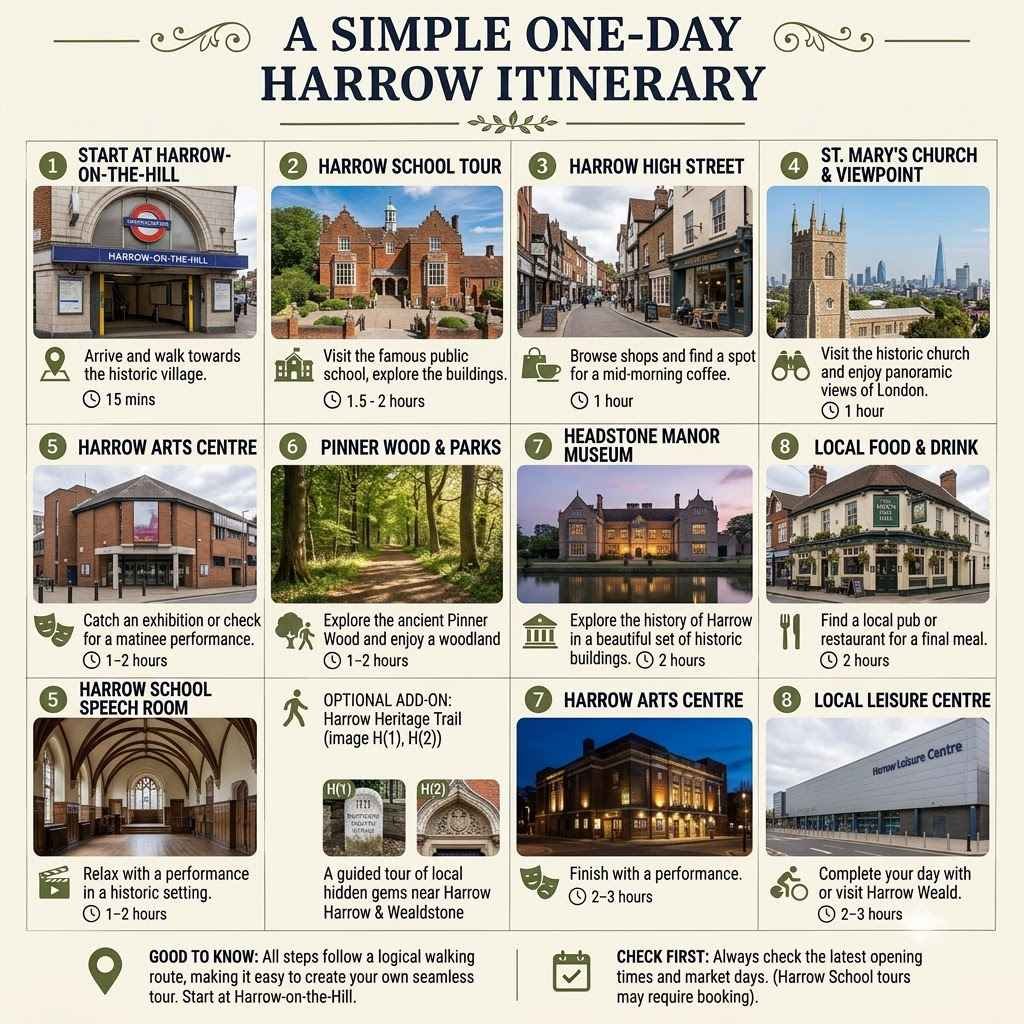
A simple one-day Harrow itinerary
If this is your first visit, a manageable itinerary would be:
- Morning: Start at Harrow-on-the-Hill Underground station and walk through the historic part of Harrow-on-the-Hill. Visit St Mary’s Church and spend some time exploring the surrounding streets.
- Lunch: Continue towards central Harrow or choose a café in the wider Harrow on the Hill/Pinner area.
- Afternoon: Head to Headstone Manor & Museum. Allow enough time for the museum and a walk around the manor grounds and Headstone Manor Park.
- Late afternoon: If you still have time and energy, continue towards another nearby green space rather than trying to cross the entire borough.
For a culture-focused day, replace Headstone Manor with a performance or exhibition at Harrow Arts Centre in Hatch End.
Things to know before visiting Harrow
A little planning will make the day easier.
- Check attraction schedules. Museums and cultural venues have their own opening hours and event calendars.
- Wear sensible shoes. Harrow on the Hill is much more enjoyable on foot, and some walks involve slopes.
- Allow extra time for parks. Several green spaces are larger than they initially appear, so they are easy to underestimate when planning a tight itinerary.
- Check transport before leaving. Tube and Overground services can change because of planned engineering works.
- Do not assume school buildings are open to casual visitors. Harrow School is an active independent school, so visitors interested in its architecture should check official visitor arrangements rather than expecting unrestricted access.
- Check event dates. Harrow’s museums, arts venues and parks host seasonal activities, so an event can significantly change what is available on a particular weekend.
Current events worth checking
Harrow’s attractions are not static. The borough runs a regular programme of community, cultural and nature-related events.
For example, Headstone Village Show is scheduled for 31 August 2026 at Headstone Manor & Museum, with live music, outdoor theatre, family activities, craft stalls and other entertainment.
Harrow Arts Centre also has performances and creative events scheduled through late August and September 2026, including theatre, comedy, music and visual arts.
The safest approach is to check the official event listings immediately before visiting because programmes, ticket arrangements and timings can change.
Frequently Asked Questions
What are the best things to do in Harrow?
The best things to do in Harrow include exploring Harrow on the Hill, visiting St Mary’s Church and Headstone Manor & Museum, walking through Canons Park and Headstone Manor Park, and seeing a performance at Harrow Arts Centre.
Is Harrow on the Hill worth visiting?
Yes. Harrow on the Hill is the borough’s most historically distinctive area, with old streets, St Mary’s Church, links to Harrow School and views across London. It is best explored on foot.
Is Headstone Manor & Museum free?
Yes. The museum currently offers free entry. Its published opening hours are Tuesday to Sunday, 10 am to 4 pm, and it is closed on Mondays.
What can families do in Harrow?
Families can visit Headstone Manor & Museum, explore Headstone Manor Park, visit Roxbourne Park and its miniature railway when operating, or choose family programming at Harrow Arts Centre.
Where can I get good views in Harrow?
The Viewpoint at Old Redding is one of the clearest choices. Harrow Council specifically identifies the site for its views across north London on clear days.
Is Harrow good for walking?
Yes. Harrow has a large network of parks and open spaces, while Harrow on the Hill and the surrounding historic streets provide a different kind of walking experience. The borough has 80 green spaces according to Harrow Council.
What is there to do in Pinner?
Pinner is suited to a relaxed day combining its local centre with green spaces such as Pinner Village Gardens. The gardens are around a 10-minute walk from Pinner Underground station.
What can I do in Harrow when it rains?
Check the programme at Harrow Arts Centre for theatre, comedy, music, film, exhibitions or workshops. Headstone Manor & Museum is another option when it is open.
How do I get to Harrow on the Hill?
Harrow-on-the-Hill Underground station is on the Metropolitan line and is the most convenient Tube station for the historic hilltop area.
Can I visit Harrow School?
Harrow School is an active school rather than a conventional public attraction. Its historic buildings are an important part of the character of Harrow on the Hill, but visitors should check the school’s official arrangements before planning a visit.
Final thoughts
The best Things To Do in Harrow are not concentrated around one attraction. The borough rewards visitors who move between its different neighbourhoods.
Start with Harrow on the Hill if history and architecture appeal to you. Headstone Manor is the stronger choice for understanding the area’s past, while Canons Park, Pinner Village Gardens and the borough’s other green spaces provide plenty of opportunities to get outdoors.
For culture, Harrow Arts Centre gives the area a year-round programme of theatre, comedy, music and creative events.
The easiest way to plan a visit is to pick one part of Harrow and explore it properly rather than attempting to cover the whole borough. Check opening times and event listings before travelling, then leave some room for an unplanned walk or stop along the way.