
Fulham has a particularly appealing mix of London experiences. The River Thames runs along its southern edge, historic buildings sit alongside residential streets, and some of west London’s best-known green spaces are within easy walking distance of one another. There is also a strong sporting connection, with Craven Cottage occupying a distinctive riverside position and the area’s football heritage woven into everyday life.
For visitors, the best things to do in Fulham are not confined to one attraction. You can spend a morning exploring the history of Fulham Palace, walk through Bishop’s Park to the Thames, browse North End Road Market, stop for lunch around Parsons Green and finish the day beside the river. Football fans can make Craven Cottage the centrepiece of a visit, while families have parks, open spaces and accessible activities to choose from.
This guide focuses on the places and experiences that make Fulham worth exploring, with practical information on what to see, how to get around and how to combine several attractions in one day.
The best things to do in Fulham at a glance
| Place or activity | Best for | Time to allow | Cost |
| Fulham Palace | History, gardens, families | 1.5–3 hours | Free admission |
| Bishop’s Park | Walking, relaxing, families | 1–2 hours | Free |
| Craven Cottage | Football and architecture | 1–2 hours | Varies |
| Thames riverside walk | Walking and views | 45 mins–2 hours | Free |
| North End Road Market | Food and local shopping | 30–90 mins | Free to browse |
| All Saints Fulham | History and architecture | 20–40 mins | Check access |
| Parsons Green | Cafés, pubs and local atmosphere | 1–2 hours | Varies |
| Hurlingham Park area | Green space and outdoor time | 1–2 hours | Free |
| Fulham’s independent streets | Shopping and food | 1–3 hours | Free to browse |
The attractions are spread across Fulham rather than concentrated in a single tourist quarter. That is part of the appeal. A visit works particularly well on foot, although the District line provides convenient access to several parts of the neighbourhood.
The best things to do in Fulham

1. Visit Fulham Palace and its historic gardens
Fulham Palace should be near the top of any list of the best things to do in Fulham.
The site was home to the Bishops of London for more than 1,300 years, and its history reaches much further back than the surviving house. Archaeological evidence indicates activity on the site thousands of years before the first Bishop of London was established there. Today, visitors can explore the museum and historic rooms, then move outside into the gardens.
The attraction is unusually good for a London historic site because admission to the house and garden is free. A free time slot is required for the house, while the grounds provide considerably more space to explore. The botanic garden covers 13 acres and includes the walled garden.
Inside, the museum explains the story of the Palace through archaeology, the Bishops of London, religion, domestic life and the development of the estate. There are interactive displays as well as historic rooms, making it more approachable than a museum that relies solely on display cases and information panels.
What to see at Fulham Palace
- The museum and historic rooms
- The Tudor great hall
- The chapel
- Archaeological displays
- The botanic garden
- The walled garden
- The historic grounds
- Seasonal events and guided tours
The current published opening times list the museum and historic rooms from 10.30 am to 5 pm, with last entry at 4.30 pm. The botanic garden opens from 7 am to 6 pm, while the walled garden has shorter hours. Opening arrangements can change for private events, so check before travelling.
Best for: history, gardens, families, photography and a quieter London afternoon.
2. Walk through Bishop’s Park
Bishop’s Park is the natural companion to Fulham Palace.
The park sits beside the Thames and is listed Grade II on the Register of Parks and Gardens of Special Historic Interest. Its location makes it easy to combine with a visit to the Palace rather than treating it as a separate destination.
A walk through the park gives you a different perspective on Fulham. Instead of busy main roads and shops, the route opens onto lawns, trees, paths and the river. It is a useful place to slow down between sightseeing stops.
For families, the park is also significant because Hammersmith & Fulham Council has included Bishop’s Park among the borough’s major playground improvement projects as part of a three-year programme approved in 2025.
If you are visiting Fulham Palace, allow time to continue through the park towards the river rather than turning straight back towards Fulham Palace Road.
Best for: families, walking, picnics, open space and combining several attractions.
3. Follow the Thames beside Fulham
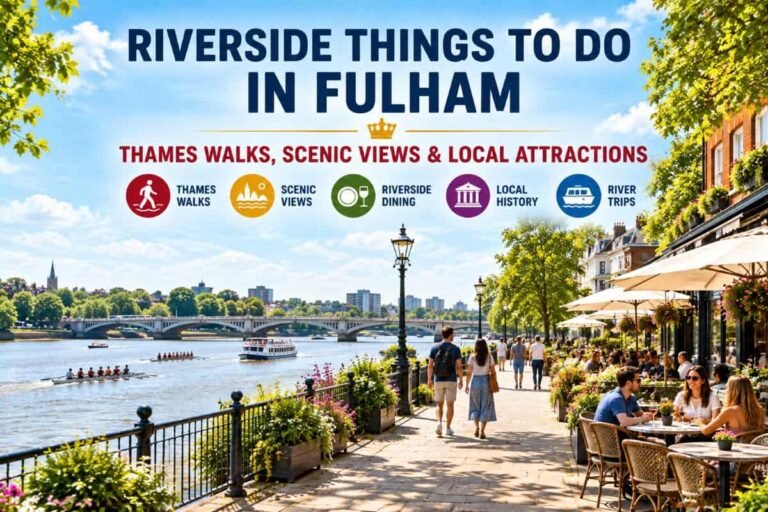
The River Thames is one of Fulham’s defining features, and walking beside it is one of the simplest things to do in the area.
The stretch around Fulham Palace, Bishop’s Park and Putney Bridge is particularly useful for visitors because several landmarks sit close together. Fulham Palace itself identifies the Thames Path and Bishop’s Park among its immediate neighbouring attractions.
A riverside walk can be as short or long as you want. A short outing might link Bishop’s Park with Putney Bridge. A longer walk can take in more of the Thames frontage and neighbouring parts of west London.
One practical point matters at present: access around Putney Bridge and the approach to Fulham Palace is affected by a construction programme. Fulham Palace says a signed pedestrian diversion is in place and that part of the Thames Path and Willow Bank are closed during the works, currently expected to continue into 2027.
Check the latest route information before setting off, particularly if you are planning a longer walk.
Best for: walkers, photographers, couples and anyone looking for free things to do in Fulham.
4. See a match or take a tour at Craven Cottage
Football is impossible to separate from Fulham.
Craven Cottage, the home of Fulham Football Club, occupies a distinctive position beside the River Thames. The club describes the stadium as its historic home and offers stadium tours as well as matchday experiences.
Even if you are not attending a match, the ground is worth including in a Fulham itinerary. Its riverside setting gives it a character that is quite different from many modern football grounds.
For football supporters, a stadium tour offers a chance to see more of the ground and learn about its history. Matchday is a different experience altogether, with the surrounding streets taking on a stronger football atmosphere.
The club’s current visitor information is the best place to check tour availability, match arrangements and prices before travelling, as these details vary.
Craven Cottage or Fulham Palace?
If you have limited time:
- Choose Fulham Palace for history, gardens and free admission.
- Choose Craven Cottage for football, sport and stadium history.
- Visit both if you have most of a day, as they are close enough to combine with Bishop’s Park and the riverside.
Best for: football supporters, sports fans and visitors interested in London stadium history.
5. Stop at All Saints Fulham
Just beside Fulham Palace and Bishop’s Park, All Saints Fulham adds another layer to the area’s history.
The church has a particularly close relationship with Fulham Palace. Eleven Bishops of London are buried at All Saints, and the church has long been connected with the former episcopal estate.
It is therefore worth considering the Palace, All Saints and Bishop’s Park as one historical group rather than three unrelated attractions.
The church remains an active place of worship, so visitors should check arrangements before entering and be respectful of services and other activities. Its location beside the park also makes it an easy stop during a walking itinerary.
Best for: architecture, local history and visitors exploring the Fulham Palace area.
6. Browse North End Road Market
For a more everyday side of Fulham, head towards North End Road.
North End Road Market has been established since the 1880s and remains an important local market. Hammersmith & Fulham Council describes it as a six-day-a-week market selling fresh produce, household goods and other everyday items.
The market is quite different from London’s major visitor-focused markets. Its value is in seeing a working neighbourhood market serving residents as well as visitors.
It is a good place to browse fresh food, pick up something inexpensive to eat and explore the surrounding shops. The council’s published market information lists trading on North End Road from Monday to Saturday, with trading hours generally running from 8 am to 6 pm.
Market arrangements can change, particularly around special events and seasonal trading, so check the council’s latest information if the market is a specific reason for your visit.
Best for: food, local shopping, budget-friendly outings and experiencing everyday Fulham.
7. Explore Parsons Green
Parsons Green gives you a different feel from the historic riverside end of Fulham.
The open green itself is surrounded by residential streets, restaurants, pubs and cafés, making it a useful place to stop for food or a drink during a day of exploring.
The surrounding area is particularly pleasant to explore on foot. From Parsons Green you can walk towards Fulham Road, Fulham Broadway or the quieter residential streets around Peterborough Road and New King’s Road.
It is also a practical base for visitors who want to combine sightseeing with lunch or dinner rather than spending the entire day inside formal attractions.
There is no need to create a rigid itinerary here. Allow some time to wander, then choose somewhere to eat based on what looks appealing on the day.
Best for: food, cafés, pubs, relaxed walks and an afternoon break.
8. Spend time in Hurlingham Park
Hurlingham Park is another option when you want outdoor space rather than another indoor attraction.
The park sits close to the Thames and the wider Hurlingham area, allowing visitors to break up a sightseeing itinerary with time outdoors.
Nearby is The Hurlingham Club, a private members’ club occupying 42 acres beside the river. The club dates from 1869 and has a long association with tennis, croquet and polo. Access to the club itself is not the same as visiting a public park, so visitors should not assume that the club grounds are open for general sightseeing.
That distinction is useful when planning a visit: enjoy the public spaces around Hurlingham, but treat the private club as a separate destination requiring appropriate access.
Best for: outdoor time, walking and combining Fulham with a quieter riverside area.
9. Explore Fulham’s streets rather than only its attractions
One of the best ways to experience Fulham is simply to walk between its main areas.
The neighbourhood is made up of several distinct pockets. Fulham Broadway has a more commercial character, North End Road has its long-established market, Parsons Green provides open space and places to eat, while the southern end around Bishop’s Park and Fulham Palace is strongly shaped by the river and historic buildings.
Fulham Road and New King’s Road are useful routes for browsing shops, cafés and restaurants. Around the smaller residential streets, you will also see the Victorian and Edwardian housing that gives much of west London its distinctive architectural character.
This is where a local directory can be more useful than a conventional sightseeing list. Once you know which part of Fulham you are visiting, you can search for nearby restaurants, cafés, pubs, shops and services rather than crossing the neighbourhood unnecessarily.
10. Look for seasonal events at Fulham Palace
Fulham Palace is not simply a static historic attraction.
Its programme includes exhibitions, talks, tours, family activities and seasonal events. Current listings show history and garden tours alongside other activities, although the programme changes throughout the year.
This makes checking the official calendar worthwhile before visiting.
A return visit in spring, summer or autumn can feel quite different because the gardens change through the seasons. Special events can also alter access to parts of the site, so advance checking is particularly useful if you are travelling for a specific activity.
Best for: repeat visitors, families, history enthusiasts and garden lovers.
11. Things to do in Fulham for families
Fulham works well for a family day because several of its main attractions are free or outdoors.
A practical family route could look like this:
- Start at Fulham Palace.
- Explore the museum and historic rooms.
- Walk through the gardens.
- Continue into Bishop’s Park.
- Stop for a picnic or outdoor break.
- Walk towards the Thames.
- Finish with food around Fulham or Parsons Green.
The Palace also provides free children’s trails, giving younger visitors something specific to look for rather than relying on a conventional museum visit.
For families with mobility considerations, check current access information before travelling. Fulham Palace provides accessibility resources including a visual story, large-print information and other visitor support.
Free things to do in Fulham
You do not need a large budget to enjoy the area.
Some of the best free things to do in Fulham include:
- Visit the museum at Fulham Palace.
- Explore the Palace gardens.
- Walk through Bishop’s Park.
- Follow the Thames Path where routes are open.
- Walk around Parsons Green.
- Browse North End Road Market.
- Explore Fulham’s historic streets.
- Visit the exterior of Craven Cottage and surrounding riverside area.
- Explore the area around All Saints Fulham, subject to church access.
Fulham Palace is particularly useful for budget-conscious visitors because admission to the house and garden is free, although a free ticket is required for the house.
How to get around Fulham
Fulham is well connected by the London Underground, with several District line stations serving the area.
The main stations relevant to visitors include:
- Putney Bridge – useful for Fulham Palace, Bishop’s Park and the Thames.
- Parsons Green – convenient for Parsons Green and central Fulham.
- Fulham Broadway – useful for Fulham Broadway, Fulham Road and Craven Cottage connections.
- West Brompton – useful for the northern edge of the area.
Transport arrangements can change because of planned works, weekend engineering and temporary closures, so use TfL’s live journey information on the day.
For Fulham Palace specifically, the Palace currently recommends Putney Bridge Station, followed by a walk through Bishop’s Park. It warns that a signed diversion is currently in place because of construction works around the station and riverside route.
Walking is often the easiest option once you arrive because many of the attractions can be linked together without returning to a station after every stop.
A useful one-day Fulham itinerary
If you have one full day, avoid trying to cover every street. Concentrate on the western and southern parts of the neighbourhood.
Morning: Fulham Palace
Arrive at Fulham Palace and allow around two hours for the museum, historic rooms and gardens.
If history is your priority, check whether a guided tour is running.
Late morning: Bishop’s Park
Walk through Bishop’s Park towards the river. Take your time rather than treating the park as a route between attractions.
Lunch: Fulham or Parsons Green
Head back towards central Fulham for lunch. North End Road is useful for a more casual, market-oriented option, while Parsons Green and the surrounding streets offer a wider choice of sit-down venues.
Afternoon: Craven Cottage
Continue towards Craven Cottage. If a stadium tour is available and suits your schedule, book ahead. Otherwise, explore the riverside surroundings and continue your walk.
Late afternoon: Thames walk
Finish with a riverside walk, checking the current diversion information before setting off.
Evening: Parsons Green or Fulham Broadway
End the day around Parsons Green or Fulham Broadway for dinner or drinks.
Fulham at a glance: which area suits you?
| Area | Best for | Suggested time |
| Fulham Palace | History and gardens | 2–3 hours |
| Bishop’s Park | Parks and families | 1–2 hours |
| Craven Cottage | Football | 1–2 hours |
| Parsons Green | Food and local atmosphere | 1–2 hours |
| North End Road | Market and everyday shopping | 30–90 minutes |
| Thames riverside | Walking and views | 45 minutes–2 hours |
| Hurlingham area | Outdoor space | 1–2 hours |
| Fulham Broadway | Shopping, food and football access | 1–2 hours |
Times are planning estimates rather than fixed attraction durations.
What are the best things to do in Fulham?
For a first visit, the strongest combination is Fulham Palace, Bishop’s Park, the Thames and Craven Cottage.
They give you four different sides of the neighbourhood: history, green space, riverside scenery and football.
If you have more time, add North End Road Market and Parsons Green. Those stops provide a better sense of contemporary Fulham and its everyday life.
The main advantage of this approach is that you do not spend the day travelling between unrelated attractions. Much of the sightseeing can be linked into one walking route.
FAQ
Is Fulham worth visiting?
Yes. Fulham is particularly good for visitors who enjoy historic buildings, parks, riverside walks, football, local markets and food. Its attractions can also be combined into a compact walking itinerary.
What is the main attraction in Fulham?
Fulham Palace is arguably the area’s most significant historic attraction. It was home to the Bishops of London for more than 1,300 years and now contains a museum, historic rooms and extensive gardens. Admission is free.
Is Fulham Palace free to visit?
Yes. Entry to the house and garden is free, although visitors to the house need to book a free ticket or timeslot. Donations are welcomed.
What can you do in Fulham for free?
Free options include Fulham Palace and its gardens, Bishop’s Park, riverside walks on open sections of the Thames Path, exploring Parsons Green and browsing North End Road Market.
Is Craven Cottage open to visitors?
Fulham Football Club offers stadium tours, but availability and pricing vary. Check the club’s official visitor information before travelling.
What is Fulham known for?
Fulham is known for Fulham Football Club and Craven Cottage, Fulham Palace, its Thames-side setting, parks and established residential neighbourhoods.
Which Tube station is best for Fulham Palace?
Putney Bridge is the station recommended by Fulham Palace. The Palace says the walk takes around 15 minutes through Bishop’s Park, although a temporary diversion is currently in place because of construction works.
Is Fulham good for families?
Yes. Fulham Palace offers free family trails, while Bishop’s Park and other open spaces provide opportunities for outdoor activities. The local council is also investing in improvements to playground provision.
What can you do in Fulham on a rainy day?
Visit Fulham Palace’s museum and historic rooms, then combine the day with lunch, cafés, shops or a stadium tour if one is available. Check individual venues before travelling.
Can you walk around Fulham?
Yes. Walking is one of the best ways to experience the area because Fulham Palace, Bishop’s Park, the Thames, Craven Cottage, Parsons Green and local shopping streets can be linked into longer walks.
Final thoughts
Fulham rewards visitors who take their time.
The headline attractions are easy to identify: Fulham Palace provides the history, Craven Cottage supplies the football connection and the Thames gives the neighbourhood its riverside character. But the area becomes more interesting when these are combined with Bishop’s Park, North End Road Market, Parsons Green and the quieter residential streets between them.
For a first visit, start around Fulham Palace and Bishop’s Park, walk towards the river and continue towards Craven Cottage. Add North End Road or Parsons Green depending on whether you prefer markets or restaurants.
Before setting off, check official attraction and transport information, particularly for Palace events, stadium tours and the current riverside diversions. That small amount of planning leaves more time to enjoy Fulham at street level.