Greenwich is one of those parts of London where a shopping trip can easily turn into something much bigger. You might start by looking for a gift at Greenwich Market, browse independent shops around Maritime Greenwich, head towards Greenwich Peninsula for outlet bargains, or cross into Charlton for a larger retail trip.
That variety is useful, but it can also make it difficult to know where to go first.
This Shopping Guide to Greenwich explains how to choose the right shopping area for what you actually need, how to compare prices, where markets make sense, when outlet shopping can offer genuine value, and how to avoid spending more simply because you are in a tourist-heavy part of London.
The key is to treat Greenwich as several shopping destinations rather than one conventional high street. Historic Greenwich is particularly strong for independent products, gifts, crafts and specialist purchases. Greenwich Peninsula is better suited to outlet shopping and major brands, while the wider Royal Borough provides larger high streets and retail parks for everyday essentials.
Quick guide to shopping in Greenwich
| Shopping area | Best for | Shopping style | Good choice when |
| Greenwich Market | Gifts, crafts, vintage, art, handmade goods | Independent traders | You want something distinctive |
| Maritime Greenwich | Boutiques, homeware, specialist shops and souvenirs | Independent and specialist | You want to browse at a relaxed pace |
| Greenwich Peninsula | Fashion, sportswear, designer and lifestyle outlets | Outlet shopping | You are looking for branded goods |
| Greenwich Shopping Park | Everyday shopping, home, fashion and food | Retail park | You want several practical shops together |
| Blackheath Village | Independent shops, fashion, food and charity shops | Village high street | You prefer smaller retailers |
| Woolwich | Everyday essentials and high-street shopping | Large high street | You need practical purchases |
| Eltham | High-street shopping and local services | Town-centre shopping | You want everyday convenience |
Greenwich Market and Maritime Greenwich offer a particularly different experience from the large-format retail destinations around Greenwich Peninsula and Charlton. Visit Greenwich describes the wider borough as having a mix of independent makers, high-street retailers, markets and outlet shopping.
Smart Shopping Tips and Tricks: Save money and Shop the Best
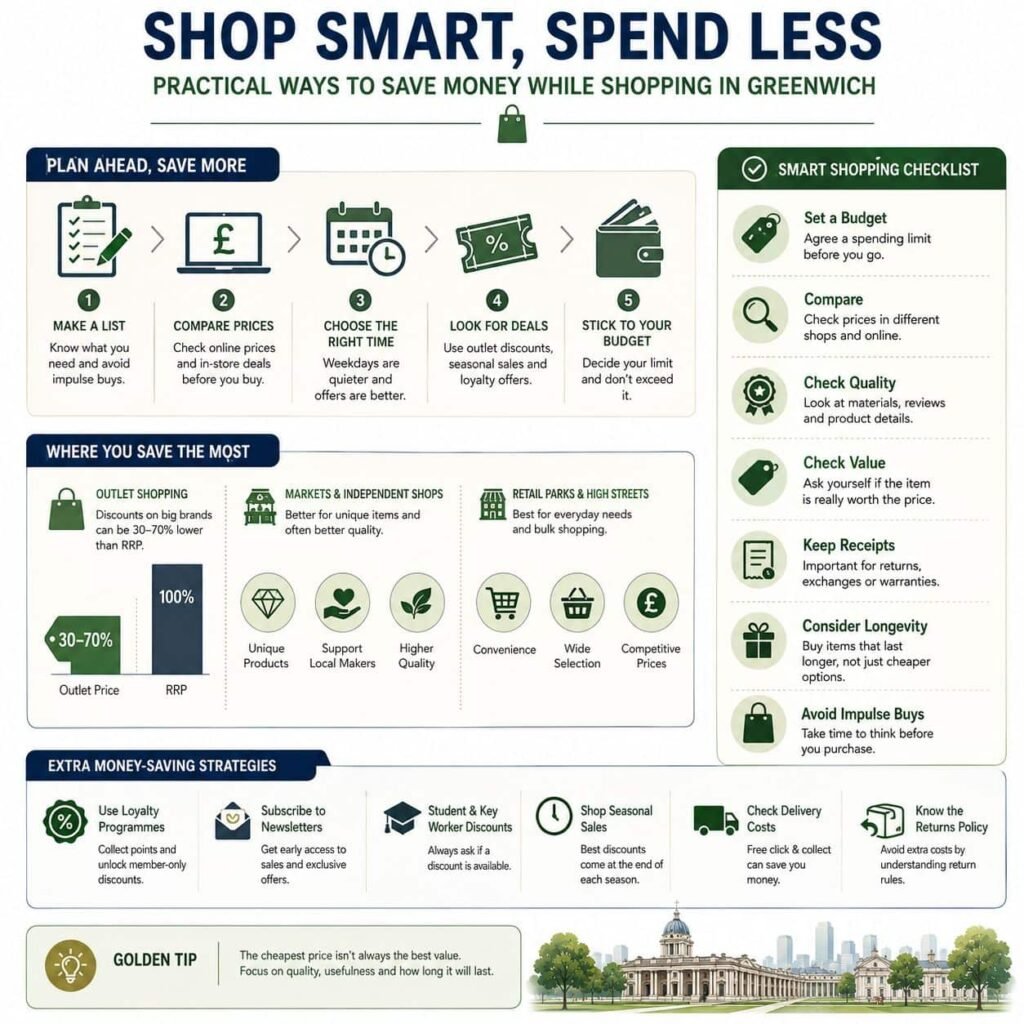
1. Decide what you actually need before you leave
The simplest way to shop more intelligently is to decide what kind of purchase you are making.
A £20 gift, a new pair of trainers, weekly groceries and a piece of furniture should not all lead to the same shopping destination.
Before travelling, make a short list:
- Everyday essentials: look at supermarkets, high streets and retail parks.
- Fashion: compare high-street shops with outlet retailers before buying.
- Gifts: Greenwich Market and the specialist shops around Maritime Greenwich are worth considering.
- Vintage or unusual items: allow time for market and independent shopping.
- Homeware: compare retail-park prices with independent retailers.
- Food: decide whether you need a full grocery shop or simply a few specialist ingredients.
- Branded goods: check outlet pricing against the normal retail price before assuming you have found a bargain.
This sounds obvious, but it prevents one of the most common shopping mistakes: choosing a destination because it looks interesting rather than because it suits the purchase.
2. Start with Greenwich Market when you want something different
For distinctive gifts and independent products, Greenwich Market is one of the most useful places to begin.
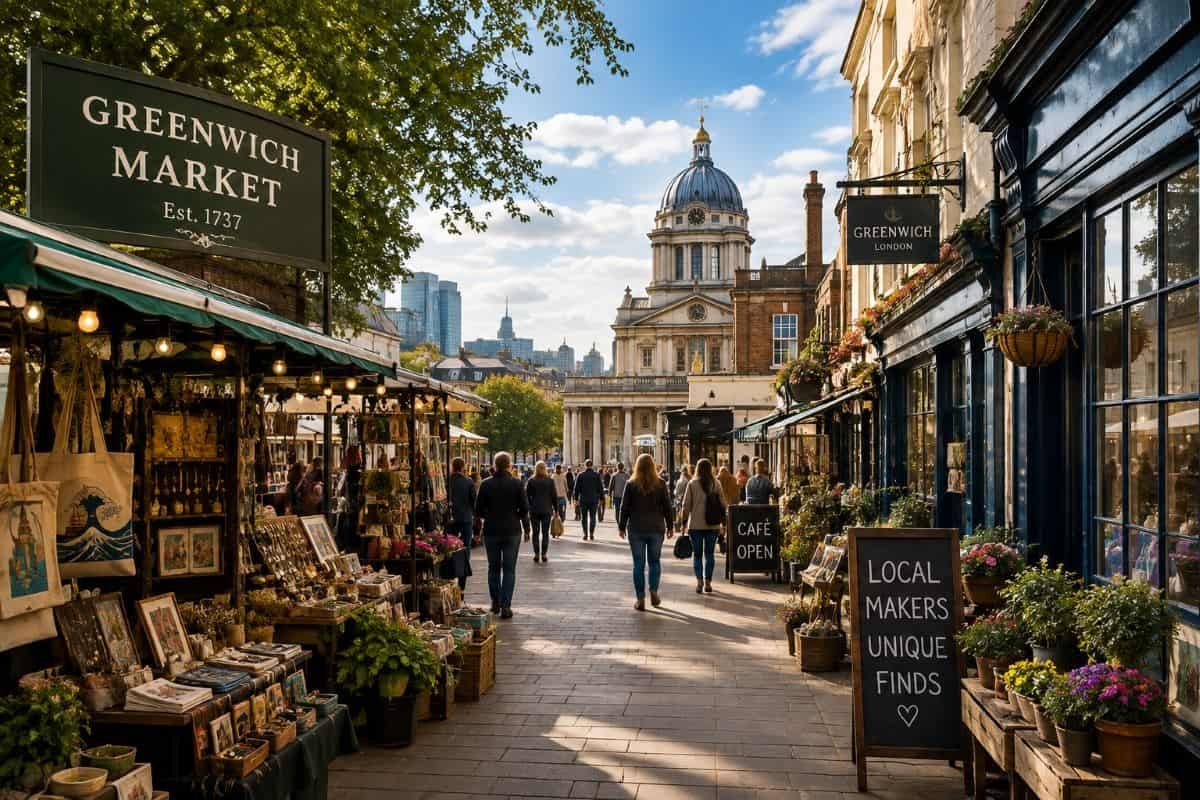
The market has traded since 1737 and currently describes itself as home to more than 120 independent traders. Its offer includes handcrafted gifts, artwork, jewellery, vintage fashion, homeware, artisan food and other specialist products. The market is open daily from 10 am to 5.30 pm, although its own guidance notes exceptions around Christmas and some early-year Mondays.
Shop with a market mindset
Market shopping works differently from buying from a standard chain.
Do not assume that the first attractive item is the best option. Walk around first, compare similar products and ask questions about materials, production and sizing where appropriate.
For higher-value purchases, consider:
- What is the item made from?
- Is it handmade or mass-produced?
- Can you find something similar elsewhere?
- Is the price clear?
- What happens if the item develops a problem after purchase?
Greenwich Market has also signed the Real Deal fake-free charter with the Royal Borough of Greenwich, reinforcing its commitment to safe and legitimate trading.
That does not mean shoppers should stop exercising normal judgement. It simply provides useful reassurance when buying from a market environment.
Take cash, but don’t rely on it
Payment methods can vary between individual traders, so carrying a backup payment option is sensible. Check with the seller before committing to a purchase, particularly for larger or specialist items.
3. Use Maritime Greenwich for independent shopping
The streets around historic Maritime Greenwich are better suited to browsing than a tightly planned supermarket-style shop.
Visit Greenwich highlights independent designer makers, antiques and collectables, fashion, lifestyle brands and homeware alongside cafés, restaurants and pubs.
This area works particularly well if you are shopping for:
- gifts that feel local rather than generic;
- art and craft products;
- specialist homeware;
- vintage or antique-style pieces;
- souvenirs connected with Greenwich;
- small purchases from independent retailers.
The advantage is choice. The disadvantage is that independent products are not necessarily cheaper than mass-market alternatives.
That distinction matters.
Shopping smart does not always mean paying the lowest price. If you are buying a locally designed print, handmade piece or specialist product, the comparison should include quality, originality and usefulness rather than price alone.
4. Compare outlet prices before calling them bargains
For major brands, Greenwich Peninsula is the obvious alternative to the historic town centre.
Outlet Shopping at The O2 has more than 60 brands, with the official venue describing the destination as offering fashion and lifestyle shopping alongside restaurants and entertainment. Examples of brands featured by The O2 include adidas, Calvin Klein, Levi’s, Nike and Tommy Hilfiger.
Visit Greenwich says outlet shopping at The O2 can offer discounts of up to 70% off RRP on selected products.
That headline figure should not automatically determine a purchase.
A better way to judge an outlet bargain
Before buying, ask:
What is the actual price today?
Then consider:
- Is the same product currently cheaper elsewhere?
- Is it the exact model or a different outlet-specific version?
- Is the claimed discount based on a realistic reference price?
- Would you buy it if there were no discount sign?
- Do you genuinely need it?
A 50% discount on something you do not need is still money spent.
The strongest outlet purchases tend to be products you had already planned to buy and have researched beforehand.
5. Know the difference between Greenwich Shopping Park and Greenwich Peninsula
The phrase Greenwich shopping park can confuse because visitors may use it loosely when referring to several retail destinations.
Greenwich Shopping Park is in Charlton and is listed by Visit Greenwich as a retail-park destination offering fashion, gifts, sports equipment, home essentials and food. It also advertises free parking for up to three hours, subject to its stated conditions.
Greenwich Peninsula, by contrast, is centred around North Greenwich, The O2 and Peninsula Square. The area has its own supermarkets and convenience shops as well as outlet shopping and other retail uses.
The distinction is useful:
- Greenwich Shopping Park: practical retail-park trip.
- Greenwich Peninsula: outlet brands, leisure and food.
- Maritime Greenwich: independent and specialist shopping.
- Greenwich Market: artisan, vintage and gift shopping.
Choose the destination according to the shopping list rather than assuming all four provide the same experience.
6. Don’t overlook Blackheath Village
If you have time to travel beyond central Greenwich, Blackheath Village offers a very different shopping experience.
Visit Greenwich lists a mixture of independent fashion retailers, established brands, tailors, cafés, delicatessens and charity shops in the village.
Charity shops can be particularly useful for shoppers willing to spend time browsing rather than looking for a specific item immediately.
For second-hand shopping, check:
- condition;
- labels and materials;
- signs of wear;
- whether the price reflects the condition;
- whether a similar item is available new for less.
The best charity-shop purchases are rarely about finding something on demand. They are about recognising value when you see it.
7. Consider Woolwich and Eltham for practical shopping
Greenwich’s shopping offer extends well beyond the tourist centre.
Woolwich High Street, also known as Powis Street, includes fashion, pharmacy, discount retailers, technology and phone shops, greengrocers, health-food retailers and supermarkets nearby.
Eltham is another useful option for everyday shopping, with its high street combining shops, cafés and services.
For residents, these areas can make more sense than travelling into Maritime Greenwich for routine purchases.
The lesson is simple: local convenience can itself be a form of saving.
If travelling across London costs more time and money than the product is worth, the cheaper item is not necessarily the cheaper shopping trip.
8. Plan your route around transport
Greenwich is well connected, but the best transport option depends heavily on which shopping area you are visiting.
Historic Greenwich is served by Greenwich station and the DLR, while North Greenwich is served by the Jubilee line. The DLR route also connects Greenwich with destinations including Canary Wharf and Bank.
As of 2026, Cutty Sark DLR station has reopened following escalator replacement works. TfL says the station reopened in March 2026, ahead of schedule.
For shopping, this matters because carrying bags changes the practicality of a route.
A useful rule is:
Do the heaviest shopping last if you can.
For example, if you are combining Greenwich Market with sightseeing, browse first and make larger purchases later. This avoids carrying bags around Greenwich Park or between attractions.
9. Combine shopping with Greenwich’s attractions carefully
Greenwich is an unusual shopping destination because some of its biggest attractions sit directly alongside shopping areas.
The Cutty Sark, National Maritime Museum, Royal Observatory and Greenwich Park make it easy to turn a shopping trip into a full day.
That can be enjoyable, but it can also encourage impulse spending.
Set a rough shopping budget before you arrive. If you are visiting with children, decide whether souvenirs are part of the day’s budget rather than deciding on every shop.
Greenwich Park is also useful as a natural break from shopping. The Royal Parks lists cafés and kiosks within the park, including the Pavilion Café and Ignatius Sancho Café.
A pause can be surprisingly effective at preventing unnecessary purchases. If you still want an item after lunch and a walk, you are more likely to be buying it because you actually want it.
10. Make a shopping budget before visiting
You do not need a complicated spreadsheet.
A simple three-part budget is enough:
| Budget | What it covers |
| Planned | Items you came specifically to buy |
| Flexible | Gifts, food or smaller finds |
| Optional | Anything you would only buy if the price is excellent |
This is particularly useful at markets and outlets, where there can be a strong temptation to buy something simply because it appears unusual or discounted.
For larger purchases, give yourself a cooling-off period. Walk away, compare the price online and return if it still makes sense.
11. Compare prices online before buying expensive items
Physical shops are useful because you can see, handle and sometimes try products before buying.
But there is no reason to stop comparing prices once you are in the shop.
For higher-value purchases:
- Search the exact product name or model.
- Compare the current price from several reputable retailers.
- Check delivery charges.
- Check the returns policy.
- Confirm the product specification.
- Only then decide whether the local purchase represents good value.
Be careful with vague comparisons. A different colour, size, generation or specification can make two apparently identical prices difficult to compare.
For outlet shopping, this step is especially important.
12. Use markets for discovery, shops for certainty
One useful way to approach Greenwich is to divide shopping into two categories.
Markets are better for
- unusual gifts;
- handmade goods;
- vintage items;
- art;
- jewellery;
- browsing;
- locally produced products.
Conventional retailers are better for
- standard sizes;
- warranties and established returns processes;
- repeat purchases;
- household essentials;
- products where you already know the exact model.
Neither approach is automatically better.
If you know exactly which pair of trainers you need, a conventional retailer or outlet may be more efficient. If you want a birthday present with some personality, a market can provide far more useful choice.
13. Shop around food destinations rather than buying everything in one place
Greenwich Peninsula has a range of grocery options, including Sainsbury’s Local, Tesco Express and other convenience retailers, while larger supermarkets are available around Charlton and the wider area.
For a small food shop, convenience can win.
For a large weekly shop, compare basket prices before travelling. A small difference on individual products can become meaningful when multiplied across an entire trolley.
Specialist food shopping can be different again. Greenwich Market’s food offer is more suited to eating and browsing than replacing a conventional supermarket shop.
The smartest option depends on the purpose of the trip.
14. Watch for seasonal and event-related shopping
Greenwich Market regularly runs special events and themed trading periods. For example, its 2026 programme includes market events alongside its regular shopping offer.
Events can be a good reason to visit, but shoppers should distinguish between an event purchase and an everyday bargain.
If you are visiting because a market has a particular event or collection of traders, check the organiser’s current information before travelling. Trading line-ups and event schedules can change.
The same applies to The O2. Shopping there can become considerably busier around major entertainment events, so checking the venue’s current event calendar can help you decide when to visit.
15. Think about what you will do with your purchases
This is an overlooked part of shopping efficiently in London.
A bargain becomes less attractive if you have to carry it around for six hours.
Before buying something bulky, consider:
- Can you carry it comfortably?
- Does the retailer offer delivery?
- Are you travelling by public transport?
- Will you be visiting other attractions afterwards?
- Can you return home before continuing your day?
This is particularly relevant when combining Greenwich shopping with Greenwich Park, the Cutty Sark or The O2.
For larger household purchases, delivery can sometimes make more sense than trying to transport everything yourself.
Pros and cons of shopping in Greenwich
| Advantages | Limitations |
| Strong mix of independent and major retailers | Different shopping areas are spread across the borough |
| Historic Greenwich Market offers distinctive products | Market prices are not always lower |
| Outlet shopping provides branded options | Not every outlet price represents the best available deal |
| Good combination of shopping and attractions | Tourist areas can become busy |
| Several high streets provide practical alternatives | Travelling between areas takes planning |
| Greenwich Peninsula has shopping, food and entertainment together | Easy to spend more when combining several activities |
A simple smart-shopping itinerary
If you have half a day, keep the plan focused.
Option 1: Independent shopping
Start: Greenwich Market
Then: Maritime Greenwich shops
Break: Greenwich Park
Finish: Greenwich town centre
This is the strongest option for gifts, crafts, independent products and browsing.
Option 2: Branded bargains
Start: North Greenwich station
Shop: Outlet Shopping at The O2
Break: Food and drink at The O2
Finish: North Greenwich Peninsula
The O2 currently promotes more than 60 outlet brands alongside more than 30 bars and restaurants.
Option 3: Practical retail trip
Start: Greenwich Shopping Park
Then: Charlton-area supermarkets or retailers
Finish: Return home with the heavier purchases
This makes more sense when the objective is practical shopping rather than sightseeing.
Option 4: Local high-street browsing
Start: Blackheath Village
Then: Browse independent and charity shops
Finish: Eltham or Greenwich depending on what remains on your list
This is better suited to shoppers who enjoy browsing smaller retailers rather than visiting a large shopping destination.
What makes a Greenwich shopping trip genuinely smart?
The best strategy is not to chase the biggest discount.
Instead:
- Know what you need before you travel.
- Choose the shopping area that matches the purchase.
- Compare expensive items before paying.
- Treat outlet discounts as a starting point, not proof of value.
- Browse markets before committing to a purchase.
- Use independent shops when originality matters more than the lowest price.
- Consider transport and the weight of your purchases.
- Check current opening information before travelling.
- Set a spending limit for impulse purchases.
- Keep receipts and understand the retailer’s returns policy.
Greenwich works best for shoppers who are prepared to move between different types of retail rather than expecting one street or centre to provide everything.
Frequently Asked Questions
1. What is the best shopping area in Greenwich?
It depends on what you want to buy. Greenwich Market is particularly useful for handmade goods, gifts, vintage items and independent products, while Outlet Shopping at The O2 is better suited to major fashion and lifestyle brands.
2. Is Greenwich Market open every day?
Yes. Greenwich Market states that it is generally open daily from 10 am to 5.30 pm, with some exceptions including Christmas Day and certain Mondays early in the year. Check the market’s current information before making a special journey.
3. Is Greenwich Market good for gifts?
Yes. Its traders sell handmade gifts, artwork, jewellery, vintage fashion, homeware and other distinctive products, making it particularly suitable when you want something less generic than a standard high-street purchase.
4. Is there a Greenwich shopping park?
Yes. Greenwich Shopping Park is in Charlton and offers a mixture of retail, food and practical shopping, with Visit Greenwich listing free parking for up to three hours subject to the site’s conditions.
5. Where can I find outlet shopping in Greenwich?
Outlet Shopping at The O2 is on Greenwich Peninsula near North Greenwich station. The O2 says the destination has more than 60 brands, while Visit Greenwich notes that selected outlet products can be offered at discounts of up to 70% off RRP.
6. Is Greenwich good for independent shopping?
Yes. Maritime Greenwich has independent designer makers, specialist retailers, antiques and collectables, fashion, lifestyle products and homeware. Blackheath Village is another useful area for independent shopping.
7. What is the best place for everyday shopping in Greenwich?
For everyday purchases, the answer depends on where you live and what you need. Greenwich Shopping Park, Woolwich High Street, Eltham High Street and supermarkets around Greenwich Peninsula all provide more practical alternatives to the tourist-centred parts of Maritime Greenwich.
8. Is Greenwich Market expensive?
Prices vary considerably because the market includes different independent traders and product types. Handmade, specialist and vintage products may cost more than mass-produced alternatives, so comparing quality and originality as well as price is sensible.
9. How do I find genuine bargains in Greenwich?
Research the normal price first, particularly for branded goods. At outlet shops, compare the exact product with prices elsewhere rather than relying only on the advertised percentage discount. At markets, walk around before buying and compare similar products.
10. Can I combine shopping with sightseeing in Greenwich?
Yes. Shopping in Maritime Greenwich can be combined with attractions such as the Cutty Sark, National Maritime Museum, Royal Observatory and Greenwich Park. The O2 also combines outlet shopping with food, entertainment and leisure facilities on Greenwich Peninsula.
Conclusion
A successful shopping trip in Greenwich is less about finding one supposedly perfect destination and more about matching the place to the purchase.
Start at Greenwich Market for handmade products, art, vintage pieces and unusual gifts. Explore Maritime Greenwich when you want independent and specialist retailers. Head to Outlet Shopping at The O2 when branded fashion and lifestyle products are the priority, but compare prices before assuming a discount is a bargain. For practical retail shopping, Greenwich Shopping Park, Woolwich and Eltham provide useful alternatives across the wider Royal Borough.
Most importantly, permit yourself to walk away from a purchase.
The smartest Greenwich shopper is not necessarily the person who finds the biggest discount. It is the person who spends money on the right thing, at a sensible price, from the right place — and still enjoys the rest of the day.