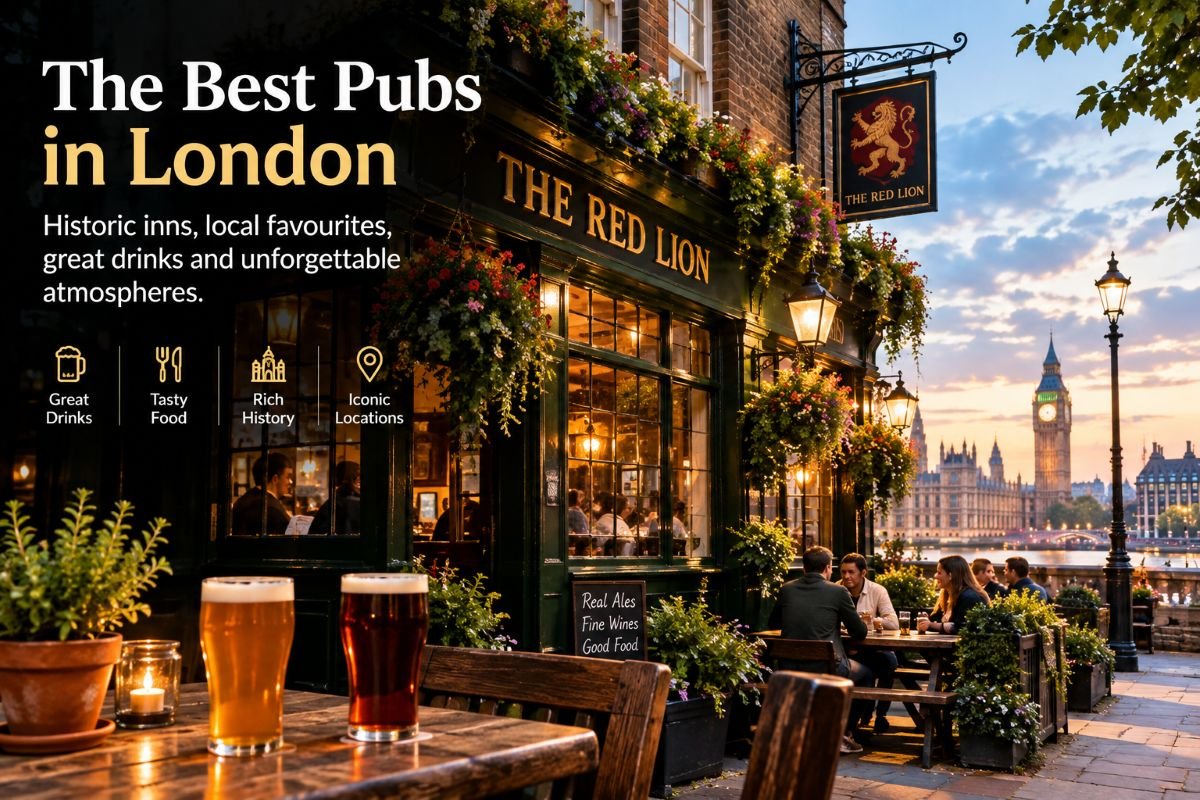
Finding the best pubs in London depends on what you want from the visit. One person might be looking for a properly traditional pub with a good pint of cask ale; another might want a riverside terrace, a Sunday roast, a quiet corner, or somewhere with centuries of history.
London has all of them.
The capital’s pub scene stretches from tiny drinking houses tucked away behind Covent Garden to riverside pubs in Wapping and Hammersmith, historic inns near Fleet Street and lively neighbourhood locals in Kentish Town, Kensington and beyond. Some are destinations in their own right, while others are places Londoners return to because they simply do the basics well.
There is no single official list of the best pubs in London. This selection instead focuses on pubs that stand out for their history, atmosphere, beer, setting, food or importance to London’s pub culture. CAMRA’s work is particularly useful for anyone interested in traditional pub interiors: its 2026 London’s Real Heritage Pubs guide identifies 249 Greater London pubs with interiors or internal features of special historic interest.
So, rather than chasing a single “number one” pub, here are some of the London pubs worth knowing — and why each one deserves a place on your list.
Best Pubs in London at a Glance
| Pub | Area | Best for |
| The Harp | Charing Cross | Real ale and traditional atmosphere |
| Ye Olde Cheshire Cheese | Fleet Street | History and character |
| The Lamb & Flag | Covent Garden | Historic pub experience |
| The Spaniards Inn | Hampstead | Country-pub atmosphere |
| The Dove | Hammersmith | Riverside drinking |
| Prospect of Whitby | Wapping | Thames views and history |
| The George Inn | Borough | Historic architecture |
| The French House | Soho | Traditional Soho pub culture |
| The Churchill Arms | Kensington | Iconic exterior and character |
| Southampton Arms | Kentish Town | Independent beer and cider |
| The Mayflower | Rotherhithe | Riverside history |
| The Guinea | Mayfair | Steak and traditional pub setting |
| The Viaduct Tavern | City of London | Victorian pub history |
| The Ten Bells | Spitalfields | East London history |
| The Cutty Sark | Greenwich | Thames-side setting |
This is an editorial selection, not a ranked league table. Pub opening hours, menus and availability can change, so check the pub’s current information before travelling.

What makes a pub one of the best in London?
A good London pub does not necessarily need a famous address or a long list of awards.
For this article, the most useful way to judge a pub is by looking at several things together:
- The atmosphere: Does the pub feel distinctive rather than interchangeable?
- The beer and drinks: Is there a worthwhile selection, particularly for people interested in cask ale, cider or independent breweries?
- The setting: Is it beside the Thames, hidden down an alley, overlooking a park or rooted in a neighbourhood?
- The history: Does the building or pub have a meaningful connection with London’s past?
- The food: Where food is a major part of the experience, does it complement the pub rather than turn it into a restaurant with a bar?
- The character: Would you remember the place after leaving?
- The location: Is it useful for combining with a walk, attraction, market or London neighbourhood?
That produces a much more interesting list than simply choosing the pubs with the biggest review counts.
CAMRA’s current London listings are also a useful reminder that London’s strongest pub experiences extend well beyond the obvious central destinations. Its 2026 regional winners include pubs such as Long Haul in Bexleyheath, Cockpit in Chislehurst, Dark Horse in Croydon, Cock Tavern in Hackney, Little Green Dragon in Winchmore Hill, Antelope in Surbiton, Wenlock Arms in Hoxton and Mitre in Richmond.
For visitors, however, the following pubs provide a good introduction to the capital’s different pub traditions.
1. The Harp, Charing Cross
Best for: real ale, cider and traditional central London pub atmosphere
The Harp is one of the strongest choices if your priority is the drink itself.
At 47 Chandos Place, close to Charing Cross and Leicester Square, this relatively compact pub has built a particularly strong reputation among cask-ale and cider drinkers. CAMRA records it as a former National Pub of the Year winner and notes its long history of recognition.)
Its narrow bar, mirrors, portraits and upstairs room give it considerably more character than its central location might suggest. There is no need for elaborate décor or a large dining room: the pub’s appeal is its traditional drinking-house feel.
It can become crowded, particularly at busy times, so this is a pub where arriving early can make a difference.
Nearest area: Charing Cross / Covent Garden
Good for: Cask ale, cider, pre-theatre drinks and traditional pub atmosphere.
2. Ye Olde Cheshire Cheese, Fleet Street
Best for: historic London atmosphere
Few pubs provide such a strong sense of old London as Ye Olde Cheshire Cheese.
Hidden down a narrow passage off Fleet Street, the pub is known for its low ceilings, wood-panelled rooms, fireplaces and maze-like interior. Visit London lists it among London’s historic pubs and highlights its associations with Charles Dickens and Samuel Johnson.
Its location also makes it easy to combine with a walk through the City, St Paul’s Cathedral, Fleet Street and the Inns of Court.
This is a pub to visit for the building and atmosphere as much as the pint. If your idea of a great London pub involves discovering a place that feels very different from the surrounding modern city, it belongs high on the list.
Nearest Tube: Temple / Blackfriars
Good for: History, architecture and traditional interiors.
3. The Lamb & Flag, Covent Garden
Best for: historic pub character in central London.
The Lamb & Flag sits on Rose Street, just away from the busiest parts of Covent Garden.
The pub dates to 1772 and has a long association with Charles Dickens. Visit London’s historical-pub guide also records its colourful past, including its early-19th-century reputation for bare-knuckle fighting.
Today, its appeal is rather more peaceful. The compact interior and old-fashioned character make it a useful stop when exploring Covent Garden, Seven Dials and the surrounding theatre district.
It is particularly suitable for anyone who wants a traditional pub without leaving central London.
Nearest Tube: Covent Garden / Leicester Square
Good for: Historic atmosphere, traditional ale and Covent Garden walks.
4. The Spaniards Inn, Hampstead
Best for: a country-pub feel without leaving London
The Spaniards Inn is one of the easiest recommendations for anyone who wants a pub that feels removed from central London.
The building dates back to the 16th century and has longstanding literary associations, including connections with Charles Dickens and Bram Stoker. Visit London also links the pub with John Keats and its Hampstead setting.
Its position beside Hampstead Heath makes it particularly appealing after a walk. The outdoor area works well in warmer weather, while the fireplaces make the pub equally suited to colder days.
The important point is the setting. You can spend an afternoon walking across Hampstead Heath and finish at a historic pub without needing to travel deep into the Home Counties.
Area: Hampstead
Good for: Hampstead Heath walks, history, gardens and relaxed drinking.
5. The Dove, Hammersmith
Best for: a riverside pint
The Dove is one of London’s classic Thames-side pubs.
Situated on Upper Mall in Hammersmith, the pub looks directly onto the River Thames. Fuller’s describes it as a historic waterside pub with a terrace overlooking the river, while Visit London highlights its history, traditional character and riverside position.
It is particularly good as part of a longer riverside outing. The Thames Path provides plenty of opportunities for walking around Hammersmith, Barnes and Chiswick, with The Dove forming a natural stopping point.
Inside, its smaller rooms and open fire give it a different character from the larger modern riverside venues found elsewhere along the Thames.
Area: Hammersmith
Good for: Thames walks, riverside seating and traditional pub atmosphere.
6. Prospect of Whitby, Wapping
Best for: riverside history
For a pub with an unmistakable Thames setting, head east to Wapping.
The Prospect of Whitby is widely associated with London’s maritime history and is described by Visit London as dating back to 1520. It has long connections with sailors and the river and is positioned directly beside the Thames.
The location is part of the experience. Wapping’s riverside streets provide a very different perspective on London from the West End, while the pub’s terrace gives visitors a chance to sit close to the river.
It works particularly well as part of a walk around Wapping and the eastern Thames.
Area: Wapping
Good for: Thames views, maritime history and exploring East London.
7. The George Inn, Borough
Best for: architecture and historic London
The George Inn is unusual even by London’s standards.
Located on Borough High Street, it is the capital’s surviving galleried coaching inn and is now owned by the National Trust. Visit London highlights its galleried frontage and links with Charles Dickens.
Its Southwark location makes it particularly convenient for combining a pub visit with Borough Market, Southwark Cathedral, Shakespeare’s Globe and the riverside.
This is a particularly good choice for visitors who want their pub stop to form part of a sightseeing day rather than being the sole destination.
Area: Borough / Southwark
Good for: Architecture, history and combining food and sightseeing.
8. The French House, Soho
Best for: traditional Soho character
The French House has a personality that is difficult to reproduce.
The Soho pub dates from the late 19th century and has long been associated with writers, artists and musicians. Visit London notes its links with figures including Dylan Thomas, Francis Bacon and Lucian Freud. It is also known for its half-pint beer servings and its traditional atmosphere.
The pub’s location is another reason to visit. Dean Street sits at the heart of Soho, surrounded by restaurants, theatres, shops and nightlife.
The French House is best approached as a proper drinking pub rather than somewhere to settle in for a long meal.
Area: Soho
Good for: Soho history, conversation and traditional pub culture.
9. The Churchill Arms, Kensington
Best for: an instantly recognisable London pub
The Churchill Arms is one of the capital’s most distinctive pub exteriors.
Its façade on Kensington Church Street is covered with flowers and plants, making it one of London’s most photographed pubs. The building dates to 1750 and was renamed after the Second World War in honour of Winston Churchill’s grandparents, who were regular visitors.
Inside, the pub has a collection of Churchill memorabilia and also houses a Thai restaurant.
Its position makes it easy to combine with Kensington Gardens, Kensington Palace, Notting Hill or Portobello Road.
The pub can be busy, particularly at weekends, but its popularity is understandable: there are few London pubs with such a recognisable exterior.
Area: Kensington
Nearest Tube: Notting Hill Gate
Good for: Photos, history, Thai food and exploring west London.
10. Southampton Arms, Kentish Town
Best for: independent beer and cider
If historic interiors are not your priority and you care more about what is behind the bar, the Southampton Arms deserves attention.
Located on Highgate Road in Kentish Town, it focuses on beers and ciders from smaller independent UK producers. CAMRA describes it as a traditional ale and cider house and records a long list of local and regional awards.
The pub itself is relatively straightforward: a long bar, traditional seating, a small rear garden and a more stripped-back approach to food.
This is a useful example of why “best pub” cannot simply mean “oldest pub”. London’s contemporary beer culture is an important part of the scene too.
Area: Kentish Town
Nearest transport: Kentish Town / Gospel Oak
Good for: Cask beer, cider and independent producers.
11. The Mayflower, Rotherhithe
Best for: riverside history away from central London
Rotherhithe has some of London’s most interesting Thames-side history, and The Mayflower fits naturally into that setting.
The pub stands close to the river and is associated with the history of the Mayflower voyage. Visit London highlights its riverside position, traditional interior and connection with the seafaring history of the area.
It is worth pairing with a walk through Rotherhithe rather than treating it as an isolated pub destination. The neighbourhood’s quieter riverside paths offer a very different experience from the South Bank.
Area: Rotherhithe
Good for: Thames walks, history and traditional pub character.
12. The Guinea, Mayfair
Best for: steak and traditional Mayfair pub atmosphere
The Guinea combines two very British pub pleasures: a pint and a substantial meal.
The pub has been associated with the site since the 15th century, while the modern establishment is particularly known for its grill and dry-aged British beef. Young’s currently describes The Guinea as a Mayfair institution specialising in dry-aged, grass-fed British beef cooked over an open grill.
Its Bruton Place location also makes it an interesting contrast with the more informal neighbourhood pubs elsewhere on this list.
If you are exploring Mayfair and want a traditional pub rather than a cocktail bar, The Guinea is a strong option.
Area: Mayfair
Good for: Steak, British pub food and historic surroundings.
13. The Viaduct Tavern, City of London
Best for: Victorian pub history
The Viaduct Tavern sits close to St Paul’s Cathedral and provides another example of London’s extraordinary collection of historic drinking houses.
Visit London highlights its Victorian interior and the former prison-cell features in the basement.
Its location is particularly useful for visitors exploring the City of London. St Paul’s, the Old Bailey, Smithfield and Fleet Street are all within the wider central area, making it easy to incorporate into a walking route.
The pub’s ornate interior also makes it a worthwhile stop when the weather is less suitable for a riverside terrace.
Area: City of London / St Paul’s
Good for: Victorian interiors, history and sightseeing.
14. The Ten Bells, Spitalfields
Best for: East London history
The Ten Bells has stood in Spitalfields for centuries and has become closely associated with the area’s Victorian history.
Visit London dates the pub’s history to the 17th century and notes its association with two of the women murdered by Jack the Ripper.
The surrounding area makes the pub particularly easy to include in an East London day out. Spitalfields Market, Brick Lane and the streets around Commercial Street are all nearby.
It is worth separating the pub’s genuine historical significance from the sensationalism that has sometimes surrounded its story. The wider neighbourhood is interesting in its own right.
Area: Spitalfields / Shoreditch
Good for: History, East London walks and traditional pub atmosphere.
15. The Cutty Sark, Greenwich
Best for: a Thames-side pub with Greenwich views
Greenwich is one of London’s strongest neighbourhoods for combining sightseeing, walking and food and drink.
The Cutty Sark sits beside the Thames at Ballast Quay and has views across the river. Visit London describes it as a historic Greenwich institution and a Grade II-listed pub, while Young’s currently lists it among its London pubs.
It can be paired with a visit to the Cutty Sark itself, Greenwich Market, the Old Royal Naval College and Greenwich Park.
For visitors spending a full day south-east of the river, it offers a more traditional pub stop than some of the newer bars around central Greenwich.
Area: Greenwich
Good for: Riverside drinking, sightseeing and Sunday lunch.
Which London pub should you choose?
The easiest way to narrow down the list is to decide what matters most to you.
| If you want… | Try… |
| The best traditional drinking experience | The Harp |
| Historic interiors | Ye Olde Cheshire Cheese |
| Literary history | The Lamb & Flag or The Spaniards Inn |
| A riverside pint | The Dove |
| Thames history | Prospect of Whitby |
| Architecture | The George Inn |
| Soho character | The French House |
| An iconic London exterior | The Churchill Arms |
| Independent beer and cider | Southampton Arms |
| Steak and pub food | The Guinea |
| Victorian character | The Viaduct Tavern |
| East London history | The Ten Bells |
| Greenwich and river views | The Cutty Sark |
Best areas in London for pubs
Central London
Central London has some of the capital’s most historic pubs, particularly around Covent Garden, Soho, Charing Cross, Holborn, Fleet Street and the City.
This is the area to choose if you are sightseeing and want to combine pubs with theatres, museums, landmarks and shopping.
The downside is that popular pubs can become extremely busy, particularly around the West End after work and before theatre performances.
West London
Hammersmith, Barnes, Kensington, Chelsea, Richmond and Chiswick offer a different style.
The Thames is a major attraction here, with pubs such as The Dove providing riverside views. Kensington and Chelsea also have some of London’s most recognisable traditional pubs.
North London
For beer-focused drinkers, areas such as Kentish Town, Hampstead, Highgate and Islington are particularly interesting.
The Southampton Arms is a notable example, while Hampstead provides pubs such as The Spaniards Inn that can be combined with long walks.
East London
Wapping, Rotherhithe, Spitalfields, Shoreditch and Hackney provide some of the strongest combinations of pub culture and local history.
The east is also useful for anyone who wants to explore beyond central London and find pubs with a stronger neighbourhood identity.
South London
Borough, Greenwich, Barnes, Wimbledon, Richmond and surrounding neighbourhoods offer everything from historic inns to modern beer-focused locals.
CAMRA’s London listings are particularly useful here because many highly regarded pubs are outside the usual tourist routes.
How to choose a good London pub
If you are choosing somewhere unfamiliar, a few simple checks can save a disappointing visit.
1. Decide whether you want food or drinks
Some pubs are primarily drinking establishments; others have become serious food destinations.
If you mainly want a pint and conversation, a pub with a large restaurant operation may not provide the atmosphere you are looking for.
2. Check the beer list
Cask ale, keg beer, cider and craft beer are different parts of the pub market.
CAMRA’s pub listings can be particularly useful if real ale or cider is important to you. Its heritage-pub database also allows visitors to search for pubs with historically significant interiors.
3. Look at the location
A pub beside the Thames is a very different experience from one tucked down a Soho side street.
Think about what you are doing before and after the pub visit.
4. Check current opening information
London pubs can change their hours, food service, menus and booking arrangements.
Always check the pub’s current information before making a dedicated journey.
5. Consider timing
Friday evenings and weekend afternoons can be particularly busy at famous pubs.
If atmosphere matters more than seeing a particular landmark, visiting outside peak periods can make the experience considerably more relaxed.
Why London’s historic pubs matter
London’s historic pubs are more than attractive places to drink.
They form part of the city’s built heritage. CAMRA’s Pub Heritage Group has spent decades documenting pubs with intact or historically important interiors, and its current system categorises heritage pubs according to the significance of their interiors.
In March 2026, CAMRA highlighted the publication of London’s Real Heritage Pubs, covering 249 pubs in London with interiors or internal features of special historic interest.
That makes a pub visit an interesting architectural experience as well as a social one.
Look beyond the bar itself. Original tiling, etched glass, wood panelling, snob screens, mirrors, fireplaces, stained glass and multi-room layouts can tell you a great deal about how London’s pubs were designed and used.
For anyone interested in the history of the capital, these details are often as rewarding as the drink.
What are the best pubs in London for real ale?
For real-ale drinkers, The Harp and Southampton Arms are two particularly strong starting points.
The Harp has a long CAMRA history and was named National Pub of the Year in 2010. Southampton Arms has also accumulated significant recognition for its ale and cider selection.
But the choice does not end there. CAMRA’s London listings provide a much broader way to explore the capital’s real-ale scene, including pubs outside the tourist centre.
For a visitor, the main advantage of using CAMRA is that it allows the search to be based on what you actually care about — real ale, cider, heritage interiors or local pub awards — rather than simply relying on general popularity.
What are the best riverside pubs in London?
London’s relationship with the Thames makes riverside pubs one of the city’s most distinctive categories.
Three strong choices from this list are:
The Dove, Hammersmith — particularly good for a traditional pub beside the river.
Prospect of Whitby, Wapping — better suited to people interested in maritime history and East London’s riverside heritage.
The Cutty Sark, Greenwich — useful for combining a pub visit with Greenwich’s major attractions.
A pub walk along the Thames can turn the drink into part of a much longer day out, particularly around Hammersmith, Barnes, Wapping, Rotherhithe and Greenwich.
A simple London pub itinerary
If you want to turn this list into a pub-focused day rather than visiting random venues, choose one area.
Central London history route
Start around Covent Garden, visit The Lamb & Flag, walk towards Fleet Street and continue to Ye Olde Cheshire Cheese.
From there, you can continue towards St Paul’s and The Viaduct Tavern.
West London riverside route
Start around Hammersmith, walk along the Thames and stop at The Dove.
Continue towards Barnes if you want a longer walk, taking in the riverside scenery along the way.
East London history route
Start around Spitalfields, visit The Ten Bells, walk towards the City or east towards Wapping and finish at the Prospect of Whitby.
Greenwich day out
Combine Greenwich Park, the Old Royal Naval College, Greenwich Market and the Cutty Sark area with a stop at The Cutty Sark.
This approach is often more enjoyable than trying to visit several famous pubs scattered across London.
Pros and cons of choosing famous London pubs
Pros
- Often located close to major attractions
- Strong historical or cultural identity
- Usually easy to find information about
- Good introduction to London’s pub traditions
- Many have distinctive architecture and interiors
Cons
- Famous pubs can be crowded
- Some are more tourist-oriented than neighbourhood locals
- Prices can vary considerably by area
- Central London venues may have limited seating
- A famous name does not automatically mean it is the best pub for your particular needs
That final point matters.
A pub that is excellent for historic interiors may be poor for watching football. A brilliant real-ale pub may not be the best place for a three-course Sunday lunch. A riverside terrace may be wonderful in summer but much less useful when the weather turns.
The best pub is usually the one that fits the occasion.
7. FAQ
What are the best pubs in London?
Some of the strongest choices include The Harp in Charing Cross, Ye Olde Cheshire Cheese in Fleet Street, The Lamb & Flag in Covent Garden, The Spaniards Inn in Hampstead, The Dove in Hammersmith and Southampton Arms in Kentish Town. Each offers a different type of London pub experience.
What is the best traditional pub in London?
There is no single objective winner, but The Harp, Ye Olde Cheshire Cheese, The Lamb & Flag and The Spaniards Inn are strong choices for traditional atmosphere and history.
Which London pubs are best for real ale?
The Harp and Southampton Arms are particularly well known among real-ale and cider drinkers. CAMRA’s London pub listings provide a wider way to search for pubs specialising in real ale and cider.
What are the best historic pubs in London?
Ye Olde Cheshire Cheese, The George Inn, The Lamb & Flag, Prospect of Whitby, The Spaniards Inn and The Viaduct Tavern are all notable historic choices. CAMRA’s heritage-pub research provides an even broader list of pubs with historically significant interiors.
Which London pubs are best for a riverside drink?
The Dove in Hammersmith, Prospect of Whitby in Wapping, The Mayflower in Rotherhithe and The Cutty Sark in Greenwich are good options for a Thames-side pub experience.
What is a good pub to visit near Covent Garden?
The Lamb & Flag is one of the best-known traditional options in Covent Garden. The Harp is also within easy reach around Charing Cross. Both offer a more traditional experience than many of the area’s modern bars.
Which London pubs are good for food?
The Guinea in Mayfair is particularly associated with steak and grilled British beef, while The Churchill Arms is known for its Thai food alongside its pub drinks. The Cutty Sark and The Dove are also useful options if food is part of a riverside visit.
Are London’s famous pubs expensive?
Prices vary considerably according to location, ownership, food offering and the type of drink ordered. Central areas such as Mayfair, Soho and Covent Garden generally have higher costs than many neighbourhood pubs farther from the centre. Checking the current menu before visiting is sensible.
Should you book a table at a London pub?
It depends on the pub and the occasion. Booking can make sense for Sunday lunch, larger groups and pubs with substantial food operations. For a quick drink at a traditional pub, simply turning up is often more appropriate, although busy periods can mean limited seating.
Wrap-up
London’s pub scene is too varied for a single definitive winner. The best pub for a quiet pint is unlikely to be the best choice for a Sunday roast, while a centuries-old City inn offers something very different from an independent beer house in Kentish Town.
For history, start with Ye Olde Cheshire Cheese, The George Inn or The Lamb & Flag. For real ale and cider, look towards The Harp and Southampton Arms. For the Thames, The Dove, Prospect of Whitby and The Cutty Sark make strong starting points. And if the setting matters as much as the drink, The Spaniards Inn and The Churchill Arms are difficult to overlook.
The wider lesson is that London’s best pubs are not confined to the West End. Explore beyond the obvious tourist routes, use CAMRA’s current listings when beer or heritage matters, and choose the neighbourhood that fits the kind of day you want to have.
For London City Directory, this article would also work particularly well as a hub page, with individual area guides and pub-listing pages linking back to it. That creates a useful local-search structure while giving readers a straightforward route from a broad “best pubs in London” search to a specific neighbourhood or pub.