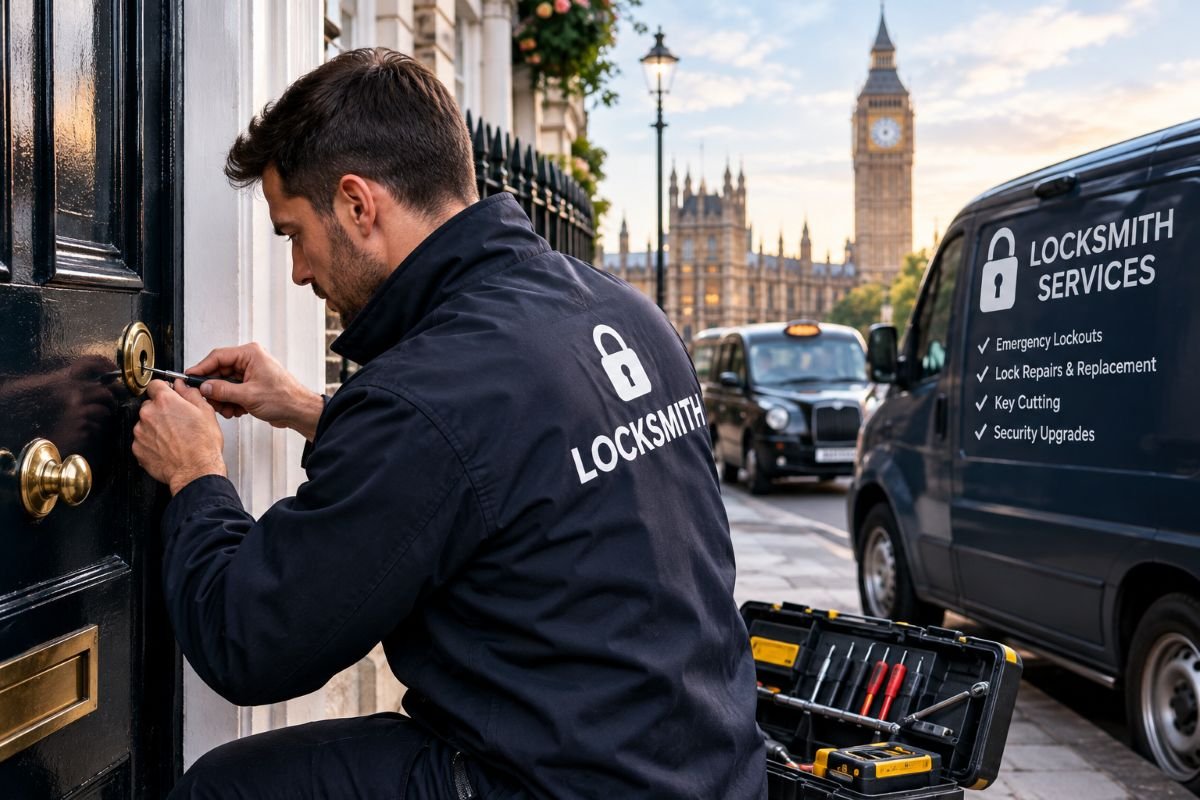
Being locked out of your home is inconvenient enough. Finding a locksmith in a hurry can make the situation harder, particularly when you are searching for locksmiths near me late at night and have little time to compare options.
London has locksmiths covering everything from emergency lockouts and broken keys to lock replacement, burglary repairs, key cutting, safes and commercial security. The challenge is working out which provider is properly established, appropriately qualified and transparent about what the job will cost.
The UK locksmith industry is not subject to statutory occupational licensing, so checking credentials and asking the right questions matters. The Master Locksmiths Association (MLA) operates an approval scheme involving vetting, inspection and qualification, and the UK Government has specifically advised consumers to consider trusted schemes such as the MLA when choosing a locksmith.
This guide looks at locksmith services across London, what to check before booking, when an emergency locksmith is appropriate, and several established London locksmith businesses that can be researched further.
What should you look for when choosing a locksmith in London?
A good locksmith should be able to explain the problem, tell you what work is likely to be required, and give you a clear idea of the cost before starting.
That becomes particularly important when you need help urgently.
When comparing locksmiths, look for:
- Evidence of professional qualifications or recognised trade membership
- A real London address or clearly established operating area
- A telephone number that connects you to the business
- Clear information about services
- An explanation of call-out and labour charges
- A written or confirmed quotation where practical
- Evidence of appropriate insurance
- Good independent customer feedback, considered alongside other evidence
- Experience with the type of lock or door involved
- A willingness to explain what needs replacing and why
The MLA’s directory allows consumers to search for approved locksmiths by location and service. Approved companies are described by the organisation as vetted, inspected and qualified.
That does not mean every non-MLA locksmith is unsuitable. It means consumers should carry out sensible checks rather than assuming that a company appearing prominently in an online search is automatically trustworthy.
Selected locksmiths in London worth researching
There is no single objective way to name the “best” locksmith in a city as large as London. The right choice can depend on where you live, whether you need an emergency call-out, the type of lock involved, and whether the work is domestic, commercial or automotive.
The businesses below have been included because they can be independently checked through established sources, with several appearing in the MLA’s London listings. They are not presented as a ranking.
Court Security Ltd — Soho and Central London
Court Security Ltd is based at St Anne’s Court in Soho and is listed by the MLA as a Central London locksmith. The company states that it provides 24-hour emergency locksmith services across central London and works with domestic and commercial customers.)
Its location makes it relevant to searches around areas such as Soho, Mayfair, Covent Garden, Westminster and surrounding central districts, although customers should confirm service coverage when booking.
Barry Bros Security — Paddington
Barry Bros Security is based on Praed Street in Paddington and appears in the MLA’s London directory. Its listed services extend beyond conventional locksmithing to security products, key duplication, safes and other security-related work.
The MLA’s directory also lists Barry Bros as providing 24-hour service, alongside retail, access-control, safe and automotive services.
G Worrall & Son Ltd — Southwark
G Worrall & Son Ltd is listed by the MLA at Great Suffolk Street in Southwark. Its location can make it relevant to searches around Southwark, London Bridge, Elephant and Castle and nearby areas, subject to the company’s current service coverage.
For planned work, it is worth contacting the business directly to establish availability, the type of lock it handles, and whether it provides emergency call-outs for your particular situation.
Bramah Security — Fitzrovia
Bramah has a long history in London security. The company says it was established in 1784 and is now based at Goodge Place in Fitzrovia, where it manufactures Bramah and Rola locks as well as providing locksmith and security services.
Its history and manufacturing background make it particularly relevant for readers interested in specialist locks as well as ordinary locksmith services.
Two Brothers Locksmiths LLP Master Locksmiths of skill & integrity — Earls Court
Two Brothers Locksmiths is based on Earls Court Road in West London. It also appears in the MLA’s historical regional directory for London, which lists a 24-hour service among its service categories.
Its location may be useful for people searching around Earls Court, Kensington, Chelsea and nearby west London neighbourhoods.
Franchi Plc — North London
Franchi Plc appears in the MLA’s Central London directory, with locations including Kentish Town Road and Holloway Road. The MLA listing describes services including lock opening and repair, key cutting, security gates and grilles, master-key systems and vehicle key cutting.
This broader service range may be useful for customers looking beyond a straightforward house lockout.
What services do London locksmiths provide?
Locksmithing is much broader than simply opening a locked door.
Common services include:
| Service | When you may need it |
| Emergency lockout | You cannot get into your home, flat or business |
| Lock repair | Existing lock is damaged, sticking or failing |
| Lock replacement | A lock is beyond repair or needs upgrading |
| Key replacement | Keys have been lost, stolen or damaged |
| Broken key extraction | Part of a key is stuck in the lock |
| uPVC lock repair | Multipoint mechanism or cylinder has failed |
| Burglary repair | Door or lock has been damaged during a break-in |
| Key cutting | Additional household or business keys |
| Safe services | Safe opening, repair or related work |
| Access control | Electronic or controlled access for businesses |
| Commercial locksmithing | Locks and security for shops, offices and other premises |
| Auto locksmithing | Vehicle keys and vehicle lock problems, where offered |
The MLA’s emergency locksmith service directory specifically includes lockouts, lost keys, damaged locks, lock replacement, lock upgrades, burglary repairs, safe opening, and automotive locksmith services among common emergency requirements.
Not every locksmith offers every service, so check before arranging a visit.
When should you call an emergency locksmith?
An emergency locksmith is generally appropriate when waiting until normal business hours would leave you unable to access or secure a property.
Typical situations include:
- Being locked outside your home
- Losing your only set of keys
- Breaking a key inside the lock
- A lock suddenly failing
- A door refusing to lock
- Damage following a burglary
- A lock becoming unsafe or unusable
- Being unable to secure business premises
The situation is slightly different if your property has been burgled.
If there is an immediate threat to personal safety or an offence is taking place, contact the emergency services rather than treating it solely as a locksmith problem. The Metropolitan Police advises calling 999 or 112 in an emergency.
Once the immediate situation is safe, a locksmith may be needed to secure or repair the damaged door.
How much does an emergency locksmith cost in London?
There is no single London-wide price for locksmith work.
The final cost can depend on:
- Time of day
- Day of the week
- Location
- Type of lock
- Whether parts are required
- Whether the job involves opening, repairing or replacing the lock
- How difficult the work is
- Emergency or out-of-hours arrangements
The MLA’s current emergency locksmith guidance gives indicative UK rates starting from £85 per hour for standard work, with higher hourly figures cited for out-of-hours work. It also stresses that the final price depends on the job, location and time. These figures should therefore be treated as an indication rather than a fixed London price list.
Ask these questions before agreeing to the work
A short phone conversation can prevent an unpleasant surprise later.
Ask:
- What is the call-out charge?
- Is labour charged separately?
- Is the quotation inclusive of VAT?
- What happens if the lock needs replacing?
- How much will replacement parts cost?
- Is there an additional night or weekend charge?
- Is the quoted amount an estimate or a fixed price?
- Will I be contacted before additional work is carried out?
If the locksmith cannot give you a useful explanation of the pricing structure, consider contacting another provider.
How to find “locksmiths near me” in London
Searching for “locksmiths near me” is often the quickest option when you are standing outside a locked property.
But proximity should not be the only consideration.
Step 1: Check the exact location
London is large, and a business advertising “London-wide” coverage may not be physically close to your property.
Tell the locksmith your postcode or neighbourhood and ask whether they actually cover it.
Step 2: Explain the problem
Do not simply say that you need a locksmith.
Explain whether:
- You are locked out
- The key is lost
- The key has snapped
- The lock is damaged
- The door will not lock
- You need a replacement
- The property has suffered a break-in
This gives the locksmith more information to assess the likely job.
Step 3: Ask about the lock
If possible, tell them whether the door is:
- Timber
- uPVC
- Composite
- Aluminium
- A commercial door
A photograph can also help a locksmith identify the likely lock type before travelling.
Step 4: Check credentials
The MLA maintains a searchable directory of approved locksmith companies. Its scheme includes vetting, inspection, and qualification requirements.
Step 5: Confirm the price
Get as much pricing information as possible before the locksmith arrives.
Step 6: Confirm what happens if the job changes
For example, ask:
“If you arrive and the lock needs replacing, will you tell me the price before fitting it?”
A straightforward answer is a good sign.
How to avoid rogue locksmith problems
The speed of an emergency search can work against you.
A company appearing at the top of a search engine does not automatically mean that it is the best choice for your situation.
The MLA identifies several warning signs, including unusually low advertised prices, national call centres that may subcontract work, and locksmiths who are vague about pricing.
Be cautious about extremely cheap headline prices
A very low figure may refer only to a basic call-out rather than the complete job.
Ask what is actually included.
Avoid agreeing to an unlimited job
If the locksmith says the lock needs replacing, ask for the replacement price before authorising the work.
Check the company identity
Look for a business name, physical address, telephone number, and consistent information across its website and other business listings.
Ask for identification
A reputable locksmith should be able to identify themselves and explain why they need to carry out the proposed work.
Keep the invoice
For completed work, retain the invoice or receipt. This is particularly useful if you need to contact the business later or make an insurance claim.
Does London have licensed locksmiths?
This is one of the most useful points for consumers to understand.
Locksmithing is not currently subject to statutory occupational licensing in the UK. The UK Government has said that the profession is not subject to statutory regulation, while existing consumer protection law applies to locksmiths like other traders.
The government has also advised consumers to consider providers operating under trusted schemes such as the MLA, whose approval system includes vetting, inspection and qualification.
That distinction matters.
A locksmith saying that they are “licensed” does not necessarily mean they hold a government-issued occupational licence.
Instead, ask what qualification, accreditation or trade-association approval they hold and verify the claim independently.
What lock should you have on your London home?
The right lock depends on the door and the requirements of your home insurance policy.
For timber external doors, BS 3621 is an important British Standard covering lock assemblies operated by key from both sides. BSI currently lists BS 3621:2017+A1:2024 as the current release.
For modern uPVC and composite doors, the locking arrangement is different and may involve a multipoint mechanism and a Euro cylinder.
The key point is not to buy a lock simply because someone describes it as “insurance approved”.
Your own insurance policy should be checked first. Insurers can specify particular security requirements, and Allianz, for example, advises policyholders to check their policy documents to establish the exact requirements for their property.
Before upgrading a lock
Check:
- Your home insurance policy
- The type of door
- The existing lock
- The required British Standard, if specified
- Whether the door is a fire or escape route
- Whether the replacement affects the existing locking mechanism
A qualified locksmith can then advise on suitable options.
What should you do if your key breaks inside the lock?
Do not keep twisting the broken key or push another object into the cylinder.
If part of the key is visible, you may be tempted to pull it out yourself. That can sometimes work, but forcing the mechanism can make the problem worse.
A locksmith can assess whether the key can be extracted without replacing the entire cylinder.
If the key has broken because the lock is worn or damaged, simply cutting another key may not solve the underlying problem.
What should you do after losing your house keys?
If you have lost keys and cannot establish where they are, consider the security implications rather than simply ordering another copy.
The risk is greater if the keys were lost with something identifying your home address.
Depending on the circumstances, a locksmith may recommend:
- Replacing the cylinder
- Changing the lock
- Rekeying where the lock system permits it
- Checking other external doors
- Reviewing window security
- Improving the property’s general access security
If the keys were stolen, contact your insurer if appropriate and check whether your policy provides cover for replacement locks.
Locksmith vs emergency locksmith: what is the difference?
| Need | Standard locksmith | Emergency locksmith |
| Planned lock upgrade | Yes | Sometimes |
| Key cutting | Yes | Sometimes |
| Routine lock repair | Yes | Sometimes |
| Home lockout | Sometimes | Yes |
| Lost keys at night | Usually no | Yes |
| Broken lock outside normal hours | Usually no | Yes |
| Burglary repair | Sometimes | Yes |
| Commercial security upgrade | Yes | Sometimes |
| Safe work | Depending on provider | Depending on provider |
An emergency service is mainly about availability and urgency, not necessarily a different type of locksmith qualification.
A locksmith who works during normal hours may have exactly the technical skills you need, but an emergency provider is set up to respond outside normal working hours.
Pros and cons of using a local London locksmith
Advantages
- Potentially shorter travel distance
- Better knowledge of local areas
- Easier communication with a nearby business
- Useful for follow-up work
- May offer both emergency and planned services
Limitations
- “Local” does not automatically mean qualified
- Coverage areas can be wider than the business’s physical location
- Emergency pricing can be higher
- Service availability varies by postcode and time
- A small local business may not offer specialist commercial or automotive services
The best approach is to combine location, credentials, service capability and transparent pricing rather than relying on proximity alone.
Quick checklist before hiring a London locksmith
Keep this checklist handy:
Before the locksmith arrives
- Confirm the business name
- Give the correct postcode
- Explain the problem
- Ask about call-out charges
- Ask about labour rates
- Ask about parts and replacement locks
- Confirm VAT treatment
- Check qualifications or trade membership
- Ask whether they are genuinely local
- Confirm the price before additional work
After the work
- Test the lock
- Check all keys supplied
- Ask for the invoice
- Keep details of the lock fitted
- Ask about guarantees or warranties
- Update your insurer if the policy requires it
7. FAQ
How do I find reliable locksmiths near me in London?
Start with your postcode and compare local businesses rather than choosing solely on search position. Check credentials, service coverage and pricing. The MLA maintains a directory of approved locksmith companies that have undergone its vetting, inspection, and qualification requirements.
How much does an emergency locksmith cost in London?
There is no fixed London-wide price. The cost depends on the job, location, time, and parts required. The MLA’s current guidance gives indicative UK hourly rates starting from £85 for standard work, with higher rates for some out-of-hours periods.)
Are locksmiths licensed in the UK?
There is currently no statutory occupational licensing system for locksmiths. The Government has advised consumers to consider trusted schemes such as the MLA and confirms that locksmiths remain subject to consumer protection law.
What does an emergency locksmith do?
Emergency locksmiths deal with urgent problems such as lockouts, lost keys, broken locks, damaged doors and burglary repairs. Some also provide emergency vehicle locksmith services and safe opening.
Should I replace my locks after losing my keys?
Not necessarily in every situation, but it can be sensible if the lost keys could be linked to your property or you cannot establish where they went. A locksmith can advise whether the cylinder or the complete lock should be changed.
Can a locksmith repair a uPVC door lock?
Yes. Locksmiths commonly work on uPVC door locks and multipoint mechanisms, although the exact service depends on the lock and the fault. Explain the problem before booking and, if possible, provide a photograph.
What is BS3621?
BS3621 is a British Standard covering lock assemblies operated by a key from both inside and outside the door. BSI lists BS 3621:2017+A1:2024 as the current release.
Can a locksmith help after a burglary?
Yes. A locksmith can assess damaged locks and doors and help secure the property. If a burglary is in progress or there is an immediate danger, contact the police first rather than waiting for a locksmith.
Should I get a quote before a locksmith starts?
Yes. Ask for the call-out fee, labour rate, likely parts cost, and any out-of-hours charges. If the required work changes after inspection, ask for the revised price before authorising it.
Final wrap-up
Finding locksmiths near me in London is easy; finding one that is suitable for the actual job requires a little more checking. Look beyond proximity and search rankings. Confirm the locksmith’s credentials, coverage, availability, and pricing before authorising work.
For urgent situations, explain exactly what has happened and ask for the likely cost before the locksmith starts. For planned security upgrades, check your insurance requirements and the type of door you have first.
London has established locksmith businesses across areas including Soho, Fitzrovia, Paddington, Southwark, Earls Court, Kentish Town and many other parts of the capital. The MLA directory is a useful starting point for independently checking approved providers, while individual businesses should still be contacted directly to confirm current services and prices.