
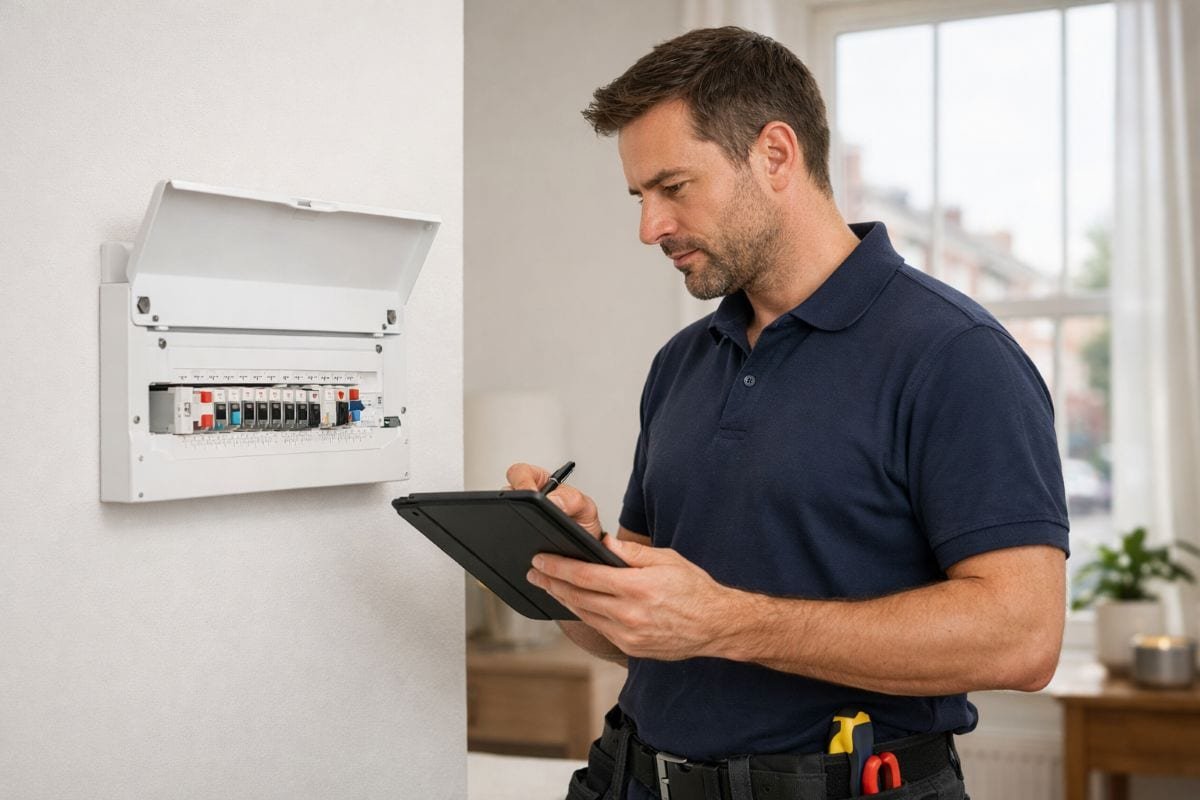
Finding the best electricians in London is not simply a matter of choosing the company with the highest star rating. Electrical work can involve fire, electric shock and serious damage to a property, so qualifications, registration, certification and experience matter just as much as customer feedback.
London also presents a particular challenge. A Victorian terrace in Islington may need very different work from a modern flat in Canary Wharf, while a landlord in Croydon may be looking for an Electrical Installation Condition Report (EICR) rather than an emergency repair.
We have looked at current London electrician listings, available customer review information, company details, and guidance from UK electrical safety authorities to explain what to look for. The businesses featured below are examples worth considering, rather than a definitive league table.
You will also find guidance on electrical emergencies, rewiring, consumer units, EICRs, Part P, typical London costs and questions to ask before hiring an electrician.
Best electricians in London: our editorial shortlist
There is no single electrician who is automatically the best choice for every London property. A good emergency electrician may not be the right contractor for a large commercial rewiring project. In contrast, an electrician experienced with EICRs and landlord compliance may be a better choice for a rented flat.
For that reason, this shortlist considers several factors:
- Current customer ratings and review volume where independently listed
- Range of electrical services
- Evidence of professional registration or accreditation
- Areas of London covered
- Emergency availability where relevant
- Experience with domestic, commercial or landlord work
- The type of electrical problem the contractor appears particularly suited to
The following businesses are among the London options readers may wish to investigate.
London Electricians 24/7 — emergency electrical work
London Electricians 24/7 is particularly relevant for people who need an electrician outside normal working hours. Its own website states that it operates 24 hours a day, 365 days a year, and describes the business as NICEIC registered. It also advertises domestic and commercial electrical services, including fault finding, wiring problems and consumer-unit issues.
The business currently appears in local search results with a 5.0 rating from 118 reviews.
Best suited to: emergency call-outs, urgent faults, domestic electrical repairs and customers who need out-of-hours availability.
Al-Amin Electrical Contractor — domestic and commercial work
Al-Amin Electrical Contractor is based in East London and advertises domestic, commercial and industrial electrical services. Its website states that it provides 24-hour emergency call-outs and services across areas of North, South, East, West and Central London.
The company is also listed on Checkatrade, where its current profile shows a 9.83/10 rating based on 379 reviews and identifies NICEIC Approved Contractor and Part P credentials among its accreditations.
Its current Google business listing shows a 4.9 rating from 525 reviews.
Best suited to: general domestic work, commercial electrical services, testing and emergency repairs.
SES Electrical Contractors (UK) Ltd — compliance and commercial electrical work
SES Electrical Contractors is based in Chiswick and has a particularly strong focus on electrical compliance, fire safety, emergency lighting, EICRs and planned maintenance. Its website identifies the company as an NICEIC-approved contractor and lists coverage including Chiswick, Ealing, Hammersmith, Fulham, Kensington and Chelsea, Westminster, Camden, Islington and Southwark.
Companies House records show SES Electrical Contractors (UK) Ltd is an active company incorporated in 2010, with electrical installation listed as its principal business activity.
Its current business listing shows a 4.9 rating from 445 reviews.
Best suited to: landlords, commercial properties, compliance work, fire-safety systems, EICRs and planned electrical maintenance.
ABCD Electrical — South London
ABCD Electrical is based in Norwood and currently appears in local business results with a 5.0 rating from 164 reviews. The listing identifies it as an electrician and shows 24-hour availability.
It may therefore be worth considering for readers in areas such as Norwood and surrounding parts of South London, particularly when emergency availability is a priority.
Best suited to: South London domestic electrical work and emergency requirements.
London Electrics Ltd — East London and Essex-border areas
London Electrics Ltd is based in Ilford and currently has a 5.0 rating from 297 reviews in local business listings.
Companies House records show the active company was incorporated in 2019 and lists electrical installation, electrical-equipment repair and security-system service activities among its registered business activities.
Best suited to: readers in Ilford and surrounding north-east London areas looking for general electrical installation and repair services.
Novi Electrics — North London
Novi Electrics is based in the Crouch End area of North London and currently appears in local business results with a 5.0 rating from 131 reviews. The listing also shows 24-hour availability.
Best suited to: North London homeowners and customers looking for an electrician with strong current local review feedback.
Editorial note: Ratings and review counts can change. They should be treated as one part of the decision, not proof that a contractor is suitable for a particular electrical job.
What makes an electrician one of the best in London?

The phrase “best electrician” can mean different things to different customers.
For a homeowner with a dangerous burning smell coming from a consumer unit, speed and emergency experience may be the priority. For a landlord preparing a property for a new tenancy, the ability to carry out an appropriate inspection and provide the correct documentation matters more.
A strong electrician should be able to demonstrate several of the following:
| Factor | Why it matters |
| Appropriate qualifications | Shows the electrician has relevant technical knowledge |
| Competent Person registration | Can allow eligible domestic work to be self-certified |
| NICEIC, NAPIT or another recognised scheme | Provides an additional layer of assessment and registration |
| BS 7671 compliance | Electrical installations should meet the applicable wiring standard |
| Proper certification | Gives you documentation showing what work was carried out |
| Public liability insurance | Protects if something goes wrong |
| Clear quotations | Helps prevent disputes over scope and price |
| Good recent reviews | Offers evidence of customer experience |
| Relevant experience | A specialist job may require specialist knowledge |
| Local coverage | Can make emergency attendance and follow-up easier |
Electrical Safety First recommends using a registered electrician and explains that registered electricians are assessed, work to the BS 7671 safety standard and are insured.
What services do electricians in London provide?
Electrical contractors cover a much wider range of work than changing a light fitting.
Electrical repairs and fault finding
A professional electrician can investigate issues such as:
- Repeatedly tripping circuits
- Faulty sockets
- Flickering lights
- Damaged switches
- Loss of power to part of a property
- Faulty wiring
- RCD or RCBO trips
- Problems with fixed electrical equipment
Repeated circuit trips should not simply be treated as an inconvenience. They can indicate an underlying fault that needs investigation.
Consumer-unit replacement
The consumer unit, sometimes still called a fuse box, is an important part of a property’s electrical installation.
Replacing or upgrading one can involve significant electrical work and should be handled by an appropriately competent electrician. Ask beforehand what certification will be provided when the job is complete.
House rewiring
Older London properties can present additional challenges.
Victorian and Edwardian terraces, converted flats and older maisonettes may have electrical installations that have been altered repeatedly over decades. A full rewire can involve opening walls, lifting floors and coordinating with plasterers or other trades.
A rewire should therefore be planned carefully rather than treated as a simple repair.
Ask for:
- A written scope of work.
- A description of what will be replaced.
- The number and location of sockets and lighting points.
- Details of consumer-unit work.
- The expected certification.
- A clear payment schedule.
- Confirmation of any making-good or decorating that is excluded.
EICR inspections
An Electrical Installation Condition Report, or EICR, assesses the condition and safety of an electrical installation.
It is particularly relevant to landlords. Government guidance states that landlords in England must have electrical installations inspected and tested by a qualified person at least every five years, with a report provided to tenants and the local authority where requested. (GOV.UK)
The report can identify different categories of issue, including:
- C1: Danger present
- C2: Potentially dangerous
- C3: Improvement recommended
- FI: Further investigation required
A C3 recommendation does not, by itself, make an installation unsatisfactory, whereas C1 and C2 findings require attention under the landlord electrical-safety rules.
Emergency electricians
Emergency work can include:
- Burning smells
- Smoke or scorching around sockets
- Sparks
- Electrical shocks
- Loss of power caused by an internal fault
- Dangerous damage to wiring
- Water affecting electrical equipment
- A consumer unit showing signs of overheating
If you see smoke, flames or an immediate risk of fire, prioritise personal safety and contact the emergency services where appropriate rather than trying to diagnose the electrical fault yourself.
How much does an electrician cost in London?
Electrical prices vary significantly according to the job, location, materials, access, urgency and the electrician’s experience.
Current Checkatrade London data gives an indicative £45 call-out charge, while emergency out-of-hours work can be £90+ per hour and standard hourly rates are shown at around £45–£60 per hour. Its listed average electrician job cost is around £526, with a range of £361 to £785.
These figures should not be treated as a fixed London tariff.
A simple socket replacement is obviously different from a consumer-unit upgrade or a complete rewire.
Factors that can increase the price
- Emergency or overnight attendance
- Bank holidays
- Difficult access
- Fault finding that takes several hours
- Replacement parts
- Consumer-unit upgrades
- Rewiring
- Additional testing
- Work in bathrooms or other special locations
- Out-of-hours commercial work
For larger projects, obtain at least two or three written quotations where practical.
Part P: what London homeowners need to know
One of the most useful things to understand before hiring an electrician is Part P of the Building Regulations.
Part P covers electrical safety in dwellings in England and Wales. Electrical Safety First explains that electrical installation work must be designed and installed to protect people from fire and electric shock.
Some electrical work must be notified to building control unless it is carried out by an electrician registered with an appropriate Competent Person Scheme.
Using a registered electrician can simplify the process because the electrician can self-certify eligible work and arrange the relevant compliance documentation.
This is one reason registration is worth checking before work begins rather than assuming that an electrician’s claim of being “qualified” is enough.
NICEIC, NAPIT and Competent Person registration: what’s the difference?
Homeowners sometimes assume that every electrician has to belong to NICEIC. That is not quite how the system works.
The government recognises several competent-person schemes for electrical installations. GOV.UK lists schemes including Certsure, NAPIT and other authorised scheme operators for relevant electrical installation work.
NICEIC is therefore one recognised route, but it is not the only one.
Electrical Safety First’s registered-electrician search also identifies NICEIC, NAPIT and other recognised registering bodies.
The sensible approach is to check the specific electrician or company and the type of work they are registered to undertake, rather than relying solely on a logo displayed on a website.
The Registered Competent Person Electrical search allows consumers to search by postcode and distinguish between installation/remedial work and electrical safety reports.
How to choose an electrician in your London borough
London’s geography matters.
An electrician based in Chiswick may cover Hammersmith, Fulham and Kensington regularly, while another contractor may concentrate on Hackney, Stratford, Leyton and Walthamstow.
Before booking, check:
North London
Areas such as Camden, Islington, Highgate, Finchley, Barnet and Crouch End contain a mixture of period properties, conversions and newer developments.
Ask whether the electrician has experience with the type of building you own.
East London
Hackney, Stratford, Bow, Bethnal Green, Walthamstow, Ilford and surrounding areas contain everything from older terraces and converted properties to modern apartment developments.
For flats, clarify whether the electrician is dealing only with your private installation or whether communal electrical systems are involved.
South London
Brixton, Clapham, Dulwich, Lewisham, Greenwich, Bromley, Norwood and surrounding areas have a broad mix of Victorian houses, conversions and newer homes.
For larger houses, ask whether the quote covers testing and certification throughout the property.
West London
Chiswick, Ealing, Hammersmith, Fulham, Richmond, Acton and surrounding areas have a similarly diverse property stock.
For landlords and commercial premises, contractors with compliance and planned-maintenance experience can be particularly useful.
Questions to ask before hiring an electrician
A five-minute conversation can prevent a surprisingly expensive mistake.
Ask:
- 1. Are you registered with a Competent Person Scheme?
- If yes, ask which scheme and whether your specific work falls within their registration.
- 2. Will I receive a certificate?
- The exact certificate depends on the work. Do not assume every electrical visit automatically results in the same documentation.
- 3. Is the quotation fixed?
- For larger work, ask what could cause the final price to change.
- 4. Does the price include materials?
- Clarify this before accepting the quote.
- 5. Are you insured?
- Ask what insurance cover is held and, for larger projects, request confirmation if appropriate.
- 6. Who will actually carry out the work?
- This matters when a company uses subcontractors.
- 7. How long will the work take?
- A rewiring project and a socket replacement have very different timescales.
- 8. What happens if you find additional faults?
- Agree how additional work will be authorised before it begins.
Warning signs when hiring an electrician
A cheap quotation is not necessarily a bargain.
Be cautious if an electrician:
- Refuses to provide a written quotation for substantial work
- Cannot explain what certification you will receive
- Claims registration but cannot provide details that can be checked
- Pressures you to authorise unnecessary work immediately
- Wants a large cash payment without proper paperwork
- Gives an unusually low price without explaining what is included
- Cannot clearly describe the proposed work
- Dismisses questions about insurance or certification
- Suggests you ignore an electrical safety issue
The government advises consumers to use the Electrical Competent Person Register when looking for an electrician for domestic work.
What should you do during an electrical emergency?
If you smell burning, see smoke, notice sparking or receive an electric shock from an appliance or installation, treat the situation seriously.
First steps
- Do not touch damaged wiring or electrical equipment.
- Keep children and other people away from the affected area.
- If it is safe to do so, isolate the electricity using the main switch.
- Do not attempt a repair if you are not competent to do so.
- Call an appropriately qualified electrician.
- If there is a fire or immediate danger to life, contact emergency services.
A tripped RCD or circuit breaker that repeatedly trips should also be investigated rather than repeatedly reset without finding the cause.
London electrician checklist
Before accepting a quote, run through this quick checklist:
Before the visit
- Check the electrician’s registration.
- Describe the fault accurately.
- Ask whether they regularly undertake this type of work.
- Ask about call-out charges.
- Ask whether VAT applies.
Before work starts
- Get the scope of work in writing.
- Confirm the price or pricing structure.
- Confirm what materials are included.
- Establish who will carry out the work.
- Ask what certificate or report you will receive.
After the work
- Check the installation has been tested.
- Obtain the relevant certificate.
- Keep invoices and reports.
- Photograph important new installations for your property records.
- Do not discard electrical documentation, particularly if you are a landlord or may sell the property.
Best electrician for different types of jobs
| Your requirement | What to prioritise |
| Emergency fault | 24/7 availability, response time and relevant emergency experience |
| House rewiring | Experience with full rewires, detailed scope and certification |
| Consumer-unit replacement | Competent Person registration and appropriate certification |
| Landlord EICR | Competence in inspection/testing and clear reporting |
| Commercial property | Commercial experience, compliance and planned maintenance |
| Lighting installation | Design, installation and testing experience |
| Fault finding | Diagnostic experience rather than simply replacing parts |
| Older London property | Experience with period homes and altered installations |
| Flat/apartment | Understanding of leasehold and communal-system boundaries |
| New domestic installation | Part P/Competent Person capability and BS 7671 compliance |
Why London property type matters
Electrical work in London is often complicated by the age and design of the building.
A Georgian or Victorian property may have undergone several rounds of renovation. Older wiring can be concealed behind plaster, floors or ceilings, and previous alterations may not be immediately obvious.
Converted flats create another issue: the electrical installation inside the flat may be the responsibility of the individual owner, while communal systems can fall under separate arrangements.
Modern developments have their own complications, including communal electrical infrastructure, access restrictions and management-company requirements.
This is why the cheapest electrician may not be the best choice.
The right contractor should understand the actual building, identify the source of the problem and explain what needs to happen next.
How to compare three electrician quotes
If the work is substantial, put the quotations side by side.
| Check | Quote A | Quote B | Quote C |
| Labour included | ✓ / ✗ | ✓ / ✗ | ✓ / ✗ |
| Materials included | ✓ / ✗ | ✓ / ✗ | ✓ / ✗ |
| Testing included | ✓ / ✗ | ✓ / ✗ | ✓ / ✗ |
| Certification included | ✓ / ✗ | ✓ / ✗ | ✓ / ✗ |
| VAT included | ✓ / ✗ | ✓ / ✗ | ✓ / ✗ |
| Expected completion date | |||
| Warranty/guarantee | |||
| Additional-work procedure |
A quote that appears £300 cheaper can become more expensive if testing, materials, certification or remedial work are excluded.
The best electrician is the right electrician for the job
The most useful way to interpret “best electricians in London” is not as a ranking of businesses from number one to number ten.
It is about finding a contractor whose competence, registration, experience, availability and service match the job you actually need done.
For emergency work, response time can be critical. For an EICR, inspection competence and accurate reporting matter more. For a full rewire, experience, planning and certification should carry considerable weight.
LondonCityDirectory readers can use the shortlist above as a starting point, but should still check current registration, obtain a clear quote and confirm the contractor is suitable for the precise work required.
FAQ
What is the best way to find an electrician in London?
Start with a recognised registration or competent-person register, then compare relevant experience, recent customer feedback, insurance, availability and written quotations. Electrical Safety First provides a registered-electrician search by postcode.
How much does an electrician cost in London?
Current Checkatrade guidance gives indicative London rates of around £45 for a call-out and £45–£60 per hour for standard work, while emergency out-of-hours work can be £90 or more per hour. Actual prices depend heavily on the job.
Do electricians in London need to be NICEIC registered?
No. NICEIC is one recognised route, but it is not the only competent-person scheme. NAPIT and other authorised schemes also operate. Check the electrician’s actual registration and whether it covers the work you need.
What is Part P?
Part P is the electrical-safety section of the Building Regulations covering domestic electrical installations in England and Wales. It requires electrical work to be designed and installed to protect people from fire and electric shock.
Do landlords in London need an EICR?
Private landlords in England generally have to ensure electrical installations are inspected and tested by a qualified person at least every five years, with the required report provided to tenants and the local authority when requested.
What do C1 and C2 mean on an EICR?
C1 means danger is present and there is a risk of injury. C2 means the installation has a potentially dangerous condition. These classifications require remedial attention under the applicable landlord electrical-safety rules.
How often should a rented property’s electrics be checked?
For properties covered by the Electrical Safety Standards in the Private Rented Sector rules in England, the installation must generally be inspected and tested at least every five years, or sooner where the report recommends it.
Should I use an emergency electrician for a tripping circuit?
If a circuit repeatedly trips, it is sensible to have the underlying fault investigated. If there is burning, smoke, sparking, an electric shock or another immediate danger, treat it as an electrical emergency and prioritise safety.
Can an electrician issue an electrical certificate?
Yes, where the work and circumstances require one, the appropriate certificate or report should be issued. For eligible work carried out by a registered electrician, Building Regulations compliance can also be self-certified through the relevant Competent Person Scheme.
Here’s a concise, natural conclusion that fits the article and keeps the tone informative rather than promotional:
Conclusion
Choosing among the best electricians in London comes down to finding the right professional for the job, rather than simply picking the highest-rated name. Qualifications, registration, relevant experience, clear pricing and proper certification should all be considered before work begins.
For routine repairs, rewiring, consumer-unit upgrades or an EICR, take time to compare quotations and check that the electrician is appropriately registered for the work involved. If you are dealing with an electrical emergency, safety should come first, and professional help should be sought promptly.
London has a wide range of properties, from Victorian terraces in Islington and Brixton to modern flats in Canary Wharf and Wembley, so experience with your type of property can also make a difference. Use the directory to compare suitable local electricians, check their services and contact details, then make your choice based on competence, transparency and the requirements of your particular job.