
Choosing an architect in London is rarely just about finding a practice with an impressive portfolio. The right firm needs to understand the type of building you are working on, the planning environment, your budget, the site’s constraints, and how much support you need once construction begins.
That matters even more in London, where a project can involve conservation areas, listed buildings, tight urban sites, planning restrictions, neighbouring properties and complex building regulations.
There is also a big difference between the needs of a homeowner planning an extension and those of a developer looking for commercial architects in London. A small residential practice may be a strong fit for a loft conversion or rear extension, while a large multidisciplinary studio may be better suited to an office, mixed-use scheme, masterplan or major regeneration project.
This guide looks at established London practices and explains what they are known for, the types of projects they undertake and what to check before appointing any architect.
Quick answer: There is no single architect that is best for every London project. The most suitable practice depends on your project type, scale, budget, planning requirements, location and the level of service you need.
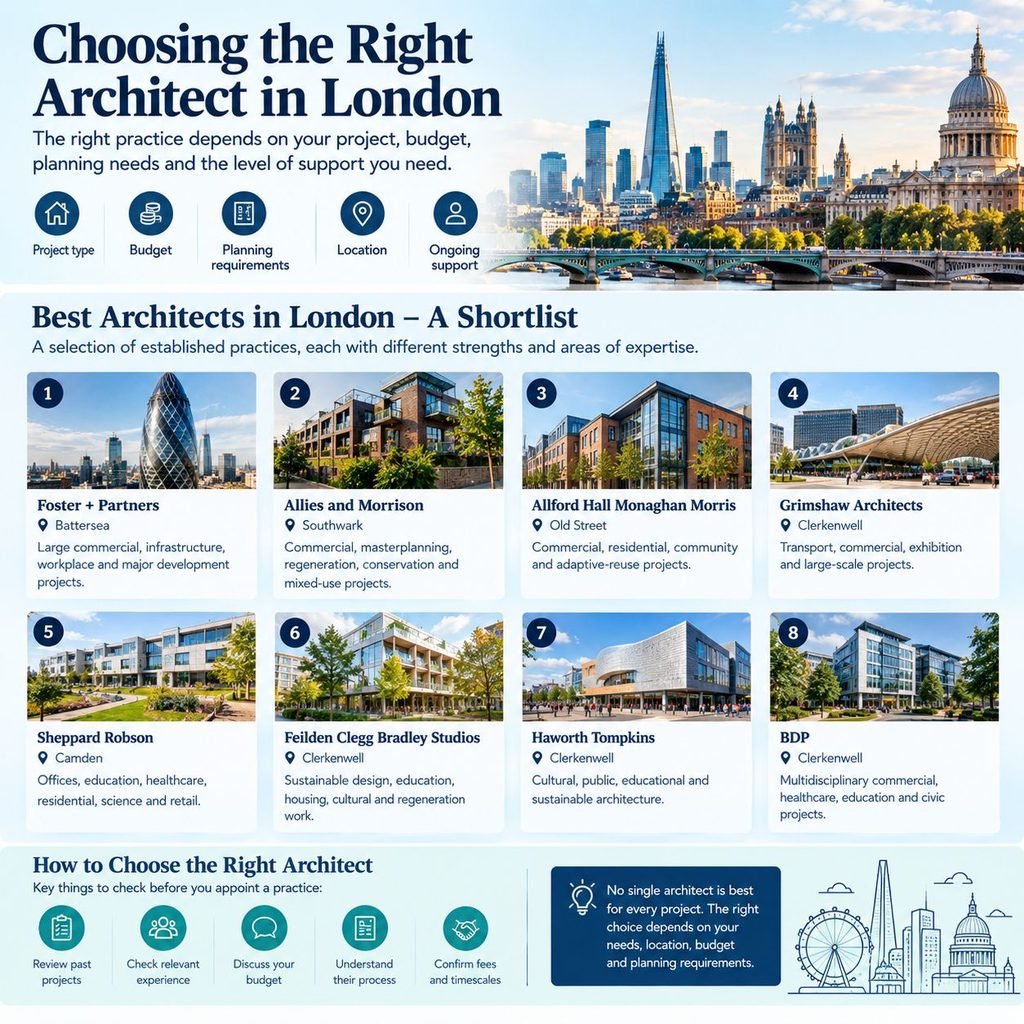
Best Architects in London: A Shortlist
The practices below represent different parts of London’s architecture sector, not a single ranking. We include them based on documented project experience, sector coverage, and information available through the Royal Institute of British Architects (RIBA) and other authoritative sources.
| Architecture practice | London base | Particularly relevant for |
| Foster + Partners | Battersea | Large commercial, infrastructure, workplace and major development projects |
| Allies and Morrison | Southwark | Commercial, masterplanning, regeneration, conservation and mixed-use |
| Allford Hall Monaghan Morris | Old Street | Commercial, residential, community and adaptive-reuse projects |
| Grimshaw Architects | Clerkenwell | Transport, commercial, exhibition and large-scale projects |
| Sheppard Robson | Camden | Offices, education, healthcare, residential, science and retail |
| Feilden Clegg Bradley Studios | Clerkenwell | Sustainable design, education, housing, cultural and regeneration work |
| Haworth Tompkins | Clerkenwell | Cultural, public, educational and sustainable architecture |
| BDP | Clerkenwell | Multidisciplinary commercial, healthcare, education and civic projects |
This is a shortlist, not a league table. A firm’s size or reputation does not automatically make it suitable for a particular project.
Best Architects in London:
Foster + Partners
Based at Riverside in Battersea, Foster + Partners is one of London’s best-known international architecture and design practices. Its work covers architecture, engineering, urbanism and design, with a portfolio ranging from infrastructure and airports to major commercial buildings.
Its London portfolio includes 30 St Mary Axe, better known as the Gherkin, and Wembley Stadium. The practice’s RIBA profile also records work on major headquarters and infrastructure projects.
For businesses and developers, the attraction is the breadth of expertise available within a large multidisciplinary practice. Foster + Partners says architects and engineers work together from early stages of projects, which can be particularly relevant where structure, environmental performance, engineering and complex building systems are central to the brief.
Consider it for:
- Major commercial developments
- Headquarters and workplace projects
- Large infrastructure schemes
- Masterplanning
- Complex mixed-use developments
- Major public or cultural buildings
For a small domestic extension, however, a large international practice may provide a very different service model from a smaller London studio.
Allies and Morrison
Allies and Morrison is based on Southwark Street and works across architecture, urban planning, interior design, conservation, masterplanning and research. Its portfolio includes projects ranging from individual buildings to large regeneration schemes.
The practice has substantial experience in London’s commercial and mixed-use environment. Its Bankside 123 project, for example, involved the redevelopment of a major site near Tate Modern, creating commercial office buildings alongside public realm and retail space.
Its involvement in King’s Cross Central is another useful example of large-scale urban planning. The masterplan established a framework for mixed-use development around King’s Cross and St Pancras, incorporating offices, homes, retail, public spaces and connections to the surrounding neighbourhood.
The practice has also worked on conservation and cultural projects, including the Royal Festival Hall and Highbury Square.
Consider it for:
- Commercial developments
- Mixed-use schemes
- Urban regeneration
- Masterplanning
- Conservation
- Large residential developments
- Public realm and city-centre projects
Allford Hall Monaghan Morris
Allford Hall Monaghan Morris, commonly known as AHMM, operates from Old Street in east-central London. Its portfolio covers commercial, residential, healthcare, cultural and other building types.
The practice’s RIBA profile highlights its focus on clarity and flexibility, intelligent use of space and understanding of building economics.
A particularly relevant London example is the Angel Building in Islington. The project reinvented an under-used early-1980s commercial building rather than simply replacing it. The existing concrete frame was retained, and the building was reworked to provide 260,000 sq ft of office space, alongside cafés and rooftop terraces.
That makes AHMM particularly interesting for clients considering commercial refurbishment or adaptive reuse, where the existing building is part of the design challenge.
The practice has also worked on community and public projects, including Kentish Town Health Centre in Camden and the Saatchi Gallery on the King’s Road.
Consider it for:
- Commercial architecture
- Office refurbishment
- Adaptive reuse
- Residential development
- Healthcare buildings
- Cultural projects
- Urban sites where existing buildings need to be reconsidered
Grimshaw
Grimshaw’s London studio is on Clerkenwell Road. The practice’s portfolio includes transport, infrastructure, commercial, exhibition and other large-scale projects, with its RIBA profile highlighting structural clarity and detailed design.
One of its London projects is the expansion of ExCeL London. The second phase added substantial flat-floor exhibition space and conference facilities, demonstrating the type of technical and operational requirements involved in large commercial and events projects.
Grimshaw can therefore be relevant when the architectural brief is closely tied to movement, infrastructure, large public buildings or demanding operational requirements.
Consider it for:
- Commercial buildings
- Exhibition and events venues
- Transport-related architecture
- Infrastructure
- Large public projects
- Complex developments requiring multidisciplinary expertise
Sheppard Robson
Sheppard Robson has its London office on Parkway in Camden Town and works across offices, education, residential, healthcare, science and retail. Its RIBA profile also highlights interior design and masterplanning.
That broad sector experience can be useful for clients whose projects combine several uses.
The practice has worked on developments including Barking Riverside and Barts Square, as well as educational and science buildings. Its interior design team has also worked on workplace environments for organisations including Channel 4, ITV and the BBC.
Consider it for:
- Commercial offices
- Workplace design
- Education
- Healthcare
- Science and research buildings
- Residential developments
- Retail and mixed-use projects
For a commercial client, it is worth asking which team would actually handle the project and what comparable schemes that team has delivered.
Feilden Clegg Bradley Studios
Feilden Clegg Bradley Studios, or FCBStudios, has a London studio on Gee Street in Clerkenwell. Its work spans housing, education, cultural buildings and regeneration, with sustainability and social considerations forming a significant part of its stated approach.
Its London portfolio includes the regeneration of Alexandra Palace’s East Wing in Haringey. The work involved a Grade II* listed building and included new technical infrastructure while retaining important historic spaces.
The practice also worked on Battersea Exchange and St Mary’s RC Primary School, a mixed-use development combining homes, a school, commercial space and improved connections around Queenstown Road Station.
This combination of architecture, regeneration and environmental considerations can make the practice relevant to larger schemes where design needs to respond to both an existing neighbourhood and a wider development brief.
Consider it for:
- Sustainable architecture
- Education
- Housing
- Cultural projects
- Regeneration
- Listed buildings
- Mixed-use development
Haworth Tompkins
Haworth Tompkins is based on Golden Lane in London. Its RIBA profile describes the practice as producing sustainable design solutions and highlights its approach to communication and the design process.
It is a practice worth investigating for clients with cultural, public or institutional briefs, particularly where the relationship between an existing building, its users and the surrounding setting is significant.
For projects involving theatres, arts organisations, community facilities or public buildings, look beyond photographs when assessing a practice. Ask how the architects have dealt with operational requirements, accessibility, technical upgrades, budgets and the practical demands of keeping buildings in use.
Consider it for:
- Cultural buildings
- Theatre and arts projects
- Public architecture
- Education
- Sustainable refurbishment
- Complex existing buildings
BDP
BDP operates from Brewhouse Yard in Clerkenwell and describes itself as a multidisciplinary practice working across multiple locations and specialisms. Its portfolio includes architecture, engineering and projects across sectors such as education, healthcare, commercial and culture.
Its London project record includes work connected with the Royal Opera House, Royal Albert Hall and London South Bank University.
A multidisciplinary practice can be useful where a project requires architects to coordinate closely with engineers, planners, interior designers and other specialists.
Consider it for:
- Commercial buildings
- Education
- Healthcare
- Cultural buildings
- Large multidisciplinary projects
- Complex refurbishments
- Mixed-use developments
What Do Architects in London Actually Do?
An architect’s role can extend well beyond producing drawings.
Depending on the appointment, an architect may help with:
- Developing the project brief
- Initial feasibility studies
- Site analysis
- Concept design
- Planning applications
- Building regulations information
- Coordination with structural and services engineers
- Tender documentation
- Contractor selection
- Contract administration
- Site inspections
- Design changes during construction
- Completion and handover
Not every architect offers every service in the same way, so the appointment should set out exactly what is included.
This is particularly important when comparing quotes. Two firms can quote different amounts because they are offering different scopes of work.
Commercial Architects in London: What Should Businesses Look For?
Commercial architecture requires a different approach from many residential projects.
A commercial building needs to work for its occupants and its owner. That can mean considering floor area, circulation, accessibility, servicing, flexibility, operating costs, planning policy, fire safety, environmental performance and future adaptability.
For commercial architects in London, relevant experience might include:
- Office buildings
- Retail units
- Restaurants and hospitality
- Industrial or logistics premises
- Mixed-use developments
- Healthcare facilities
- Education
- Hotels
- Workplace fit-outs
- Commercial refurbishments
Ask prospective practices for examples of projects similar in scale and complexity, not simply projects that look visually similar.
A stylish office portfolio does not necessarily demonstrate experience of a complicated listed-building conversion. Likewise, a firm experienced in major regeneration may not be the most suitable choice for a small independent shop conversion.
How Much Does an Architect Cost in London?
There is no single standard London architect fee.
The total cost can depend on:
- Project size
- Construction value
- Complexity
- Planning requirements
- Listed-building or conservation constraints
- Scope of the architect’s appointment
- Number of design stages required
- Whether the architect manages consultants
- Whether the architect remains involved during construction
The Architects Registration Board says architect fees can be structured in several ways, including fixed fees, percentages of construction costs or hourly rates. The agreed method should be set out in the contract. )
This means comparing two headline quotes without comparing their scope can be misleading.
Before accepting a fee proposal, ask:
- Which design stages are included?
- Is planning included?
- Are building regulations drawings included?
- Are structural engineers included?
- Are other consultants included?
- Is tendering included?
- Will the architect administer the building contract?
- How many site visits are included?
- What happens if the planning application needs to be amended?
- What additional charges could arise?
A lower initial fee may not represent a lower total project cost if important services have been excluded.
How to Choose an Architect in London
1. Start with the project, not the firm’s reputation
Write down what you are actually trying to achieve.
For example:
“We need to convert a 2,000 sq ft commercial unit into a restaurant.”
is more useful than:
“We need a good architect.”
The first brief gives an architect something concrete to respond to.
2. Check professional registration
The title architect is protected by law in the UK.
The Architects Registration Board states that only people on the Architects Register can legally use the title architect. The Register is the definitive record of UK architects.
Do this before appointing someone, even if you received their name through a personal recommendation.
3. Look for relevant project experience
Check whether the practice has worked on:
- Similar building types
- Similar project values
- Similar planning situations
- Similar locations
- Existing or listed buildings, if relevant
- Similar construction challenges
4. Check the actual team
A large practice may have an impressive portfolio, but you should know who will work on your project.
Ask:
- Who will be the project architect?
- Who will manage the day-to-day work?
- How often will the senior architect be involved?
- Who will deal with planning?
- Who will attend site meetings?
5. Ask about planning experience
London has many conservation areas and historic buildings. Planning experience can therefore be particularly important.
If your property is in Kensington, Camden, Westminster, Islington, Richmond, Hackney or another borough with particular local constraints, ask the architect about comparable planning work in that borough or similar planning environments.
6. Compare scope as well as price
Do not compare only the final fee.
Create a simple comparison:
| Question | Practice A | Practice B | Practice C |
| Initial feasibility | ✓ | ✓ | |
| Planning application | ✓ | ✓ | ✓ |
| Building regulations | ✓ | ✓ | |
| Structural engineer | Separate | Included | Separate |
| Tender support | ✓ | ✓ | |
| Site inspections | ✓ | ✓ | ✓ |
| Contract administration | ✓ | ✓ | |
| Estimated fee | £ | ££ | ££ |
This makes differences between proposals much easier to see.
Small Practice or Large Architecture Firm?
There is no universal answer.
Smaller practice
Potential advantages
- More direct contact with the architect
- Smaller project teams
- Often suitable for domestic and smaller commercial work
- Potentially greater continuity between design stages
Potential limitations
- Smaller internal resource
- May rely more heavily on external consultants
- Capacity can be limited during busy periods
Larger practice
Potential advantages
- Larger multidisciplinary teams
- Wider sector experience
- Greater capacity for complex projects
- Access to specialist expertise
Potential limitations
- More layers between client and senior staff
- May have minimum project sizes
- Potentially more formal project structures
The best fit depends on what the building requires.
What Should You Prepare Before Contacting Architects?
You do not need a finished architectural brief.
However, the more information you can provide, the easier it is for practices to assess the job.
Prepare:
- Property address
- Existing plans, if available
- Photographs
- Site measurements
- Land or property ownership information
- Your intended use
- Approximate budget
- Desired completion date
- Planning history, if known
- Listed-building information, if relevant
- Conservation-area information, if relevant
- Any previous architectural drawings
- Details of known structural problems
For a commercial project, also include the intended business use and expected operational requirements.
Questions to Ask at the First Meeting
A first meeting should be about more than design ideas.
Ask:
“Have you worked on projects like this before?”
Look for comparable evidence rather than general claims.
“What problems do you see with this site?”
A useful architect should be willing to identify constraints as well as opportunities.
“How would you approach planning?”
You are not looking for a guaranteed planning outcome. You are looking for an explanation of the process and the likely issues that need investigating.
“Who will actually work on my project?”
This is particularly important with larger practices.
“What is excluded from your fee?”
This can reveal major differences between competing proposals.
“How involved are you during construction?”
Some clients want an architect involved through to completion. Others want design and planning support only.
What Makes a Good Architect for a London Project?
A strong architect should be able to explain decisions clearly.
You should expect discussion around:
- Site constraints
- Planning policy
- Building regulations
- Budget
- Construction
- Materials
- Energy performance
- Accessibility
- Maintenance
- Long-term use
Good architecture is not simply about making a building look distinctive.
For a homeowner, that could mean gaining useful space without creating planning or construction problems.
For a commercial client, it might mean making a building more adaptable, improving the workplace, reusing an existing structure or creating a development that works financially as well as architecturally.
A Practical Shortlist for Different Project Types
| Your project | What to prioritise |
| House extension | Residential experience, planning and construction detailing |
| Loft conversion | Local planning knowledge and experience with roof structures |
| New-build home | Design, planning, technical detailing and project management |
| Listed building | Conservation and heritage experience |
| Office | Workplace, commercial and technical experience |
| Retail unit | Planning, fit-out and customer circulation |
| Restaurant | Hospitality, servicing, accessibility and building regulations |
| Mixed-use development | Masterplanning and multidisciplinary coordination |
| Large commercial scheme | Commercial delivery, planning, engineering and project management |
| Regeneration | Masterplanning, public realm and community considerations |
Common Mistakes to Avoid
- Choosing from photographs alone: A portfolio can look impressive while telling you little about budgets, planning, technical delivery or client communication.
- Assuming an award means the practice is right for you: Awards can demonstrate design recognition, but they do not establish that a practice is suitable for every type of project.
- Comparing fees without comparing services: A £10,000 fee and a £15,000 fee are not directly comparable if the first excludes several project stages.
- Leaving the architect appointment vague: Agree responsibilities, deliverables, fees and additional charges in writing.
- Assuming planning permission is guaranteed: No architect can remove the uncertainty inherent in the planning process.
- Ignoring construction-stage involvement: Design problems can become more expensive once construction starts. Decide in advance how much involvement you want from your architect.
How RIBA Can Help You Find an Architect
The Royal Institute of British Architects provides a searchable directory of RIBA Chartered Practices. It also offers a matching service for people looking for a practice with particular skills and experience.
RIBA also maintains a directory of Chartered Members.
RIBA membership and ARB registration are not the same thing. ARB is the statutory regulator and maintains the Architects Register, while RIBA is the professional membership organisation. The ARB Register should therefore be your first check when verifying whether someone is legally entitled to call themselves an architect.
FAQ
Who are the best architects in London?
There is no single practice that is best for every project. Established London practices include Foster + Partners, Allies and Morrison, AHMM, Grimshaw, Sheppard Robson, FCBStudios, Haworth Tompkins and BDP, but suitability depends on the project’s size, sector and requirements.
How do I find architects in London?
Start with the Architects Registration Board to verify an architect’s registration, then use RIBA’s Chartered Practice directory to identify firms with relevant experience.
How much does an architect cost in London?
There is no standard London-wide fee. Architects may charge a fixed fee, an hourly rate or a percentage related to construction costs. The fee structure and scope should be agreed in the appointment.
Do I need an architect for a house extension?
Not every project legally requires an architect, but professional architectural advice can be useful for design, planning, technical information and coordinating construction. Check the specific planning and building regulations requirements for your project.
What are commercial architects?
Commercial architects specialise in buildings and developments intended for business or other commercial uses. Their work can include offices, retail, hospitality, mixed-use developments and commercial refurbishments.
How do I choose commercial architects in London?
Look for practices with experience in your particular sector and project scale. Ask for comparable completed work and check whether their services cover planning, technical design, consultant coordination and construction-stage support.
Should I choose a small or large architecture practice?
It depends on the project. A small practice may offer direct contact and suit a smaller building project, while a larger practice may have greater multidisciplinary resources for complex developments.
Should my architect handle planning permission?
You can appoint an architect to prepare and manage a planning application, but the exact service should be confirmed in writing. Planning decisions remain with the relevant local planning authority.
How can I check if someone is a registered architect?
Search their name on the Architects Registration Board’s Architects Register. The ARB states that the title “architect” is legally protected in the UK.
Final Thoughts
Finding the right architect in London starts with matching the practice to the job. A major commercial development, listed townhouse, office refurbishment and house extension all require different experience.
The practices featured here cover a wide range of sectors, from large commercial and infrastructure work to housing, cultural buildings, education and regeneration. The useful next step is to narrow the field by project type, location, budget and required services, then speak to several practices before making an appointment.
Check professional registration, examine comparable projects, understand the proposed fee structure and make sure you know who will actually handle the work. For commercial clients, pay particular attention to planning, technical coordination, programme and the architect’s experience with projects of a similar scale.
A carefully chosen architect should make the project clearer from the start — not simply provide attractive drawings.