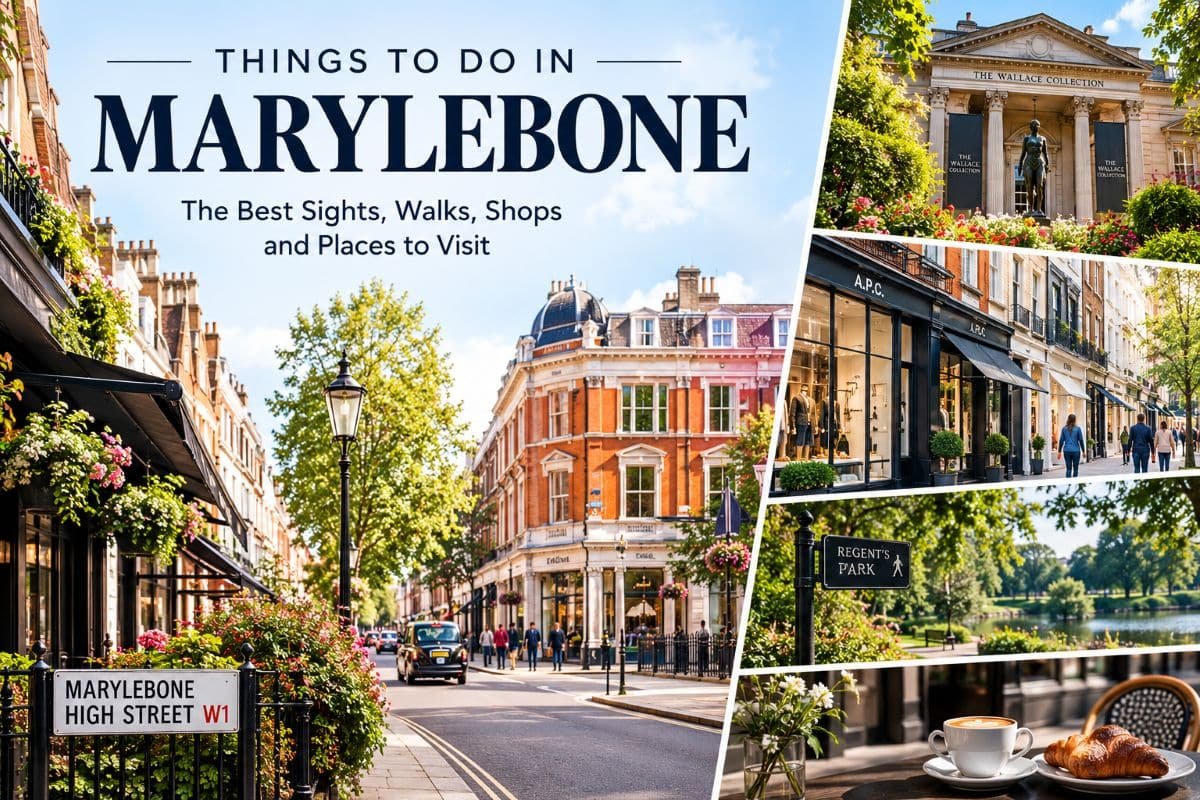
Marylebone sits between some of central London’s busiest districts, yet it has a very different pace. A few minutes from Oxford Street and Baker Street, you can move from major museums and famous literary landmarks to quiet garden squares, independent shops, grand Regency streets and one of London’s best-known parks.
For anyone searching for things to do in Marylebone, the area offers considerably more than a quick visit to Baker Street. The Wallace Collection provides free access to an outstanding collection of European art and decorative objects, while Regent’s Park offers gardens, sports facilities and long walking routes.
Marylebone High Street brings together independent shops and well-known names, and nearby venues such as Wigmore Hall and the Royal Academy of Music make the neighbourhood particularly strong for music and culture.
There is also plenty to do without spending much. You can explore Marylebone’s streets, visit the Royal Academy of Music Museum for free, walk through Regent’s Park, browse Daunt Books or admire the architecture around Marylebone Village.
Here is how to make the most of the neighbourhood, whether you have two hours, half a day or a full day.
Why visit Marylebone?
Marylebone is part of the City of Westminster and occupies a central position between Regent’s Park, Oxford Street, Fitzrovia, Paddington and Baker Street. The modern City of Westminster was created in 1965 when the former boroughs of St Marylebone and Paddington became part of the new authority.
That history helps explain the neighbourhood’s unusual mix of grand residential streets, historic churches, cultural institutions and commercial areas.
It is also an easy part of London to explore on foot. Marylebone Underground Station is served by the Bakerloo line, while Baker Street provides access to the Bakerloo, Circle, Hammersmith & City, Jubilee and Metropolitan lines. Marylebone railway station is also connected directly to the Underground station and provides mainline services from central London.
For visitors, that means you can arrive at Marylebone station, walk towards Marylebone High Street, continue to Baker Street and then reach Regent’s Park without needing to rely heavily on public transport.
Best things to do in Marylebone at a glance
| Experience | Best for | Cost |
| The Wallace Collection | Art, history and architecture | Permanent collection free |
| Regent’s Park | Walking, gardens and outdoor time | Free |
| Queen Mary’s Gardens | Roses and photography | Free |
| Sherlock Holmes Museum | Literature and popular culture | Paid |
| Daunt Books | Book lovers and architecture | Free to browse |
| Royal Academy of Music Museum | Music history | Free |
| Madame Tussauds | Families and popular culture | Paid |
| Marylebone High Street | Shopping and browsing | Free to explore |
| St Marylebone Parish Church | History and architecture | Check visitor arrangements |
| Wigmore Hall | Classical music | Ticketed performances |
Best things to do in Marylebone

1. Visit the Wallace Collection
The Wallace Collection is one of the strongest reasons to spend time in Marylebone.
The museum occupies Hertford House on Manchester Square and contains paintings, sculpture, furniture, arms and armour, and porcelain. Its permanent collection is free to enter, and the museum currently lists opening hours of 10 am to 5 pm daily.
The collection includes works associated with some of the major names in European art, making this a particularly good stop for visitors who want a substantial museum experience without paying an admission charge.
The building itself is part of the experience. Rather than feeling like a conventional modern gallery, the rooms retain much of the character of a historic private collection.
Allow: Around 1–2 hours.
Good for: Art lovers, rainy days, history enthusiasts and visitors looking for a free cultural attraction.
A useful tip is to check the museum’s official website before travelling if you are interested in a temporary exhibition, as special exhibitions can have separate arrangements.
2. Walk through Regent’s Park
Regent’s Park is one of the most rewarding outdoor attractions close to Marylebone.
The park was designed during the Regency period and is closely associated with architect John Nash. The Royal Parks describes it as a place of formal gardens, sports facilities, wildlife and historic landscape design.
You do not need a fixed itinerary here. A simple walk along the Broad Walk can take you towards some of the park’s gardens, while other paths lead towards the lake and the wider open areas.
The park is also useful for breaking up a day of indoor sightseeing. After visiting the Wallace Collection or walking around Baker Street, it provides a completely different setting.
Pedestrian access times vary during the year, so check the Royal Parks information before planning an early or late visit.
See Queen Mary’s Gardens
Queen Mary’s Gardens is particularly popular during the rose season.
The garden contains approximately 8,000 roses across 85 single-variety beds, making it the largest collection of roses in London according to The Royal Parks. The organisation recommends the first two weeks of June as the best time to see the main rose display, although seasonal conditions naturally affect flowering.
The garden is about more than roses. Formal borders, shrubbery, benches, pathways and the ornamental lake make it a pleasant place to slow down.
If photography is part of your visit, early summer is the obvious choice, but the wider gardens of Regent’s Park have something to offer throughout the year.
Visit the Queen Elizabeth II Garden
Another addition to Regent’s Park is the Queen Elizabeth II Garden.
The Royal Parks created the two-acre garden on the site of a former plant nursery. It sits behind the Espresso Bar on the Broad Walk and near the Avenue Gardens.
It is a useful stop if you prefer quieter landscaped spaces rather than the larger open areas of the park.
3. Follow the Sherlock Holmes trail around Baker Street
For many first-time visitors, Baker Street is the obvious starting point for things to do in Marylebone.
Sherlock Holmes Museum occupies the famous fictional address of Sherlock Holmes and Dr Watson.
The museum recreates Holmes’ Victorian lodgings and displays objects and scenes connected with the stories. Visit London lists the attraction at 221B Baker Street and describes it as a Victorian-style recreation of the detective’s apartment.
The museum is particularly easy to reach from Baker Street Underground Station, which is around a minute’s walk away according to Visit London.
It is worth separating the fiction from the history here: 221B Baker Street is a literary address created by Arthur Conan Doyle rather than a genuine former home of a real detective. The attraction deliberately recreates the world of the stories.
That makes it an entertaining stop for Sherlock Holmes fans, families and visitors interested in London’s literary associations.
Allow: Roughly 1–2 hours.
Practical point: Opening times and admission arrangements can change, so check the museum’s current information before setting out.
4. Explore Marylebone High Street
Marylebone High Street is one of the area’s best places for an unhurried wander.
The street and surrounding Marylebone Village have a mixture of independent retailers, fashion, food shops, cafés, restaurants and specialist stores. Visit London highlights the area’s off-the-high-street retail character, including bookshops, fashion stores, homeware and food specialists.
The attraction here is less about ticking off individual shops and more about exploring the neighbourhood.
Walk along Marylebone High Street, turn into the surrounding streets and look for the smaller garden squares and traditional architecture. The contrast with nearby Oxford Street is noticeable: Marylebone feels more residential and village-like despite being firmly in central London.
It is also a useful place to combine shopping with lunch or coffee.
5. Step inside Daunt Books
Daunt Books Marylebone is one of the area’s most recognisable independent bookshops.
The Marylebone branch occupies an Edwardian building at 83–84 Marylebone High Street. Its distinctive oak-panelled galleries and large rear reading room make the interior almost as interesting as the books.
Although travel books and maps are central to its identity, the shop also carries fiction, non-fiction and children’s books.
The shop also hosts author talks and other literary events, so it is worth checking the programme if you want more than a browse.
Current listed opening hours are Monday to Saturday from 9 am to 7.30 pm and Sunday from 11 am to 6 pm. These can change, particularly around holidays, so check before making a special journey.
Best for: Book lovers, architecture enthusiasts and anyone looking for a slower-paced stop between attractions.
6. Visit the Royal Academy of Music Museum
Music enthusiasts have a particularly good free option in Marylebone.
Royal Academy of Music Museum holds collections of musical instruments, manuscripts, scores, photographs and other objects relating to music history.
The collection includes historic string instruments by makers such as Stradivari and the Amati family, as well as keyboards and material connected with significant musicians. The museum also stages temporary displays and public events.
The museum is currently open to the public on Fridays from 11 am to 6 pm, and admission is free. The Academy warns that particular galleries can sometimes be affected by events, classes or installations, so checking ahead is sensible if you are visiting for a specific display.
The Academy itself is on Marylebone Road, with Baker Street and Regent’s Park among the nearest Underground stations. Marylebone railway station is around a 10-minute walk away.
7. See a concert at Wigmore Hall
Wigmore Hall is another major cultural venue in the wider Marylebone area.
The concert hall is particularly associated with chamber music and recitals, making it a different proposition from the large-scale performances found at some of London’s bigger venues.
For visitors planning a cultural evening, it can work well alongside dinner around Marylebone High Street.
Because performances have individual schedules and ticket arrangements, this is one attraction where checking the current programme is essential rather than planning around generic opening hours.
8. Visit Madame Tussauds London
Madame Tussauds London is one of the area’s major paid attractions and is particularly popular with families.
The attraction is on Marylebone Road, close to Baker Street Underground Station. Its current experience includes more than 150 figures across themed zones, along with attractions such as the Spirit of London ride.
Unlike a traditional museum, the emphasis is on interactive entertainment and photography. That makes it a better fit for visitors who want a high-energy attraction rather than a quiet cultural visit.
Timed entry is used, and the attraction recommends booking ahead because slots can sell out. Opening times vary by date, so the official calendar should be checked before travelling.
Baker Street is particularly convenient: the attraction states that the Underground station is around two minutes away.
9. See St Marylebone Parish Church
St Marylebone Parish Church provides a quieter historical stop away from the main tourist attractions.
The current church opened in 1817 and is the fourth known parish church building to serve the parish. The church’s own historical guide traces the parish’s story back nearly 900 years.
The present building was designed by Thomas Hardwick, and its history connects Marylebone with figures including Lord Byron and Charles Wesley.
The church is also useful for understanding how much the neighbourhood has changed. What is now a central London district developed from a parish and village landscape whose history predates the modern city around it.
Check visitor arrangements before making a special trip, as a functioning parish church may have services, ceremonies or other activities that affect access.
10. Look around Manchester Square and the surrounding streets
Marylebone is particularly rewarding when you stop treating the neighbourhood as a collection of attractions and simply walk.
Manchester Square, where the Wallace Collection is located, is a good starting point. From there, you can explore the streets around Marylebone High Street and the quieter residential areas.
Look for changes in architecture, garden squares, mews streets and older terraces. Marylebone’s appeal is partly visual: the district offers a concentrated example of London’s transition from Georgian and Regency planning to the commercial city that developed around it.
This is also one of the best free things to do in Marylebone because there is no need to follow a paid tour or fixed itinerary.
11. Explore the area around Baker Street
Baker Street is much more than the Sherlock Holmes Museum.
The Underground station is one of London’s useful transport interchanges, with Bakerloo, Circle, Hammersmith & City, Jubilee and Metropolitan services.
From here, you can walk south towards Marylebone High Street, north towards Regent’s Park or east towards Fitzrovia.
The streets around Baker Street also provide an easy way to combine several attractions in one outing. Madame Tussauds, the Sherlock Holmes Museum, Regent’s Park and the Royal Academy of Music are all within the wider area.
For visitors with limited time, Baker Street is therefore one of the most practical places to begin.
12. Walk towards Primrose Hill
If you have several hours to spare, extend your Regent’s Park walk towards Primrose Hill.
Primrose Hill is technically a separate part of the Royal Parks landscape, but it is close enough to Marylebone to make a sensible extension to a longer walking day.
The Royal Parks describes the summit as one of London’s notable viewpoints, with views across the capital. Primrose Hill itself is open 24 hours, although seasonal restrictions can affect some surrounding access arrangements.
The walk works particularly well when you want to combine gardens, open parkland and a city panorama rather than spend the entire day indoors.
Allow extra time: the distance and walking pace will depend on where you begin in Marylebone and how much of Regent’s Park you explore.
13. Take a garden-focused walk
Marylebone and Regent’s Park work particularly well for a self-guided garden walk.
A simple route can include:
- Start at Marylebone High Street.
- Walk north towards Regent’s Park.
- Enter the park and head towards the Avenue Gardens.
- Continue towards Queen Mary’s Gardens.
- Explore the rose gardens and surrounding paths.
- Continue towards the lake or extend the walk towards Primrose Hill.
- Return towards Baker Street or Marylebone.
The Royal Parks lists several distinct gardens in the park, including Avenue Gardens, Queen Mary’s Gardens, the Community Wildlife Garden, the Allotment Garden, St John’s Lodge Garden and the Queen Elizabeth II Garden.
The exact route is flexible, which is part of the appeal.
Find free things to do in Marylebone
You do not need a large sightseeing budget to enjoy the neighbourhood.
Some of the best low-cost options include:
- Walking along Marylebone High Street.
- Exploring the streets and garden squares.
- Visiting the permanent collection at the Wallace Collection.
- Walking through Regent’s Park.
- Visiting Queen Mary’s Gardens.
- Exploring the Queen Elizabeth II Garden.
- Visiting the Royal Academy of Music Museum on its public opening day.
- Browsing Daunt Books.
- Walking around Baker Street.
- Continuing towards Primrose Hill.
The Wallace Collection and Royal Academy of Music Museum are particularly useful for visitors looking for free cultural experiences.
15. Things to do in Marylebone with children
Families have several obvious choices.
Madame Tussauds provides an interactive attraction, while the Sherlock Holmes Museum appeals to older children who already know the character.
Regent’s Park is the better choice when children need space to walk around rather than another indoor attraction. The park contains playgrounds and sports facilities as well as gardens and open areas.
London Zoo is also within Regent’s Park, although it is best treated as a substantial standalone attraction rather than something to squeeze into a short Marylebone walking tour. ZSL London Zoo is part of the Zoological Society of London’s long history in the park; the zoo opened there in 1828.
A sensible family day could therefore be:
Morning: Madame Tussauds or the Sherlock Holmes Museum
Lunch: Marylebone High Street area
Afternoon: Regent’s Park or London Zoo
Trying to combine every major attraction in one day can make the itinerary unnecessarily rushed.
Things to do in Marylebone on a rainy day
Marylebone is particularly useful when London’s weather turns wet.
Good indoor options include:
- The Wallace Collection
- Sherlock Holmes Museum
- Madame Tussauds
- Royal Academy of Music Museum
- Daunt Books
- Wigmore Hall, if there is a suitable performance
- Restaurants, cafés and food shops around Marylebone High Street
The Wallace Collection is perhaps the strongest choice for a general rainy-day visit because the permanent collection is free and the museum offers a substantial indoor experience.
For a shorter visit, Daunt Books or the Royal Academy of Music Museum can be easier to fit around other plans.
Things to do in Marylebone for couples
Marylebone works well for a slower day out.
Start with the Wallace Collection, then walk through Manchester Square and towards Marylebone High Street. Stop at Daunt Books before continuing through the surrounding streets.
If the weather is good, carry on into Regent’s Park and Queen Mary’s Gardens. In the evening, consider a concert at Wigmore Hall.
This type of itinerary works because it does not depend on moving quickly between attractions. Much of Marylebone’s character comes from the spaces between the headline sights.
How long do you need in Marylebone?
Two to three hours
Concentrate on Baker Street and Marylebone High Street.
A practical short visit could include the Sherlock Holmes Museum, a walk along Marylebone High Street and a stop at Daunt Books.
Half a day
Add the Wallace Collection and a section of Regent’s Park.
This gives you a better sense of the neighbourhood without attempting too much.
Full day
Start with a museum, explore Marylebone High Street around lunchtime, then spend the afternoon in Regent’s Park.
If you are travelling with children, replace some of the walking with Madame Tussauds or London Zoo.
Evening
Choose a restaurant around Marylebone Village followed by a performance at Wigmore Hall, subject to the current programme.
Best Marylebone itinerary for first-time visitors
If this is your first visit and you want a balanced introduction, try this route:
9:30 am – Baker Street
Arrive at Baker Street and walk around the area before the busiest part of the day.
10 am – Sherlock Holmes Museum
Spend around one to two hours exploring the Victorian recreation of 221B Baker Street.
12 pm – Marylebone High Street
Walk south and explore the shops around Marylebone Village. Stop at Daunt Books and find somewhere for lunch.
1:30 pm – Wallace Collection
Head towards Manchester Square for the museum and its free permanent collection.
3 pm – Regent’s Park
Walk north into Regent’s Park. If you are visiting during the rose season, make time for Queen Mary’s Gardens.
5 pm – Return towards Marylebone
Finish with a relaxed meal or continue towards Baker Street.
This route can be shortened by skipping the museum or extended by walking further into Regent’s Park.
Getting around Marylebone
Marylebone is one of those central London neighbourhoods where walking often makes more sense than taking another Tube journey.
By Underground
Baker Street is the most useful station for attractions around Baker Street and Marylebone Road. It is served by the Bakerloo, Circle, Hammersmith & City, Jubilee and Metropolitan lines.
Marylebone is served by the Bakerloo line and connects with the mainline railway station.
Regent’s Park is another option for the northern part of the neighbourhood and Regent’s Park.
By train
Marylebone railway station is on Melcombe Place and offers mainline services to destinations including Oxford and Birmingham, alongside other routes.
On foot
Walking is the easiest way to connect Marylebone High Street, Manchester Square, Baker Street and the southern parts of Regent’s Park.
Wear comfortable shoes if you plan to combine several attractions. The distances are manageable, but a full day of museums and park walking can add up.
What makes Marylebone different from nearby areas?
| Area | Character | Best for |
| Marylebone | Residential, cultural and village-like | Museums, shopping, walking |
| Baker Street | Tourist and transport hub | Sherlock Holmes, Madame Tussauds |
| Fitzrovia | Creative and commercial | Food, galleries and independent businesses |
| Oxford Street | Major retail district | Department stores and high-street shopping |
| Regent’s Park | Green and spacious | Gardens, walking and outdoor activities |
| Paddington | Transport-focused and increasingly mixed-use | Canal walks and transport connections |
The boundaries between these areas are not always obvious when walking, which is useful rather than confusing. A Marylebone day can easily extend into Fitzrovia or Regent’s Park without requiring another Tube journey.
Practical tips for visiting Marylebone
- Book major paid attractions in advance. Madame Tussauds uses timed entry, and the Sherlock Holmes Museum can be busy. Check the latest availability before travelling.
- Check museum opening days. Free does not necessarily mean open every day. The Royal Academy of Music Museum, for example, currently lists Friday public opening hours.
- Use the park as your flexible part of the day. Indoor attractions have fixed entry arrangements, while walking through Regent’s Park can be fitted around them.
- Do not underestimate Marylebone High Street. It is easy to rush towards the headline attractions and miss the streets that give the neighbourhood its character.
- Check seasonal park information. Access times and some facilities in Regent’s Park can change during the year.
- Plan around your interests. A museum-heavy itinerary is very different from a family day or a garden-focused walk.
A simple way to plan your day
If you are unsure where to begin, choose one attraction from each category:
- Culture: Wallace Collection or Royal Academy of Music Museum
- Literature: Sherlock Holmes Museum
- Shopping: Marylebone High Street and Daunt Books
- Outdoors: Regent’s Park and Queen Mary’s Gardens
- Family: Madame Tussauds or London Zoo
- Evening: Wigmore Hall or dinner around Marylebone Village
That approach keeps the itinerary varied without forcing too many stops into a single day.
Why Marylebone is worth exploring
Marylebone’s strength is its variety.
It has the recognisable London attractions visitors expect, but it also rewards people who slow down. The Wallace Collection gives you serious art and history, Baker Street brings literary London to life, Marylebone High Street offers a more intimate shopping experience, and Regent’s Park provides a large green space only minutes from the centre of the neighbourhood.
The area also works well for repeat visits. You might spend one day exploring museums and another concentrating on gardens, architecture and independent shops. For music lovers, the Royal Academy of Music and Wigmore Hall add another reason to return.
Conclusion
The best things to do in Marylebone are not confined to one attraction or street. The neighbourhood works because its major sights can be combined with simple pleasures: walking through Regent’s Park, browsing a bookshop, exploring historic streets or sitting down for a meal after a museum visit.
For a first visit, Baker Street, the Wallace Collection, Marylebone High Street and Regent’s Park make a strong starting point. Families can add Madame Tussauds or London Zoo, while culture-focused visitors may prefer the Royal Academy of Music Museum and Wigmore Hall.
Before setting out, check the official opening times and booking requirements for any ticketed attraction. Then leave some room in the itinerary for walking. That is often when Marylebone makes the strongest impression.