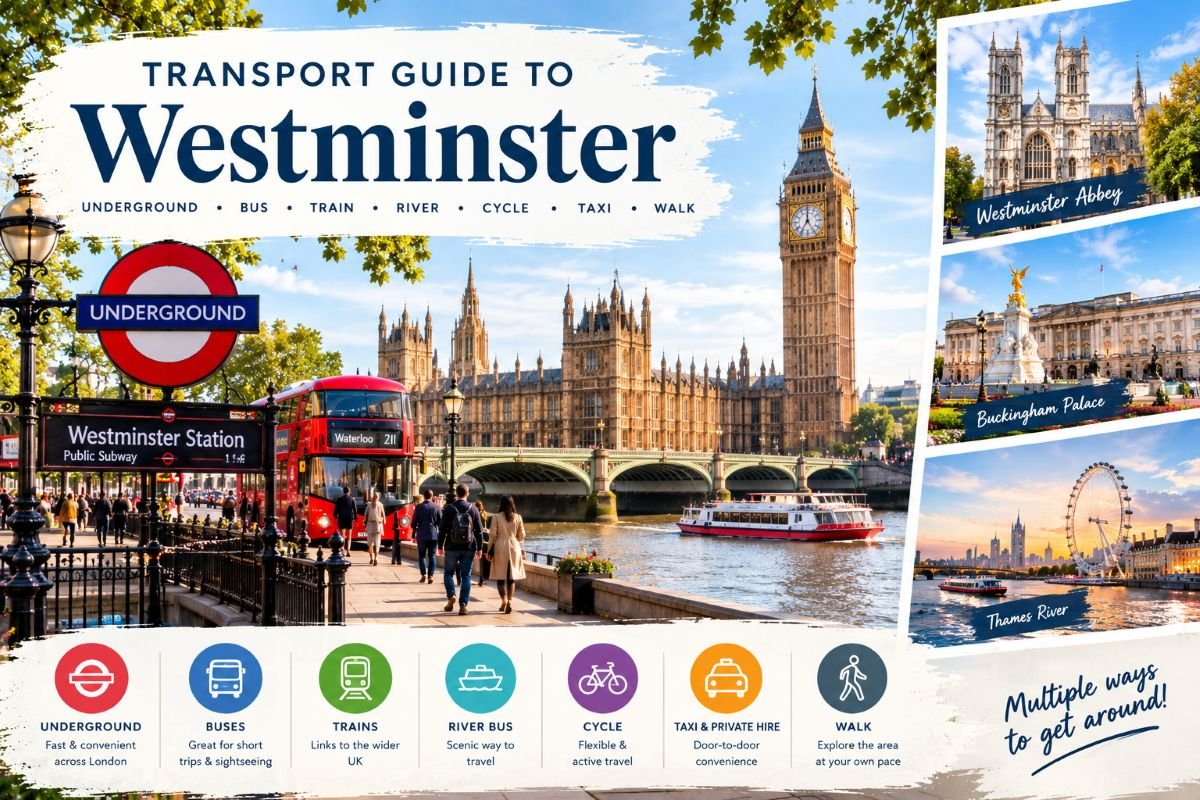
Westminster is one of London’s most visited areas, home to the Houses of Parliament, Westminster Abbey, Buckingham Palace, Whitehall and the South Bank’s famous riverside views. Getting between these landmarks is often straightforward, but choosing the right transport can save time, money and unnecessary walking.
This Transport Guide to Westminster explains how to travel around the area by Underground, bus, train, river boat, bicycle, taxi and on foot. It also covers the most useful stations, ticket options, accessibility considerations and practical routes for visitors, commuters and residents.
The main thing to know is that Westminster is well connected, but the best option depends on your destination. Westminster Underground station is ideal for Parliament Square and Big Ben, while Victoria is useful for National Rail connections and Buckingham Palace. For nearby landmarks, walking can be quicker than taking another train.
Understanding Westminster’s transport network
Westminster is in central London, within the City of Westminster local authority area. Its transport network includes the London Underground, extensive bus services, nearby National Rail stations, river transport on the Thames and cycle-hire facilities.
The area is also compact enough to explore on foot. Parliament Square, Westminster Abbey, Whitehall, St James’s Park and Buckingham Palace can be combined into a walking itinerary, although the distances between landmarks and the time spent crossing busy roads should be factored into your plans.
Which transport option is best?
| Transport option | Best for | Main advantage | Main limitation |
| London Underground | Longer journeys across London | Fast connections between major areas | Crowding, stairs and service disruptions |
| London buses | Short journeys and sightseeing | Street-level views and extensive coverage | Traffic can make journeys slower |
| National Rail | Travel from outside central London | Direct connections from many towns and cities | The nearest station may still require a walk |
| River bus | Riverside destinations | Scenic alternative to road travel | Separate fares and fixed departure times |
| Walking | Nearby landmarks | No transport fare and no interchange | Weather, crowds and walking distances |
| Santander Cycles | Short journeys around central London | Flexible point-to-point travel | Requires confidence cycling in urban traffic |
| Black cabs and private hire | Door-to-door journeys | Convenient with luggage or mobility needs | Road congestion and variable journey costs |
For most visitors, the Underground and walking are the most practical combination. Buses are useful when the destination is not close to a Tube station, while river transport can turn the journey itself into part of the experience.
Best Transport Options to Westminster:
1. Travelling by London Underground
The Underground is usually the easiest way to reach Westminster from other parts of London. Three Tube lines serve Westminster station: the Jubilee, District and Circle lines. The station is on Bridge Street, beside Westminster Bridge and close to Parliament Square.
Westminster station
Westminster station is the most convenient starting point for several major attractions:
- Big Ben and the Elizabeth Tower: immediately beside Parliament Square.
- Houses of Parliament: across the road from the station.
- Westminster Abbey: approximately a four-minute walk, depending on the exit and route.
- Westminster Bridge: useful for crossing towards the South Bank and the London Eye.
- Victoria Embankment: convenient for riverside walks and Westminster Pier.
The Jubilee line is useful for journeys towards London Bridge, Canary Wharf and Stratford, while the District and Circle lines connect Westminster with areas including Victoria, South Kensington, Blackfriars and Tower Hill. The precise route depends on your destination and any planned engineering work.
Westminster station can become particularly busy around major attractions, parliamentary activity, demonstrations and public celebrations. Check live travel information before setting off, especially if your visit is tied to a timed admission slot.
St James’s Park station
St James’s Park is a useful alternative to Westminster for the western side of the area. It is served by the District and Circle lines and is convenient for the government district, parts of Victoria Street and the western approaches to Westminster Abbey.
The Abbey’s visitor information places St James’s Park approximately 500 metres away, compared with around 300 metres from Westminster station.
Consider this station if your route starts near the Abbey’s western side or involves walking through the surrounding government quarter.
Victoria station
Victoria is particularly useful if you are arriving from elsewhere in London or travelling into the capital by train.
London Victoria combines National Rail services with the Victoria, District and Circle Underground lines. It also has connections to bus services and Victoria Coach Station, which is a short walk away.
Buckingham Palace is approximately a ten-minute walk from Victoria, according to the Royal Collection Trust, although the exact time depends on your route and walking pace.
For visitors planning to see Buckingham Palace and Westminster Abbey on the same day, Victoria can be a convenient arrival point, particularly when the itinerary starts at the palace and continues towards St James’s Park.
Green Park and Hyde Park Corner stations
Green Park and Hyde Park Corner are useful alternatives for Buckingham Palace and the surrounding royal parks. Both are approximately a ten-minute walk from the palace, according to the Royal Collection Trust.
The best station depends on where you are approaching from and which part of the palace grounds you intend to visit. Check the official visitor information if you have booked a particular entrance or tour.
2. Using buses in Westminster
London buses offer an alternative to the Underground, particularly for short trips between nearby districts. They are also useful for visitors who want to see more of central London above ground.
Victoria Street, Whitehall, Victoria Embankment and the roads around Parliament Square have bus stops serving different parts of the capital. However, routes and stopping arrangements can change, especially when roads are closed for public events.
Rather than relying on an old route number from a travel article, use the Transport for London journey planner to identify the right service for your particular journey.
How to use London buses
Taking a London bus is straightforward:
- Find the appropriate stop using the TfL journey planner.
- Check the bus number and destination displayed on the vehicle.
- Touch your contactless card, compatible mobile device or Oyster card on the yellow reader when boarding.
- Listen for announcements or watch the display for your stop.
- Press the stop button before your intended stop and leave through the appropriate doors.
You generally do not touch out when leaving a London bus. Cash is not accepted for ordinary London bus fares.
When should you take the bus instead of the Tube?
A bus is often preferable when:
- Your destination is relatively close, and a Tube interchange would add unnecessary time.
- You are travelling with luggage and want to avoid station corridors and escalators.
- You want to see central London streets during the journey.
- You need a route that stops closer to your destination than the nearest Underground station.
The main disadvantage is traffic. Buses around Westminster can be delayed by congestion, demonstrations, ceremonial occasions, and road closures. Allow extra time for journeys with fixed appointments.
3. National Rail stations near Westminster
Westminster does not have a National Rail terminal directly beside Parliament Square, but several major London stations are within reach.
| Railway station | Useful for | Transport considerations |
| London Victoria | Southern England connections and access to Buckingham Palace | National Rail, Victoria line, District and Circle lines |
| London Charing Cross | Central London and National Rail arrivals | Near Trafalgar Square; Northern and Bakerloo line connections nearby |
| London Waterloo | Services from south-west London and beyond | National Rail and Underground connections across the river |
| London Waterloo East | Some South Eastern rail services | Separate station beside Waterloo, with a short walk between the two |
| London Blackfriars | Services across central London and south-east England | Connected to the District and Circle lines |
National Rail station information confirms the main transport links at Victoria, Charing Cross and Waterloo.
Which railway station should you choose?
If your train arrives at Victoria, you can continue by Tube, bus or on foot depending on your final destination. For Buckingham Palace, walking is often the simplest option.
Waterloo is useful if you want to approach Westminster across Westminster Bridge. The walk offers views of the Houses of Parliament and Big Ben, although the bridge can be crowded during busy sightseeing periods.
Charing Cross is convenient for Whitehall and Trafalgar Square. From there, you can walk towards Parliament Square or take a connecting Tube or bus service.
Always check the station shown on your ticket. A ticket to one London terminal does not automatically permit travel to another terminal by National Rail.
4. River transport from Westminster Pier
Westminster Pier, on Victoria Embankment beside Westminster Bridge, offers a different way to travel through London. Uber Boat by Thames Clippers operates river bus services from the pier, connecting Westminster with destinations along the Thames.
River transport can be useful for reaching riverside destinations while avoiding some road congestion. It also provides views of London’s bridges, historic buildings and riverfront landmarks.
Where can you travel by river?
Depending on the service and timetable, destinations along the wider network include:
- Embankment and Blackfriars.
- London Bridge City and Bankside.
- Greenwich and North Greenwich.
- Canary Wharf.
- Vauxhall and Battersea Power Station.
- Putney and other western river destinations.
Not every service calls at every pier, so check the route and timetable before boarding.
How much does river transport cost?
River bus fares depend on the zones travelled, the ticket type and how you pay. Oyster and contactless payment are accepted on Uber Boat by Thames Clippers, and tickets can also be purchased through its ticketing channels or at the pier.
Do not assume that a Tube journey cap covers your river trip. TfL states that river bus journeys are not included in the usual pay-as-you-go journey capping arrangements. Check the current fare before travelling.
Best for: riverside sightseeing, journeys between piers and visitors who want an alternative to road transport.
Limitation: river boats follow a set route and timetable, so they may not be the quickest option for destinations away from the river.
5. Walking around Westminster
Walking is one of the most useful ways to explore Westminster. Several major landmarks are relatively close together, and short walks can save the time involved in entering a station, travelling one stop and returning to street level.
A practical walking itinerary could include:
- Westminster station to Big Ben: a very short walk beside Parliament Square.
- Westminster station to Westminster Abbey: approximately four minutes on foot.
- Westminster Abbey to St James’s Park: a short walk towards the park’s eastern side.
- Buckingham Palace to Victoria station: approximately ten minutes on foot.
- Westminster Bridge to the South Bank: cross the bridge for the London Eye and riverside attractions.
These are indicative routes rather than guaranteed journey times. Crowds, road crossings, temporary barriers and mobility requirements can make a difference. The Abbey and palace’s official visitor guidance provides further information about nearby stations and access.
Walking advantages and disadvantages
Advantages
- No additional public transport fare.
- Convenient for visiting nearby landmarks.
- Flexible stops for photographs, cafés and parks.
- No need to navigate station interchanges.
Disadvantages
- Busy pavements and crossings can slow you down.
- Weather can make longer walks uncomfortable.
- Some routes involve steps, uneven surfaces or crowded pavements.
- Walking distances may be challenging for people with limited mobility.
If you are planning several attractions in one day, group them geographically. For example, visit Parliament Square and Westminster Abbey together, then continue towards St James’s Park and Buckingham Palace rather than repeatedly travelling back and forth.
6. Cycling and Santander Cycles
Cycling can work well for short journeys between central London neighbourhoods, particularly when the weather is favourable, and traffic conditions suit your experience.
Santander Cycles is London’s public cycle-hire scheme, with docking stations across central London. Bikes can be hired through the scheme’s app or at docking terminals, subject to availability. TfL also offers e-bike options within the scheme.
Westminster’s riverside routes provide useful connections, but central London roads can be busy. Cycle lanes, road layouts and restrictions vary, so check the route before setting off.
Is cycling a good choice for visitors?
Cycling is worth considering if you are comfortable riding in traffic and want to travel between destinations without waiting for a bus or Tube.
It is less suitable if you are unfamiliar with cycling in London, travelling with young children who cannot ride independently, or carrying bulky luggage.
Before hiring a bike:
- Check the availability of bikes and docking spaces.
- Review the hire terms and current charges.
- Plan a route using suitable cycle infrastructure.
- Secure the bike at an authorised docking point when required by the scheme.
- Avoid stopping in cycle lanes or blocking pedestrian routes.
For many first-time visitors, walking remains simpler for the immediate Westminster sightseeing area.
7. Taxis and private-hire vehicles
Black cabs and licensed private-hire vehicles are available in Westminster. They can be useful when travelling with heavy luggage, accompanying someone who finds public transport difficult or reaching a destination that is awkward to access by train.
Westminster Pier’s transport information also identifies taxi availability in the area.
Black cabs can generally be hailed on the street when their taxi light is on or found at designated ranks. Private-hire vehicles must be booked through an authorised operator or app; they should not be hailed as if they were black cabs.
When is a taxi worthwhile?
A taxi may be practical for a late journey, a group carrying luggage or a trip involving several bags. However, road congestion can make short central London journeys slower than expected.
Before booking, check the estimated fare, pickup location and any additional charges. If your journey is time-sensitive, compare the taxi estimate with public transport rather than assuming the road route will be faster.
8. Fares, Oyster cards and contactless payments
For most visitors, contactless payment or an Oyster card is the simplest way to pay for London public transport.
Contactless versus Oyster
| Payment method | Main benefit | What to consider |
| Contactless bank card | No separate travel card required | Check overseas transaction fees and card compatibility |
| Contactless mobile device | Convenient if your phone or watch supports payment | Use the same device consistently throughout the journey |
| Oyster card | Useful for visitors who prefer a dedicated travel card | Check the balance and applicable fare rules |
| Travelcard | Can suit particular travel patterns or eligible ticket arrangements | Compare the price with pay-as-you-go fares first |
| River bus ticket | Designed for river services | Separate river fares and conditions apply |
For Tube, rail and bus journeys, use the same contactless card or device throughout the day. Switching between a physical bank card and the same card stored on a phone can cause the system to treat them as different payment methods.
What are the current transport fares?
TfL’s published fare information lists adult bus and tram pay-as-you-go fares at £1.75, with a £5.25 daily cap. However, these rates are scheduled to change on 1 November 2026, when the adult bus and tram fare is due to rise to £1.85 and the daily cap to £5.55. Check TfL’s latest fare page before travelling.
Tube and National Rail fares depend on the zones travelled, the time of day and the journey. A trip entirely within central London may cost less than a longer journey across multiple zones, but the exact amount should be checked using TfL’s fare finder.
For a single day of sightseeing, compare the expected journeys with the relevant daily caps before buying a Travelcard. A Travelcard is not automatically the cheapest option for every visitor.
Accessibility and step-free travel
Travellers who use wheelchairs, have limited mobility or prefer to avoid stairs should check their route before leaving.
Westminster Underground station lists lifts and boarding ramps among its facilities. However, the presence of lifts does not by itself guarantee that every part of a journey is step-free. The route, platform-to-train gap and any interchange must also be considered.
TfL’s step-free journey information can help identify suitable stations and connections. The network’s accessibility arrangements vary, so confirm the details for your specific journey and check for lift closures before travelling.
Practical accessibility tips
- Plan the complete journey: check street-to-platform access, interchange routes and the final walk to your destination.
- Allow extra time: accessible routes can take longer than the quickest route shown in a standard journey planner.
- Check attraction access: Westminster Abbey and Buckingham Palace have their own visitor-access information, which should be checked separately from transport arrangements.
- Consider buses: TfL says its bus fleet uses low-floor vehicles with wheelchair spaces and access ramps, although boarding conditions and available space can vary.
- Check river access: Westminster Pier is accessible by ramp, according to the operator, but check the destination pier as well.
If a lift is out of service, TfL advises passengers to seek assistance from staff to plan an alternative step-free journey.
Driving and parking in Westminster
Driving is possible in Westminster, but it is rarely the most convenient option for a short sightseeing visit. Traffic, limited parking and road restrictions can make a car journey more complicated than using the Underground or walking.
Westminster is within London’s Congestion Charge zone. The exact charging arrangements, hours and applicable exemptions should be checked with TfL before entering the area. Do not assume that a vehicle is exempt simply because it is electric or used for a short visit.
Parking availability and charges vary by location. Some streets have restrictions, and parking rules may be affected by special events or temporary traffic arrangements.
Should you drive to Westminster?
Driving may be necessary if you have a specific mobility requirement, need to carry equipment, or are travelling from somewhere with limited public transport. For most visitors arriving from elsewhere in London, public transport is generally the more practical choice.
If you do drive:
- Check whether the Congestion Charge applies to your vehicle and journey.
- Identify a suitable car park before setting off.
- Review parking restrictions and any event-related road closures.
- Consider parking outside central Westminster and completing the journey by public transport.
- Allow extra time for congestion and finding a parking space.
The Royal Collection Trust states that Buckingham Palace does not have general visitor car parking. Visitors should therefore plan their transport and parking arrangements.
Best transport routes for popular Westminster attractions
The easiest route depends on where you are starting and which attraction you intend to visit. This table provides a useful starting point.
| Destination | Recommended starting point | Suggested transport |
| Big Ben and Parliament Square | Westminster station | Walk |
| Westminster Abbey | Westminster or St James’s Park station | Walk |
| Buckingham Palace | Victoria, Green Park or St James’s Park station | Walk |
| Whitehall | Westminster station or Charing Cross | Walk |
| St James’s Park | St James’s Park or Westminster station | Walk |
| London Eye | Westminster station or Waterloo | Walk across Westminster Bridge or use local connections |
| South Bank | Westminster station | Walk across Westminster Bridge |
| Tate Britain | Pimlico or Vauxhall, depending on the route | Tube, bus or walk |
| Westminster Pier | Westminster station | Walk |
For Westminster Abbey, the official visitor information identifies Westminster and St James’s Park as the nearest Underground stations. For Buckingham Palace, the Royal Collection Trust lists Victoria, Green Park, St James’s Park and Hyde Park Corner as nearby Tube stations.
These recommendations are intended as practical starting points, not fixed instructions. Check the live journey planner if there are service disruptions, road closures or access restrictions.
A simple one-day Westminster transport itinerary
If you have one day to explore Westminster, combining walking with a small number of public transport journeys is usually the most efficient approach.
Morning: Westminster station and Parliament Square
Arrive at Westminster station and walk to Big Ben, Parliament Square and the exterior of the Houses of Parliament. Continue to Westminster Abbey if you have an admission booking.
Late morning: St James’s Park
Walk towards St James’s Park and enjoy a break from the main roads. Continue towards Buckingham Palace, checking visitor arrangements if you plan to enter.
Afternoon: Westminster Bridge and the Thames
Return towards the river and consider crossing Westminster Bridge to the South Bank or taking a river bus from Westminster Pier. Check departure times and fares before choosing the boat.
Late afternoon: Choose your onward connection
Walk to a convenient Tube or National Rail station, or use a bus if it better matches your next destination. Victoria is particularly useful for National Rail departures.
The advantage of this itinerary is that it avoids unnecessary journeys between nearby landmarks. If you have mobility requirements, timed tickets or a longer list of attractions, adjust the order to reduce walking and allow more time at each stop.
7. Frequently Asked Questions
1. What is the best way to get around Westminster?
The Underground and walking are usually the most practical options. Westminster station serves the Jubilee, District and Circle lines, and several major attractions are within walking distance. Buses are useful for longer street-level journeys, while river boats offer connections along the Thames.
2. Which Tube station is closest to Big Ben?
Westminster Underground station is the most convenient station for Big Ben and the Elizabeth Tower. It is beside Parliament Square, close to Westminster Bridge and a short walk from Westminster Abbey.
3. Can you walk from Westminster Abbey to Buckingham Palace?
Yes. Walking is a practical option between Westminster Abbey and Buckingham Palace, particularly if you want to pass through the surrounding streets and parks. Allow extra time for crossings, crowds and any stops along the way.
4. Can I use contactless payment on public transport in Westminster?
Yes. Contactless bank cards and compatible mobile devices are accepted on London buses and the Underground, as well as on many National Rail services within the applicable pay-as-you-go network. Use the same card or device throughout your journey to ensure fares are calculated correctly.
5. Is Westminster Underground station accessible for wheelchair users?
Westminster station lists lifts and boarding ramps among its facilities, but passengers should check the complete route before travelling. Platform-to-train gaps, interchange arrangements and temporary lift closures can affect accessibility.
6. Can I take a river boat from Westminster?
Yes. Westminster Pier serves Uber Boat by Thames Clippers, which operates river bus services to destinations along the Thames. Check the timetable, route and fare before boarding, as not every service stops at every pier.
7. Is it worth driving into Westminster?
For most sightseeing trips, public transport is more convenient because central London traffic, parking restrictions and charging arrangements can complicate car journeys. If driving is necessary, check the Congestion Charge, parking availability and any planned road closures beforehand.
8. Which railway station is best for Buckingham Palace?
London Victoria is a convenient choice because it has National Rail and Underground connections and is approximately a ten-minute walk from Buckingham Palace. Green Park, St James’s Park and Hyde Park Corner Underground stations are also useful options.
9. How can I check for Westminster transport disruptions?
Use the official Transport for London website or TfL Go app to check Underground, bus and other public transport services. National Rail’s website provides live train information. Check shortly before departure, particularly during major events or planned engineering work.
Conclusion: Choosing the best way to travel around Westminster
The best way to get around Westminster is to combine the Underground with walking, using buses, trains or river services when they suit your destination. Westminster station is the natural starting point for Parliament Square and Big Ben, while Victoria offers useful National Rail and Underground connections. Walking is often the easiest option between nearby landmarks, and Westminster Pier provides an alternative for riverside journeys.
Before travelling, check TfL’s live service updates, current fares and accessibility information. If you are planning a full day of sightseeing, group nearby attractions together and leave extra time for crowds and road closures. A little preparation makes exploring Westminster considerably easier.