

Finding the best home care in London is rarely about choosing the agency with the most impressive website or the highest number of online reviews. The right service needs to match the person’s care needs, preferred routine, location, budget, and expectations.
Home care allows someone to receive support in their own home rather than moving into a care home. Depending on individual circumstances, this might mean help with washing and dressing, preparing meals, taking medication, shopping, household tasks, or managing more complex care needs.
London has hundreds of care services operating across different boroughs, so knowing what to check can make the process much easier. The Care Quality Commission (CQC) regulates home care agencies in England and publishes information about registered services, inspections and ratings.
This guide explains what to look for, how CQC ratings work, what different types of home care can include, how funding works and which questions to ask before agreeing to a care package.
What is home care?
Home care is support provided in someone’s home by a paid carer or home care agency.
The level of support can vary considerably. One person may only need a short visit each morning, while another may require several visits throughout the day or more specialised support.
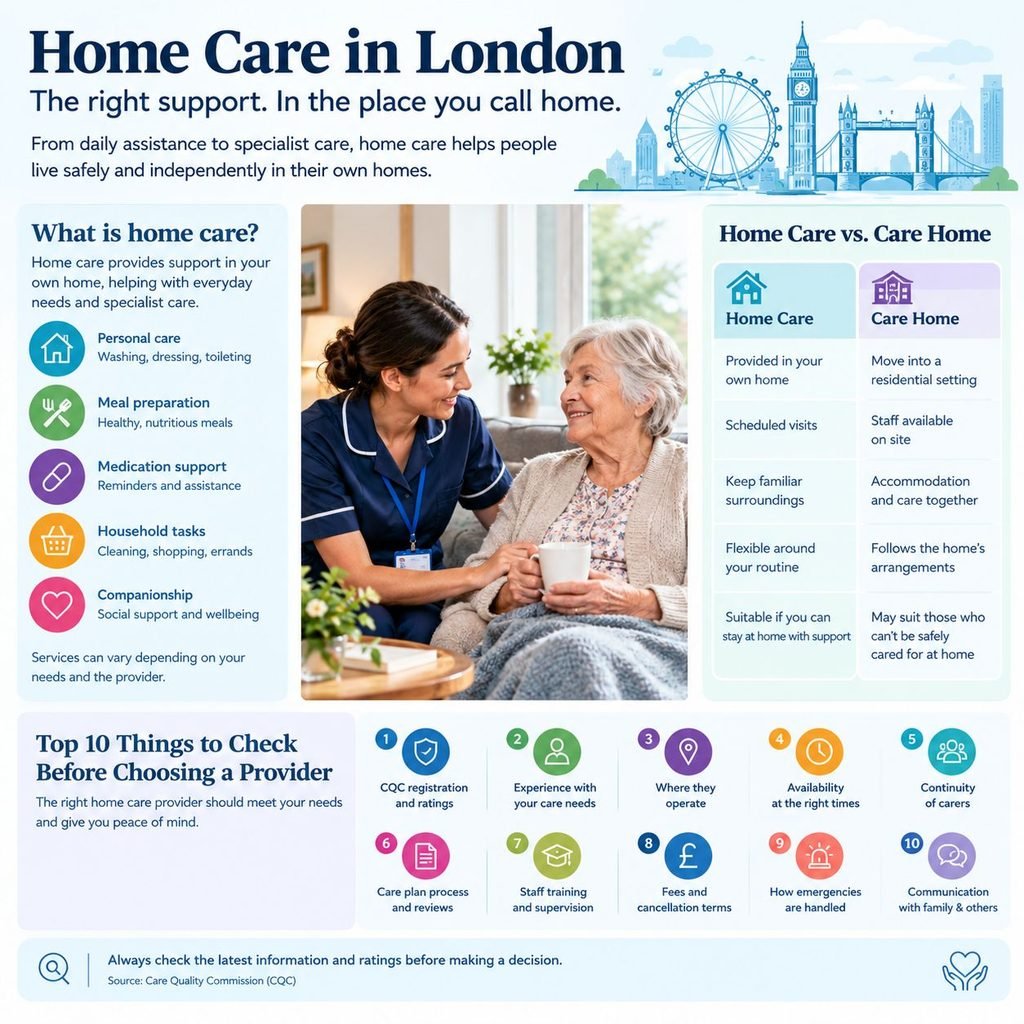
Home care can include:
- Personal care such as washing, dressing and using the toilet
- Help getting in and out of bed or moving around safely
- Meal preparation
- Shopping and some household tasks
- Support with medication routines
- Companionship and social support
- Dementia care
- Support for physical disabilities
- Assistance after illness or hospital discharge
- End-of-life or palliative support, where the provider is appropriately equipped and registered
- Longer visits or live-in care, depending on the agency
The NHS advises that even people intending to arrange private home care can benefit from a council needs assessment, as it can help identify the type and level of support required.
Home care is different from a care home
The main distinction is where the care is delivered.
| Home care | Care home |
| Care is provided in the person’s own home | The person moves into a residential setting |
| Can involve scheduled visits | Staff are available within the care home |
| Familiar surroundings are retained | Accommodation and care are provided together |
| Support can often be adjusted around existing routines | Care follows the home’s arrangements and timetable |
| Suitable for people who can continue living at home with support | May suit people whose needs cannot safely be managed at home |
The appropriate option depends on the individual’s needs rather than simply their age.
What makes the best home care in London?
There is no single home care agency that is automatically the best choice for every London household.
A provider that works well for an older person needing dementia support in Wandsworth may not be suitable for a younger adult with physical disabilities in Hackney. Availability, travel distance, specialist experience, continuity of carers and the actual care plan all matter.
A useful shortlist should therefore consider:
- CQC registration and inspection information
- The provider’s experience with the required type of care
- Where the agency operates
- Availability at the times required
- Continuity of carers
- How the care plan is created and reviewed
- Staff training and supervision
- Fees and cancellation arrangements
- How emergencies and missed visits are handled
- Communication with relatives and other professionals
The CQC allows people to search for home care agencies by service type and location and view inspection information and ratings.
Check the CQC record before choosing an agency
For home care in England, the Care Quality Commission is one of the most important sources to check.
The CQC regulates home care agencies and assesses services using areas including whether they are safe, effective, caring, responsive and well-led. Its public search tool provides inspection and rating information for regulated services.
What does a CQC rating mean?
CQC ratings generally use four levels:
- Outstanding
- Good
- Requires improvement
- Inadequate
A rating is useful evidence, but it should not be treated as the only factor in your decision.
Check when the assessment took place, what services were assessed, and whether the service’s current circumstances have changed since the published report.
For example, CQC currently lists Bluebird Care (Westminster, Kensington & Chelsea) as Outstanding following an assessment published in April 2026, while Bluebird Care (Islington) & Bluebird Care (Hackney) are currently rated Good following a 2026 assessment.
That illustrates why checking the individual London branch matters. A national care brand can have different CQC records for different local services.
Home care providers in London worth researching
The following are examples of London home care services with publicly available CQC records. They are not presented as a ranking, and the most suitable provider will depend on the person’s needs and postcode.
| Provider/service | London area | Current CQC information | Examples of specialist areas |
| Bluebird Care (Westminster, Kensington & Chelsea) | Westminster, Kensington & Chelsea | Outstanding | Older and younger adults, dementia, learning disabilities, mental health, physical disabilities |
| Bluebird Care (Islington) & Bluebird Care (Hackney) | Islington & Hackney | Good | Older and younger adults, dementia, learning disabilities, physical and sensory disabilities |
| Home Instead Westminster | Westminster area | Outstanding | Older people and dementia |
| Home Instead Wandsworth, Lambeth & Dulwich | South London | Outstanding | Older people, dementia, learning disabilities, mental health and physical disabilities |
| Helping Hands Highbury & Islington | Islington | Good | Older and younger adults, dementia, learning and physical disabilities |
| Right at Home Barnet and Edgware | Barnet/Edgware | Good | Homecare services |
The CQC records show that these are separate local services, rather than one city-wide rating that automatically applies to every branch.
For example, Bluebird Care (Westminster, Kensington & Chelsea) has a current Outstanding rating, while Bluebird Care (Islington) & Bluebird Care (Hackney) are rated Good.
Home Instead Westminster is also listed by the CQC as Outstanding.
Meanwhile, Home Instead Wandsworth, Lambeth & Dulwich is listed as Outstanding and covers many South London areas.
The important point is to check the specific branch serving the person’s postcode, rather than relying on a national brand name.
Which type of home care do you need?
The phrase “home care” covers several different services.
Personal care
This is often the first thing people mean by home care.
It can involve assistance with:
- Washing and bathing
- Dressing
- Toileting
- Grooming
- Getting up or going to bed
- Eating and drinking
Personal care is regulated by the CQC when it falls within regulated activities.
Dementia home care
People living with dementia may need help with everyday routines, personal care, meals, medication and maintaining a safe environment.
When comparing agencies, ask how much experience carers have with dementia and whether the same carers can regularly visit.
Continuity can be particularly useful when someone becomes uncomfortable with unfamiliar people entering their home.
Care for physical disabilities
A homecare service may provide assistance with daily activities for people with physical disabilities.
The type of equipment, mobility support and personal care required should be discussed during the assessment and care planning process.
Companionship care
Some people need relatively little personal care but benefit from help with social activities, shopping, appointments or simply having someone around.
Clarify exactly what “companionship” includes because services vary.
Live-in care
Live-in care is a substantially different arrangement from short homecare visits.
A live-in carer stays in the person’s home and provides agreed support throughout the day, with appropriate arrangements for breaks and rest.
It can be more intensive and expensive than scheduled visits, so it is worth discussing alternatives before making a decision.
How to choose a homecare agency in London
1. Start with the person’s actual needs
Write down what help is required before contacting agencies.
For example:
- Help getting up in the morning
- Showering three times a week
- Meal preparation
- Medication prompts
- Evening routine
- Shopping
- Dementia support
- Mobility assistance
This gives providers enough information to tell you whether they can meet the requirements.
2. Check whether the agency covers the postcode
London’s size makes this particularly important.
An agency may advertise London-wide services but only operate actively in particular boroughs.
Ask:
“Do you currently provide care in this postcode?”
Also ask how far carers typically travel between visits.
3. Check the CQC profile
Search the provider on the CQC website.
Look at:
- Current rating
- Date of the latest assessment
- Inspection findings
- Registered activities
- Specialist services
- Registered manager
- Previous reports where available
Don’t rely solely on a provider’s own website when independent regulatory information is available.
4. Ask who will actually provide the care
A good care plan can still be frustrating if a different carer arrives every day.
Ask:
- How many carers are likely to visit?
- Can the person have a regular team?
- What happens if the usual carer is unavailable?
- Are carers introduced before care starts?
- Is there a named care coordinator?
Continuity may be especially important for people with dementia or those who find changes in routine difficult.
5. Ask about training
The right training depends on the service.
If specialist support is required, ask specifically about experience and training relating to:
- Dementia
- Moving and handling
- Medication
- Personal care
- End-of-life care
- Learning disabilities
- Mental health
- Complex physical needs
Don’t be satisfied with a general statement that “all staff are fully trained”. Ask what training is relevant to the particular care package.
How much does home care cost in London?
There is no single London-wide price for home care.
Costs depend on factors such as:
- Number and length of visits
- Time of day
- Weekday or weekend care
- Bank holidays
- Specialist care requirements
- Number of carers needed
- Live-in arrangements
- Agency fees and minimum visit requirements
A provider should give you a clear explanation of its charges before care begins.
Ask for a written breakdown covering:
| Question | Why it matters |
| Hourly or visit rate? | Shows how charges are calculated |
| Minimum visit length? | Short visits may still carry a minimum charge |
| Weekend rates? | Some agencies charge differently |
| Bank holiday rates? | Check for additional costs |
| Cancellation charges? | Avoid unexpected bills |
| Travel or mileage charges? | Some arrangements may involve additional costs |
| Care plan review charges? | Establish whether reviews are included |
| Deposit or administration fee? | Clarifies upfront costs |
The NHS says that people may either arrange and pay for home care themselves or potentially receive help from their local council, depending on their circumstances and assessment.
Can the council help pay for home care?
Yes, potentially.
The first step is usually a care needs assessment from the local authority.
GOV.UK explains that a social services assessment can identify support needs, including help at home, equipment and adaptations, day services or residential care.
If the assessment identifies eligible care and support needs, a financial assessment can determine whether the council contributes towards the cost.
The NHS explains that the amount someone contributes depends on their financial circumstances and that a care and support plan should set out how eligible needs will be met when the council is contributing.
What are direct payments?
A direct payment gives an eligible person greater control over arranging their care.
Instead of the council arranging the service directly, the person can receive money to purchase agreed care and support themselves, subject to the relevant rules.
GOV.UK confirms that direct payments are available to eligible people who have been assessed as needing care and support.
The Care Act statutory guidance also explains how direct payments fit into care and support planning.
What should you ask a homecare agency before signing up?
A phone call or assessment meeting should allow you to ask direct questions.
Questions about care
- What services do you provide?
- Do you support the person’s particular condition?
- How often can carers visit?
- Can visit times be adjusted?
- Can you provide two carers when required?
Questions about staff
- How are carers recruited?
- What checks are carried out?
- What training do they receive?
- Will we have a consistent team?
- How are carers supervised?
Questions about safety
- What happens if a carer is late?
- What happens if a carer cannot attend?
- Who should we contact outside office hours?
- How are safeguarding concerns handled?
- How are medication errors reported?
Questions about money
- What is the hourly rate?
- Are there different weekend or bank holiday rates?
- Is there a minimum visit length?
- Are there cancellation fees?
- Is there a written contract?
These questions can reveal more about an agency’s day-to-day operation than a marketing brochure.
Home care in different parts of London
Local availability varies, but home care agencies operate across London boroughs including:
- Barnet
- Bexley
- Brent
- Bromley
- Camden
- Croydon
- Ealing
- Enfield
- Greenwich
- Hackney
- Hammersmith & Fulham
- Haringey
- Harrow
- Havering
- Hillingdon
- Hounslow
- Islington
- Kensington & Chelsea
- Kingston upon Thames
- Lambeth
- Lewisham
- Merton
- Newham
- Redbridge
- Richmond upon Thames
- Southwark
- Sutton
- Tower Hamlets
- Waltham Forest
- Wandsworth
- Westminster
The practical issue is not simply finding an agency in London. It is finding one that currently serves the exact area and can provide the required visits at the required times.
For example, CQC records show dedicated services operating in areas such as Hackney and Islington, Greenwich, Barnet and Edgware, Wandsworth, Lambeth and Dulwich, and Westminster.
Home care vs hiring a personal carer directly
Some people arrange care through an agency, while others use a personal assistant or carer directly.
Homecare agency
Pros
- Agency handles much of the recruitment and management
- Replacement cover may be available
- Care can be organised around a formal care plan
- There is usually a management structure to contact
Cons
- Can cost more than some direct arrangements
- You may have less control over which carer attends
- Agency minimum charges may apply
Directly employing a carer
Pros
- Greater control over who provides support
- Can offer a more personal arrangement
- May work well with a direct payment
Cons
- The person receiving care may take on employer responsibilities
- Cover for sickness and holidays needs to be arranged
- Payroll, insurance and employment obligations may need consideration
The NHS specifically points out that people receiving direct payments who employ someone can have responsibilities as an employer.
Warning signs when choosing home care
Be cautious if a provider:
- Cannot explain its CQC status where registration is required
- Avoids giving clear prices
- Cannot explain who will provide the care
- Makes promises that do not appear in the care agreement
- Is vague about missed visits
- Cannot explain its complaints procedure
- Gives little information about safeguarding
- Pressures you into signing immediately
- Cannot explain how specialist needs will be managed
A professional provider should be willing to explain the service clearly and give you time to consider the arrangements.
A simple checklist for comparing London homecare agencies
Before choosing, use this checklist:
Provider
- Serves the correct postcode
- Registered with the CQC where required
- Latest CQC report checked
- Appropriate specialist experience
Care
- Required visits available
- Care plan agreed
- Regular carers possible
- Emergency arrangements explained
- Family communication agreed
Cost
- Hourly/visit rates confirmed
- Weekend rates checked
- Bank holiday charges checked
- Cancellation policy understood
- Contract received in writing
Funding
- Council needs assessment considered
- Financial assessment considered
- Direct payment options discussed where relevant
A practical way to find the right home care
For most families, the process can be reduced to six steps:
- Step 1: List the care needs: Write down what the person needs help with and how frequently.
- Step 2: Contact the local council: Request a needs assessment, even if you are considering private care.
- Step 3: Build a shortlist: Look for agencies serving the relevant London borough or postcode.
- Step 4: Check CQC information: Compare the providers’ current regulatory records.
- Step 5: Speak to several agencies: Ask the same questions about care, staff, availability and costs.
- Step 6: Review the care agreement: Make sure the services, prices, visit arrangements and cancellation terms are clear before starting.
This approach is usually more useful than searching for a single provider described as the “best”.
Quick summary: choosing home care in London
If you need home care in London, focus on fit rather than reputation alone.
The key checks are:
- Confirm that the agency serves your postcode.
- Check its CQC profile and latest assessment.
- Make sure it provides the type of care required.
- Ask about continuity of carers.
- Get prices and cancellation policies in writing.
- Ask how emergencies and missed visits are handled.
- Consider a council needs assessment.
- Check whether financial assistance or direct payments may apply.
- Speak to more than one provider before making a decision.
CQC information should be treated as an important source of evidence, but it should sit alongside your own assessment of the person’s needs and the provider’s current availability.
7. FAQ
What is the best home care in London?
There is no single best home care provider for every person. The right choice depends on care needs, location, availability, specialist experience, cost, and the quality information available from sources such as the CQC.
How do I find a homecare agency near me in London?
Use the CQC’s care-services search to look for registered homecare agencies by postcode or location. You can then contact suitable providers to confirm that they currently cover your area and have availability.
How much does home care cost in London?
There is no single London-wide price. Costs vary according to visit length, frequency, specialist requirements, timing and the provider. Ask each agency for a written fee structure before agreeing to care.
Can I get help paying for home care?
Possibly. Your local council can carry out a care needs assessment and, where appropriate, a financial assessment. Depending on your circumstances and eligibility, the council may contribute towards eligible care needs.
Do I need a care needs assessment if I am paying privately?
You can arrange private home care yourself, but an assessment can still be useful because it helps identify what type and level of support is required. The NHS recommends considering an assessment even when arranging care independently.
What does a CQC rating mean?
CQC ratings indicate how a regulated care service is performing against the regulator’s assessment framework. Ratings include Outstanding, Good, Requires improvement and Inadequate. The latest report and assessment date should be checked rather than relying on an old rating.
Can home care help someone with dementia?
Yes. Some home care agencies provide dementia support, including personal care and assistance with daily routines. Ask specifically about dementia experience, carer continuity, and how the provider manages changes in a person’s needs.
Can home care be provided overnight?
Some agencies offer overnight or live-in arrangements, but availability varies considerably. Ask whether the service provides waking-night care, sleep-in support or live-in care and clarify exactly what is included.
Can I choose the carer?
It depends on the provider and care arrangement. Many agencies try to maintain continuity by using a regular team, but they may need to provide alternative carers when staff are unavailable. Ask about this before starting.
Wrap-up
Choosing home care in London is a decision that deserves more than a quick search and a phone call to the first agency that appears. The person’s care needs, postcode, preferred routine, budget and need for specialist support should all shape the shortlist.
Start with a clear description of the help required, check the relevant CQC records, speak to several agencies and ask for costs and care arrangements in writing. A council needs assessment can also help establish what support is required and whether financial assistance may be available.
For families comparing providers, the most useful question is not simply “Who is the best home care provider in London?” It is “Which regulated provider can reliably deliver the right care for this person, in this home, at the times they need it?” That approach makes the search more practical and gives families a much stronger basis for making their own decision.